“Opportunity to Strengthen Negotiating Leverage” Russia Launches Massive Air Assault on Kyiv, Escalating Military Pressure Amid Ukraine’s Air Defense Gaps

As one of the youngest members of the team, Tyler Hansbrough is a rising star in financial journalism. His fresh perspective and analytical approach bring a modern edge to business reporting. Whether he’s covering stock market trends or dissecting corporate earnings, his sharp insights resonate with the new generation of investors.
Authored On
Modified
Russia unleashes “devastating strike” on Ukrainian capital using Oreshnik missile
Moscow has repeatedly showcased offensive capabilities through nuclear drills and weapons demonstrations
Ukraine struggles to sustain air defense network as Western military support contracts
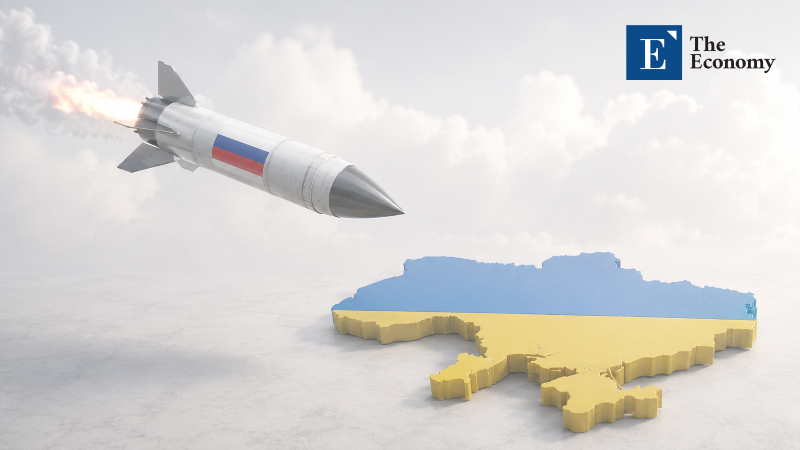
Russia has carried out the largest air assault on Kyiv since the outbreak of the war, dramatically escalating military tensions through a level of attack that exceeded prior expectations. The offensive follows months of aggressive signaling through military exercises and strategic weapons demonstrations. Analysts view the operation as part of a broader Russian effort to strengthen its negotiating position by exploiting Ukraine’s weakening air defense infrastructure and the gradual reduction of Western support.
Russia Launches Largest Attack Since Start of War
On June 24 local time, Ukrainian President Volodymyr Zelensky stated on social media that “Russia launched 90 missiles, including 36 ballistic missiles, and 600 drones overnight targeting the Kyiv region.” According to Ukrainian media outlets, the assault killed at least four people, injured nearly 100, and damaged more than 1,000 residential properties. The following day, Russia’s Foreign Ministry issued a statement warning that “systematic strikes on Ukrainian defense-industrial facilities in Kyiv have begun,” while urging foreigners and diplomats to evacuate the capital. Russian Foreign Minister Sergey Lavrov also reportedly called U.S. Secretary of State Marco Rubio directly to recommend the evacuation of American diplomatic personnel stationed in Kyiv.
In a Telegram statement, Russia’s Defense Ministry described the operation as “retaliation for Ukrainian terrorist attacks against civilian facilities inside Russian territory.” On June 22, Ukrainian forces had used drones to strike Starobilsk in eastern Luhansk, a Russian-occupied area. Moscow-installed authorities in Luhansk claimed the attack killed between six and 18 people and injured dozens more. Russian President Vladimir Putin characterized the strike as a “terrorist act,” asserting that “there were no military facilities nearby.” Ukraine, however, maintained that the target was a Russian drone command center rather than civilian infrastructure.
The assault on Kyiv is being described as the largest of the war to date. One of the most significant developments involved the deployment of Russia’s latest hypersonic intermediate-range ballistic missile, the Oreshnik. A single Oreshnik missile reportedly struck Bila Tserkva, a mid-sized city outside Kyiv, destroying water infrastructure and triggering a large-scale fire that caused severe damage. The missile system uses multiple independently targetable warheads that reenter the atmosphere separately after launch from a single missile body, with an operational range reaching up to 3,100 miles. Russian forces are believed to have equipped the missile with heavy inert warheads rather than high-explosive payloads.
Military Escalation Used as Negotiation Instrument
Even before launching direct attacks on Kyiv, Russia had been projecting offensive capabilities through nuclear drills and strategic weapons demonstrations. Earlier this month, the Russian Defense Ministry released footage of large-scale nuclear exercises conducted jointly with Belarus. The annual strategic nuclear drills, traditionally held in October, were advanced without prior notice. The exercises involved approximately 64,000 troops, more than 200 missile launchers, around 70 warships, 13 submarines, and strategic bombers.
During the drills, Russia tested and deployed the Yars intercontinental ballistic missile, the Zircon hypersonic missile, the Kinzhal air-launched hypersonic missile, and the Iskander tactical missile system, while Belarus hosted missiles capable of carrying nuclear warheads. During a Kremlin meeting held alongside the exercises, Putin declared that “the nuclear triad remains a reliable guarantee of sovereignty for the Russia-Belarus Union State,” adding that “Russia will continue modernizing its nuclear forces as global tensions intensify and new threats emerge.”
Analysts interpret Russia’s recent actions as part of a calculated strategy to secure leverage in negotiations with Ukraine. With peace talks between the two sides effectively stalled, Moscow appears to be applying simultaneous military and psychological pressure on both Ukraine and its Western backers through large-scale strikes and nuclear signaling. One Western security expert stated, “Russia views the battlefield as an extension of the negotiating table,” adding that “the Kremlin is attempting to raise the level of military tension in order to redefine the baseline of negotiations and force acceptance of its conditions, including recognition of occupied territories and Ukraine abandoning NATO membership.”
Ukraine’s Air Defense Capabilities Continue to Erode
Russia’s ability to adopt increasingly aggressive tactics stems largely from the visible deterioration of Ukraine’s defensive capacity. Moscow has persistently pressured Ukraine through coordinated deployments of drones, ballistic missiles, and hypersonic weapons. Ukraine’s air defense network is now approaching operational exhaustion. One of the most critical problems remains the shortage of Patriot interceptor missiles. The Patriot system, developed by U.S. defense contractor Raytheon, is designed to intercept ballistic missiles, cruise missiles, fighter aircraft, and drones in midair. Zelensky recently told Germany’s ZDF broadcaster that the Patriot inventory situation “could not get any worse.”
Western countries are also showing growing reluctance toward additional military support for Ukraine. On June 24, British newspaper The Telegraph and other media outlets reported that NATO Secretary General Mark Rutte’s so-called “0.25% plan” had collapsed due to opposition from several member states. First revealed in May of last year, the proposal called for all NATO members to allocate at least 0.25% of annual GDP to military assistance for Ukraine. Citing internal sources, The Telegraph identified the United Kingdom, France, Italy, Spain, and Canada as countries that voted against the proposal. Nations that had previously served as core pillars of support for Ukraine are increasingly retreating due to mounting fiscal burdens.
The United States also faces growing constraints in expanding support for Ukraine. The Washington Post reported on June 21 that U.S. forces had expended more than 200 THAAD interceptor missiles and over 100 SM-3 and SM-6 interceptors during operations linked to the war with Iran. U.S. think tanks warn that continued consumption at the current pace could rapidly deplete American air defense assets. Advanced interception systems such as THAAD and Patriot also require years to replenish even under expanded production schedules, making rapid resupply difficult.
Against this backdrop, some observers believe Ukraine may attempt to seek new opportunities in the Middle East. The Wall Street Journal recently reported that Ukraine is emerging as a potential security partner for Middle Eastern countries based on its operational experience countering Iranian-made Shahed drones. Ukraine has reportedly demonstrated drone interception technologies to Gulf states while discussing joint production and investment cooperation. However, it remains uncertain whether Middle Eastern nations will actively adopt the Ukrainian military model. For those countries, the primary threat remains Iranian drone and ballistic missile attacks themselves. Securing U.S.-style integrated air defense systems may offer stronger security advantages than adopting Ukraine’s model of large-scale low-cost drone warfare. During the recent Iran conflict, Saudi Arabia, the United Arab Emirates, and Qatar all demonstrated substantial dependence on American-made air defense networks.
As one of the youngest members of the team, Tyler Hansbrough is a rising star in financial journalism. His fresh perspective and analytical approach bring a modern edge to business reporting. Whether he’s covering stock market trends or dissecting corporate earnings, his sharp insights resonate with the new generation of investors.
- Previous “Global Stagflation Looms” Middle East-Driven Energy Shock Intensifies Low-Growth, High-Inflation Pressures as Governments Scramble for Countermeasures
- Next "If the U.S. Door Closes, Europe Will Do" — Chinese EV Makers Intensify EU Offensive, Expanding Local Production Despite Regulatory Barriers
Similar Post