“Act II of Peace Diplomacy Begins” Trump Sets Sights on Ending the Ukraine War, With Donbas Emerging as the Crucial Hurdle in Negotiations

Anne-Marie Nicholson is a fearless reporter covering international markets and global economic shifts. With a background in international relations, she provides a nuanced perspective on trade policies, foreign investments, and macroeconomic developments. Quick-witted and always on the move, she delivers hard-hitting stories that connect the dots in an ever-changing global economy.
Authored On
Modified
Trump speaks with Putin for nearly an hour, stressing the need to halt the war
Also discusses battlefield conditions and peace proposals with Zelenskyy
Diplomatic push on Ukraine resumes following efforts to contain the Middle East conflict
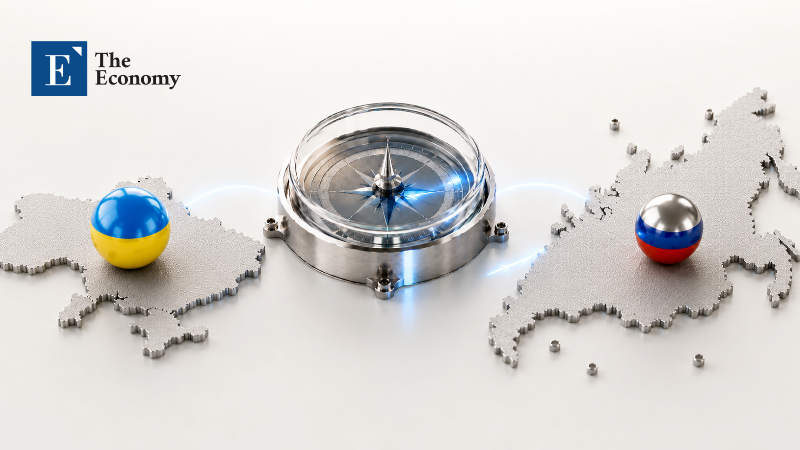
U.S. President Donald Trump, having laid the groundwork for a peace agreement with Iran, is now turning his attention to ending the war in Ukraine. After spending the past four months focused on the conflict in the Middle East, Trump appears to be reentering the diplomatic arena in an effort to bring the Russia-Ukraine war to a close. Unlike negotiations with Iran, which revolved around a relatively straightforward exchange of sanctions relief for restrictions on nuclear development, the Ukraine conflict centers on competing claims over territory and security arrangements. How Trump applies the dealmaking and mediation experience accumulated during the Middle East negotiations to the complex issue of Donbas—comprising Luhansk and Donetsk—may ultimately determine the success or failure of a peace settlement.
Trump Holds Back-to-Back Calls With Putin and Zelenskyy
According to Reuters on June 14, Kremlin foreign policy aide Yuri Ushakov told reporters that Trump reiterated during a phone conversation with Russian President Vladimir Putin that “it is extremely important to bring hostilities related to the Ukrainian conflict to an end.” Ushakov added that Trump expressed readiness to work alongside European countries and Kyiv, including through discussions scheduled at this week’s Group of Seven (G7) summit in France.
Ushakov also revealed that Steve Witkoff, Trump’s special envoy for the Middle East who has spearheaded U.S. mediation efforts on Ukraine, and Trump’s son-in-law Jared Kushner are expected to visit Russia again in the near future. Peace negotiations over Ukraine, however, have remained stalled as the U.S. administration recently concentrated much of its attention on Iran. According to the Kremlin, Trump and Putin also discussed diplomatic efforts related to the Iranian conflict during their call. “The situation surrounding the memorandum of understanding between the United States and Iran was discussed,” Ushakov said. “President Trump stated that an agreement is close and expressed hope that, despite the difficulties, the results of a successful negotiation would eventually be made public.”
The call took place shortly before Trump departed for France to attend the G7 summit. The war in Ukraine is expected to be one of the central topics on the summit agenda. Ukrainian President Volodymyr Zelenskyy also held a separate phone conversation with Trump the same day. Zelenskyy announced via Telegram that he congratulated Trump on his 80th birthday and thanked him for his support of Ukraine. He said the two leaders discussed ways to accelerate peace and that he briefed Trump on Ukraine’s improved and strengthened military and strategic position along the eastern front. The two leaders agreed to continue discussions in person during the G7 summit.
Repeated Expressions of Confidence During the “Three-Way Negotiation” Process
Having effectively brought negotiations with Iran into their final phase, Trump is now positioning the end of the Russia-Ukraine war as his next major diplomatic objective. Successfully mediating peace in Europe following a breakthrough in the Middle East would strengthen his political image as a president who ended wars and could further bolster any future pursuit of a Nobel Peace Prize. Looking back on Trump’s efforts over the roughly 18 months since the launch of his second administration, merely creating a framework in which Russia and Ukraine sat down for negotiations under U.S. observation has been viewed by some as an achievement in itself.
Trump’s optimism regarding an end to the Ukraine war is not new. Around the time of the 2024 U.S. presidential election, he repeatedly claimed that he could end the conflict on his first day in office if elected. That confidence stemmed largely from his personal relationship with Putin. Breaking from the policy of former President Joe Biden’s administration, which strongly supported Ukraine’s resistance alongside European allies, Trump believed he could pressure Ukraine into concessions while using direct diplomacy with Putin to secure a peace settlement.
That vision began taking shape immediately after Trump’s second inauguration on January 20 of last year. Guided by an America First foreign policy rooted in transactional diplomacy, even toward allies, he leveraged U.S. support and mediation efforts to pressure Ukraine into agreements granting the United States access to rare earth minerals and other strategic resources. He also sidelined Europe from peace negotiations. His perceived tendency to favor Russia, the invading power, fueled international criticism and concerns about what many described as a “dirty deal.” The breakdown of the Trump-Zelenskyy summit at the White House on February 28 last year—marked by raised voices and sharp criticism directed at Zelenskyy by Trump’s team—became a symbolic illustration of those tensions.
This Trump-style approach succeeded in bringing both Ukraine and Russia to the negotiating table in Istanbul, Türkiye, during May and June of last year. Yet meaningful progress toward peace remained elusive in talks that proceeded without direct U.S. participation. It was around this time that Trump appeared to shift his attitude toward Putin. He publicly described the Russian leader as “absolutely crazy,” accused him of “playing with fire,” and said he was “lying to us.”
Seemingly abandoning expectations that Putin would compromise voluntarily, Trump moved in July of last year to resume military support for Ukraine, including additional Patriot air defense systems, while also threatening tariffs and secondary tariffs against Russia and countries maintaining trade ties with Moscow. Building on that pressure campaign, Trump succeeded on August 15 last year in bringing Putin to Alaska, U.S. territory, for a summit meeting. He accorded Putin the treatment of a major global leader despite Russia’s deep international isolation following its invasion of Ukraine. The meeting ultimately produced no agreement on either a ceasefire or a peace settlement. Since then, Trump’s efforts to secure an end to the war have continued largely behind the scenes and now appear to be regaining momentum following the conclusion of a peace agreement with Iran on June 14.
The Donbas Barrier Facing Trump
The Ukraine conflict presents a far more complicated challenge than negotiations in the Middle East. Talks with Iran involved a clear exchange framework: restrictions on nuclear development in return for sanctions relief. The United States used military pressure to strengthen its negotiating leverage, while Iran sought an economic exit strategy. The process itself was complex, but the transactional structure remained relatively straightforward.
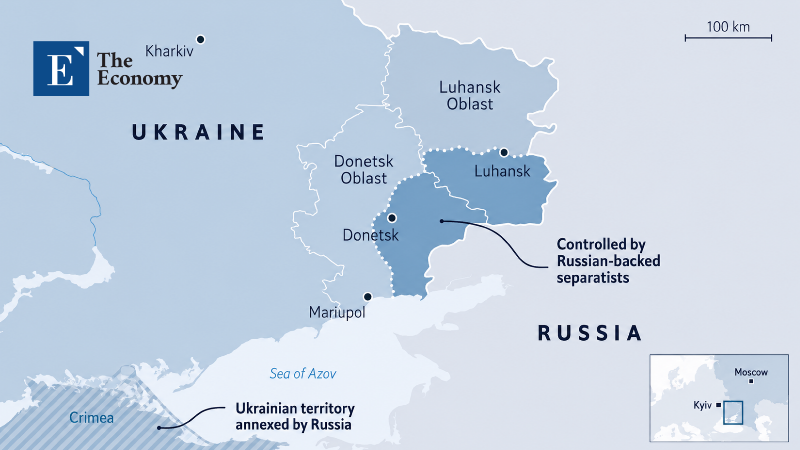
The Ukraine war is fundamentally different. Russia is demanding control over the entirety of Donbas in exchange for returning portions of occupied territory in Ukraine’s northern Sumy and Kharkiv regions. Russia currently controls approximately 88% of the Donbas region. The issue lies in the exchange ratio. The territory Russia has offered to return amounts to roughly 440 square kilometers, while the area Ukraine would be expected to cede totals approximately 6,600 square kilometers. Even by land area alone, the disparity is substantial. Russia is also seeking recognition of its annexation of Crimea and the easing of certain economic sanctions, aiming to secure both territorial legitimacy and sanctions relief simultaneously.
Moreover, Donbas occupies a central place in Russia’s justification for the invasion. The region has a high proportion of Russian speakers and strong pro-Russian sentiment. Since the outbreak of the war, Putin has consistently framed the conflict as a mission to protect ethnic Russians. Any concession involving Donbas during peace negotiations could undermine the political legitimacy of the war itself. The region is equally important from a military standpoint. Donbas serves as the strategic land corridor connecting Crimea with mainland Russia. Throughout the conflict, Russia has built extensive defensive lines centered on the area. Its strategic value is considerable. Control of Donbas would provide Russia with a continuous land bridge linking Crimea to Russian territory while securing access to the Black Sea, industrial assets, and resource-rich areas.
Ukraine, however, has little room to retreat. Donbas is a strategic hub containing major railways and road networks connected to Kyiv and other key cities. Western Donetsk, in particular, contains a fortified defensive belt that Ukrainian forces have spent more than a decade constructing. The defensive line linking Kostiantynivka and Sloviansk has served as a critical barrier against Russian advances. The Institute for the Study of War (ISW) has assessed that Ukraine invested substantial resources in building these defensive systems. Should Russia secure the region, it would gain a military springboard for future offensives. This reality also explains why European countries remain highly sensitive to negotiations over Donbas. Full Russian control of the region could fundamentally alter Europe’s postwar security environment.
As a result, the Trump administration cannot simply apply lessons learned from the Middle East. Negotiations with Iran relied on economic incentives to influence behavior. The Ukraine conflict is inseparable from issues of territory and national security. The costs of any deal are substantially higher, and the political burden is far heavier. Ultimately, the success or failure of peace negotiations may depend on what Ukraine receives in exchange for relinquishing claims to eastern Donbas. Without a combination of U.S. and European security guarantees, postwar reconstruction assistance, and long-term military support, Ukraine may struggle to establish the political justification necessary to accept territorial concessions.
This context also helps explain recent discussions between Washington and Kyiv regarding proposals to transform portions of Donbas into a demilitarized zone or a free economic area administered by the international community. According to The Guardian, the concept focuses on containing military confrontation while postponing a final resolution of territorial disputes. With neither full Russian annexation nor immediate Ukrainian restoration of sovereignty appearing realistic, the proposal seeks to place Donbas under a special administrative framework. Russia, however, is unlikely to accept such an arrangement easily. One diplomatic expert noted, “The Donbas issue extends beyond a territorial dispute and is directly linked to the reshaping of the postwar order. A long-term international administration is increasingly viewed as a realistic option, but from Putin’s perspective it would require relinquishing a significant portion of the narrative of victory.”
Anne-Marie Nicholson is a fearless reporter covering international markets and global economic shifts. With a background in international relations, she provides a nuanced perspective on trade policies, foreign investments, and macroeconomic developments. Quick-witted and always on the move, she delivers hard-hitting stories that connect the dots in an ever-changing global economy.
Similar Post