“Failed Invasion of Iran” U.S.-Iran Ceasefire Deal Reached, Yet Final Negotiations Face Formidable Hurdles

Siobhán Delaney is a Dublin-based writer for The Economy, focusing on culture, education, and international affairs. With a background in media and communication from University College Dublin, she contributes to cross-regional coverage and translation-based commentary. Her work emphasizes clarity and balance, especially in contexts shaped by cultural difference and policy translation.
Authored On
Modified
U.S. and Iran Reach Ceasefire MOU, Signing Ceremony Set for June 19
Sixty-Day Window Secured for Final Agreement
Diplomatic Battle Looms Over Nuclear Program and Frozen Assets
The Iran war, which weighed heavily on the global economy and turned the Middle East into a geopolitical tinderbox, has entered its final phase. The conflict comes to an end 106 days after it began on February 28, when the United States and Israel launched strikes against Iran. Yet the core disputes surrounding Iran’s nuclear program, control of the Strait of Hormuz, and sanctions remain unresolved. Iran’s political system also remains intact and continues to project resilience. The war may have stopped, but the region’s underlying flashpoints remain firmly in place.
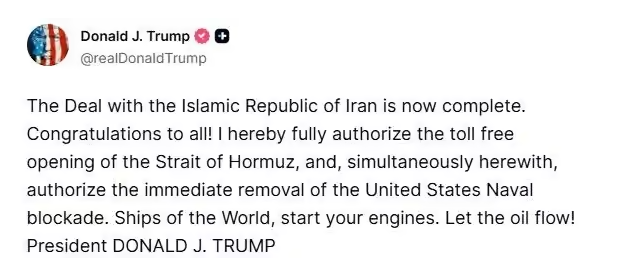
Trump Approves Reopening of Strait of Hormuz and Immediate End to Naval Blockade
On June 14 (local time), President Trump announced on his social media platform Truth Social that “negotiations with the Islamic Republic of Iran have been completed,” adding, “Congratulations to everyone.” He continued, “I hereby fully authorize the toll-free reopening of the Strait of Hormuz and simultaneously authorize the immediate lifting of the U.S. Navy blockade.” He also declared, “Ships of the World, start your engines. Let the oil flow!”
Iran also confirmed the ceasefire agreement with Washington. Shortly after Trump’s announcement, Iranian Deputy Foreign Minister Kazem Gharibabadi appeared on Iranian state television and stated that “both sides agreed to a revised draft during approximately 15 hours of final negotiations mediated by Qatar.” He added that “the U.S. maritime blockade against Iran will be lifted and conflicts across all fronts, including Lebanon, will come to an end.” He further noted that “Iran’s implementation of the agreement will officially begin on June 19.”
Pakistani Prime Minister Shehbaz Sharif, who was the first leader to announce the signing of the ceasefire memorandum of understanding (MOU), also stated on X that “the United States and Iran have declared an immediate and permanent cessation of military operations across all fronts, including Lebanon.” Sharif, who has served as a key intermediary between the two sides, confirmed that the official signing ceremony will take place in Switzerland on June 19. He added that “mediating countries will convene a series of meetings this week following the agreement.”
The announcement came roughly 106 days after the United States and Israel launched military operations against Iran. According to a leaked 14-page draft peace agreement circulated earlier through Iranian state media and other channels, Washington agreed to fully lift sanctions on Iranian oil exports, while Tehran agreed to completely reopen the Strait of Hormuz within 30 days of the agreement’s conclusion. The deal emerged after weeks of escalating tensions, public disputes, and conflicting messages regarding battlefield developments and negotiation terms. A fragile ceasefire maintained through intensive diplomatic efforts has now evolved into a formal peace agreement.
High-Stakes Bargaining Ahead Over Nuclear Program and Frozen Assets
Significant obstacles remain before a final settlement can be reached. The most urgent issue concerns Iran’s nuclear materials. The United States intends to use the next 60 days of negotiations to eliminate any possibility of Iranian nuclear weaponization. Washington is demanding the institutionalization of stringent post-agreement controls, including the immediate transfer of all highly enriched uranium and other nuclear materials abroad to a third country or their permanent disposal, along with a complete prohibition on future enrichment activities inside Iranian territory. While the United States has shown limited flexibility by accepting the possibility of disposing of highly enriched uranium within Iran, it has signaled zero willingness to compromise on broader monitoring and enforcement mechanisms, including a permanent ban on additional enrichment activities.
Iran, however, insists that nuclear negotiations can only begin after the ceasefire agreement is fully implemented. Tehran has characterized the handling of nuclear materials as a matter of national sovereignty and has drawn clear red lines against Washington’s demands. Iranian Foreign Minister Abbas Araghchi reiterated on June 14 that “Iran will not relinquish its right to enrich uranium,” emphasizing that “the nuclear program is a peaceful endeavor conducted under the supervision of the International Atomic Energy Agency (IAEA).” He further stressed that while enrichment activities and the disposition of nuclear materials may be discussed during negotiations, they cannot be imposed unilaterally by the United States.
The issue of releasing tens of billions of dollars in frozen Iranian assets overseas is expected to become another major challenge during substantive negotiations. For Iran, which has endured severe economic sanctions and even episodes of civil unrest, the immediate inflow of capital and the lifting of sanctions constitute the primary justification for accepting the ceasefire agreement. Tehran is therefore eager to secure a rapid release of frozen funds. Washington, however, mindful of domestic hawkish opposition, is expected to favor a “action-for-action” framework under which frozen assets would be released incrementally in accordance with Iran’s compliance with denuclearization measures and other obligations. This raises the prospect of an intense standoff between Iran, which seeks immediate access to the funds to revive its battered economy, and the United States, which intends to preserve the assets as its final source of leverage.
The normalization of traffic through the Strait of Hormuz is also likely to become a contentious issue during detailed negotiations. While both sides have agreed in principle to the immediate reopening of the waterway following the signing of the MOU, widespread expectations persist that Iran will seek to preserve substantial control over the strait, including potential transit fees. The Iranian parliament has already passed legislation related to the issue. On June 13, Araghchi stated on Iranian state television that “management of the Strait of Hormuz will not return to its prewar status,” signaling Tehran’s intention to pursue a toll system. The United States, by contrast, remains focused on restoring unrestricted freedom of navigation.
Even if both sides agree to a 60-day ceasefire, the possibility that Iranian hardliners could gain influence during the negotiation process remains a major variable. According to The Guardian, Iran’s Islamic Revolutionary Guard Corps (IRGC) and ultra-conservative factions have openly opposed the agreement, arguing that it risks sacrificing control over the Strait of Hormuz and the nuclear program as bargaining chips. Some hardline lawmakers and conservative media outlets have already characterized the decision to place nuclear issues and control of the strait on the negotiating table as a “surrender,” particularly in the absence of explicit guarantees regarding sanctions relief and the return of frozen assets. Moreover, segments of Iran’s political establishment continue to view any agreement with the United States as a threat to the legitimacy of the regime itself. Hardline factions are pressuring negotiators by portraying nuclear material transfers, enrichment restrictions, and adjustments to Hormuz governance as infringements upon national sovereignty.
U.S.-Israeli Vision for a New Middle East Leaves Behind Chronic Instability
This reality underscores the persistence of the very fault lines that triggered the war. President Trump and Israeli Prime Minister Benjamin Netanyahu believed that victory over Iran would create an opportunity to reshape the Middle East. When the United States and Israel launched their campaign, their objectives extended far beyond the destruction of nuclear facilities. Targets included IRGC leadership, strategic missile bases, military installations, and key figures within the Iranian power structure. Washington appeared to calculate that military shock and economic pressure would weaken the regime’s control and encourage the growth of internal dissent. Combined with the elimination of Iran’s nuclear capabilities and the restoration of free navigation through the Strait of Hormuz, U.S. policymakers appeared to believe that a regional order more favorable to American interests could emerge.
The Middle East is indeed changing. The transformation, however, has not unfolded in the manner Washington and Tel Aviv anticipated. No mass uprising materialized, and Iran’s succession mechanisms proved more resilient than expected. A primary reason was that Iranian society did not collapse as easily as outside observers had predicted. Trump anticipated that economic hardship and wartime destruction would fuel anti-government unrest. Instead, external attacks strengthened national solidarity and support for the existing system. The power structure also demonstrated greater stability than expected. Despite strikes against senior leaders and military commanders, the governing framework composed of the religious establishment, the IRGC, and the state bureaucracy remained intact. The removal of several individuals did not trigger the collapse of the state itself. China and Russia also played important roles. While neither country intervened directly in the conflict, both refrained from allowing the Iranian system to disintegrate.
The most significant reason regime change failed was the Strait of Hormuz. As the conflict dragged on, both Washington and Tehran came to recognize that the strait represented a strategic asset even more consequential than nuclear facilities. Nuclear sites can be destroyed; the strait cannot. More importantly, the global economy continues to depend on Hormuz. This reality helps explain why the United States gradually shifted its focus away from regime change and toward the more practical objectives of controlling the nuclear issue and ensuring freedom of navigation. Iran likewise adjusted its strategy, prioritizing regime survival while leveraging the strait as its principal bargaining chip.
Although the Strait of Hormuz has reopened after more than three months of disruption, reopening does not automatically mean normalization. The costs of the war are only beginning to emerge. Maritime mine-clearing operations remain unfinished, and it may take months merely to reorganize the schedules of hundreds of vessels stranded in the Persian Gulf. The 60-day technical negotiations over nuclear dismantlement also represent a potential flashpoint. Every setback in negotiations could trigger renewed volatility in oil markets and global financial markets. The economic damage inflicted by the Iran war is equally significant. Disrupted supply chains and the aftereffects of elevated oil prices have already weighed on economic activity, while inflationary pressures fueled by higher energy costs remain a shared challenge for countries worldwide.
In this war, the United States demonstrated the full extent of its military power. Yet in modern warfare, military superiority does not automatically translate into political or diplomatic success. Iraq and Afghanistan stand as clear examples. The United States won the wars but failed to secure regional stability and lasting peace, ultimately expending enormous national resources before withdrawing. The U.S.-Israeli conflict with Iran presents a similar question. Despite overwhelming firepower, serious doubts remain as to whether Washington achieved its strategic objectives. Compared with the prewar situation, the balance of power in the Middle East remains largely unchanged. Iran continues to be a central regional actor, Israel has failed to eliminate the security threats it faces, and the United States has not secured the decisive advantage necessary to redesign the regional order. Rather than producing a new geopolitical framework, the conflict has merely sharpened the contours of existing rivalries.
Siobhán Delaney is a Dublin-based writer for The Economy, focusing on culture, education, and international affairs. With a background in media and communication from University College Dublin, she contributes to cross-regional coverage and translation-based commentary. Her work emphasizes clarity and balance, especially in contexts shaped by cultural difference and policy translation.
- Previous "From the Biosecure Act to Investment Restrictions" U.S. Unleashes Sweeping Curbs on Chinese Biotech, Prioritizing Security Risk Mitigation and Strategic Dominance
- Next “Act II of Peace Diplomacy Begins” Trump Sets Sights on Ending the Ukraine War, With Donbas Emerging as the Crucial Hurdle in Negotiations
Similar Post