“Beyond Tariffs to Local-Content Rules”: EU Tightens Pressure on Chinese EVs, but Effectiveness Questioned as Chinese Brands Expand European Production

Stefan Schneider brings a dynamic energy to The Economy’s tech desk. With a background in data science, he covers AI, blockchain, and emerging technologies with a skeptical yet open mind. His investigative pieces expose the reality behind tech hype, making him a must-read for business leaders navigating the digital landscape.
Authored On
Modified
EU accelerating additional restrictions on Chinese EVs through the Industrial Accelerator Act
Chinese EV exports continuing to rise despite tariff barriers
Chinese manufacturers expanding local production as Europe’s EV ecosystem remains vulnerable
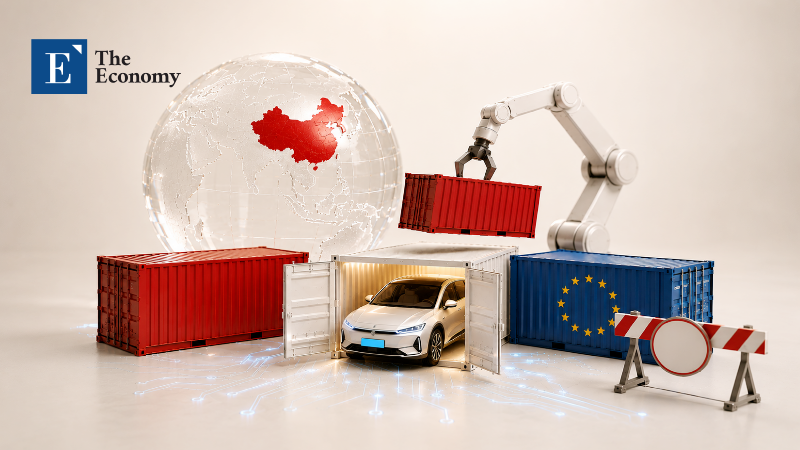
The European Union is intensifying its efforts to contain Chinese electric vehicles. Beyond maintaining trade barriers through tariffs, the bloc is now considering measures that would favor EVs manufactured within Europe, including the proposed Industrial Accelerator Act (IAA), as it seeks to protect the competitiveness of its automotive industry.
However, market observers remain uncertain whether these restrictions will produce meaningful results. Chinese manufacturers are moving rapidly to circumvent the rules by securing production capacity within Europe, while the European EV industry continues to face clear disadvantages in manufacturing costs, supply-chain integration, and mass-production capabilities.
EU Tightens Restrictions on Chinese EVs
According to automotive industry sources on July 20, the EU is seeking to strengthen non-tariff restrictions on Chinese EVs through the IAA. A draft of the legislation released in March proposes concentrating public procurement contracts, government subsidies, corporate vehicle incentives, and other public benefits on “European-made products.” Under the proposed rules, EVs participating in public procurement programs or receiving public support would have to undergo final assembly within the EU, while at least 70% of all vehicle components, excluding the battery, would have to originate in the bloc. The structure would therefore make it difficult for manufacturers to obtain European-made status simply by importing Chinese components and carrying out final assembly at European factories.
Separate localization requirements would apply to batteries. During the initial phase of implementation, at least three major battery components, including battery cells, would have to be manufactured within the EU. Three years after the legislation takes effect, the requirements would become more stringent, with at least five major components—including battery cells, cathode active materials, and battery management systems—required to be sourced within the bloc. From the same point, at least 50% of electric powertrain components by value, including electric motors and inverters, would also have to originate in the EU, while major automotive electronic systems would be required to maintain an EU-made component ratio of at least 50%.
Conditions governing foreign investment in Europe would also be tightened. The IAA would allow the EU to impose additional conditions on companies from countries accounting for more than 40% of global production capacity in strategic industries such as EVs, batteries, solar power, and critical minerals when those companies invest more than €100 million, or approximately $115 million, in the bloc. The provision is widely regarded as being aimed primarily at China, which has rapidly expanded its presence in the global EV and battery markets. Possible conditions could include requiring a European company to secure a controlling equity stake, mandating technology transfers, integrating the investment into European supply chains, and establishing commitments to local employment creation.
High Tariffs Show Clear Limits
Tariff barriers remain another central component of the EU’s response. Beginning in 2023, the EU conducted an approximately year-long anti-subsidy investigation into Chinese EVs and, in July 2024, imposed provisional countervailing duties after concluding that Chinese government subsidies were distorting competition within the European market. The measure represented the bloc’s first large-scale trade restriction targeting Chinese EVs. In October of the same year, following approval from member states, the EU finalized additional company-specific tariffs of up to 35.3% on Chinese-made EVs. The EU and China are currently considering an arrangement under which tariffs could be partially reduced if Chinese manufacturers guarantee minimum selling prices above an agreed threshold, but the two sides have yet to reach a substantive agreement.
These measures have nevertheless begun to reshape automotive production and export patterns. According to the latest research from Transport & Environment (T&E), major Western automakers that had previously relied on Chinese factories to lower manufacturing costs are now increasing the share of their EV production conducted within Europe. As both the United States and the EU move to restrict Chinese-made EVs in their core markets, automakers have adopted reshoring and in-region production strategies to reduce supply-chain risks and protect profitability. The proportion of China-made vehicles in the total EV sales of BMW, Dacia, Volvo, Smart, and Tesla fell sharply from 38% in 2024 to 23% in the first quarter of 2026.
T&E nevertheless concluded that the EU’s tariffs had failed to completely prevent the advance of Chinese EVs, noting that exports by Chinese EV brands to Europe continued to increase substantially despite the additional duties. According to the European Automobile Manufacturers’ Association, BYD registered 135,307 new vehicles in the combined EU, UK, and European Free Trade Association markets between January and May 2026, an increase of 145.2% from the same period a year earlier. Geely Group registrations rose by 6.5% to 176,676 vehicles over the same period, while Chery Automobile and Leapmotor recorded explosive increases of 316.0% and 552.9%, respectively. “The Chinese EV market has faced prolonged overcapacity and intense price competition among manufacturers, making it difficult to absorb the industry’s production volume through domestic demand alone,” one market participant said. “For Chinese EV companies, expanding their European sales base is a critical matter of survival, meaning they are unlikely to withdraw easily even as regulations become more restrictive.”
Chinese EV Push Set to Continue
Chinese EV manufacturers are expected to intensify their European expansion as they accelerate efforts to secure local production bases capable of offsetting the EU’s trade restrictions. In June 2026, Japanese automaker Nissan signed a memorandum of understanding with China’s Chery Automobile concerning contract manufacturing at Nissan’s Sunderland plant in the United Kingdom. Under the proposed arrangement, Chery would pay Nissan to manufacture a specified volume of vehicles at the facility. The companies are also reportedly considering producing Chery’s Omoda 5 compact SUV at Nissan’s former Barcelona plant in Spain, where Nissan previously discontinued operations.
Other Chinese manufacturers are pursuing similar strategies through partnerships with established European automakers. Stellantis plans to manufacture Leapmotor’s B10 electric SUV at its Zaragoza plant in Spain, while China’s Dongfeng Motor and Hongqi, the luxury vehicle brand controlled by China FAW Group, are also reportedly considering outsourcing production to Stellantis. Volkswagen is meanwhile said to be discussing factory acquisitions and contract-manufacturing arrangements with Chinese EV manufacturer Xpeng. Such agreements would allow Chinese brands to expand production within Europe, reduce their exposure to tariffs and local-content restrictions, and gain access to existing factories, labor forces, supplier networks, and distribution infrastructure.
Industry observers argue that Europe’s automotive ecosystem is not yet sufficiently equipped to withstand this continuing Chinese expansion. European manufacturers retain clear strengths in internal-combustion-engine technology, engineering, and established automotive brands, but they remain unable to match China’s advantages in EV production costs and large-scale manufacturing. The disparity is particularly pronounced in EV batteries. T&E estimates that the average cost of battery cells manufactured in Europe is currently approximately 90% higher than that of cells produced in China. Chinese manufacturers have reduced costs through enormous production capacity, integrated domestic supply chains for materials and components, and high factory utilization rates, while European manufacturers continue to struggle with low production yields, shortages of skilled workers, high energy costs, and an insufficiently developed battery supply chain.
Automotive Cells Company has also failed to produce the results originally expected of it. ACC is a joint venture established by Stellantis, Mercedes-Benz, and Saft, the battery subsidiary of French energy company TotalEnergies, and was initially regarded as a central pillar of Europe’s effort to reduce the automotive industry’s dependence on Asian battery suppliers. The company originally planned to construct large battery factories in Douvrin, France; Kaiserslautern, Germany; and Termoli, Italy, thereby substantially expanding Europe’s domestic battery-production capacity. In 2024, ACC raised €4.4 billion, or approximately $4.7 billion, to support these plans, but the Douvrin facility, which began operations in 2023, encountered serious difficulties while attempting to stabilize mass production.
Battery-cell yields fell sharply during the manufacturing process, causing delays in the production and delivery of certain long-range EV models. ACC reportedly brought Chinese battery specialists to the facility in an effort to improve production yields and reduce the proportion of defective cells, creating a striking paradox in which a battery manufacturer established to reduce European dependence on China was forced to rely on Chinese manufacturing expertise to resolve its own mass-production problems. In February 2026, ACC effectively abandoned its plans to build the Kaiserslautern and Termoli battery factories, announcing that it would instead concentrate on improving production efficiency at the Douvrin facility. The episode has reinforced doubts over whether regulatory protection alone can close the widening gap between Europe’s EV ambitions and China’s established advantages in cost, scale, and manufacturing execution.
Stefan Schneider brings a dynamic energy to The Economy’s tech desk. With a background in data science, he covers AI, blockchain, and emerging technologies with a skeptical yet open mind. His investigative pieces expose the reality behind tech hype, making him a must-read for business leaders navigating the digital landscape.
Similar Post