“China Claims Neutrality, Yet Quietly Backs Iran” — Beijing’s Covert Support Raises Risk of Protracted War

Siobhán Delaney is a Dublin-based writer for The Economy, focusing on culture, education, and international affairs. With a background in media and communication from University College Dublin, she contributes to cross-regional coverage and translation-based commentary. Her work emphasizes clarity and balance, especially in contexts shaped by cultural difference and policy translation.
Authored On
Modified
Chinese satellite networks bolster IRGC surveillance and communications capabilities
Iran reportedly paid $40 million to acquire satellite control rights from Chinese firms
Evidence mounts of precision strikes on U.S. bases in the Middle East guided by Chinese reconnaissance satellites
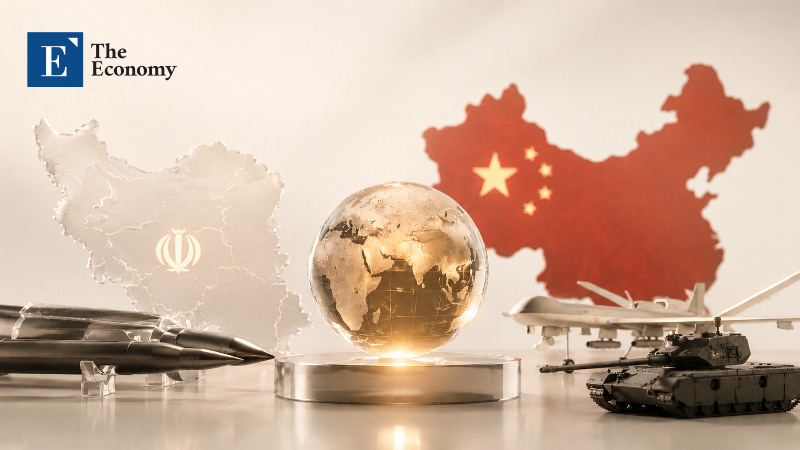
Chinese military-linked technologies supplied to Iran are emerging as a pivotal factor reshaping the trajectory of the Iran war. Evidence continues to surface pointing to the covert transfer of Chinese satellite antenna systems through the United Arab Emirates (UAE) free-trade zone, alongside allegations involving Chinese-operated reconnaissance satellites and satellite-navigation support. Although Beijing has publicly maintained a position of neutrality, growing evidence suggests China has effectively served as a rear-echelon enabler for the Islamic Revolutionary Guard Corps (IRGC), underpinning Iran’s precision-strike architecture and surveillance capabilities. The revelations are fueling expectations that the conflict could become increasingly protracted.
Iran Smuggled Chinese Satellite Equipment Through UAE Firms
On the 25th local time, the Financial Times (FT) reported, citing leaked UAE commercial contracts and shipping records, that the IRGC Aerospace Force imported advanced Chinese satellite antenna equipment through UAE-based companies in late 2025. The equipment was allegedly procured through Telesun, a satellite communications company located in Ras Al Khaimah, one of the UAE’s emirates. Telesun reportedly transported 1.8-ton satellite antenna systems manufactured in Shanghai through Dubai’s Jebel Ali port before shipping them onward to Bandar Abbas, Iran. The shipment reportedly included 4.5-meter satellite antennas produced by Chinese manufacturer StarWin.
The smuggling route reportedly unfolded in three stages. The Chinese container vessel Zhong Gu Yin Chuan departed Shanghai and unloaded the containers in Dubai on Aug. 28 of last year. Roughly three months later, on Nov. 23, the Iranian cargo ship Rama III retrieved the shipment. Rama III subsequently transmitted falsified GPS signals near the coast of Oman to disguise its location. After comparing satellite imagery from the same day, FT reported that “the vessel was not located where it claimed to be,” raising the possibility of GPS spoofing. Satellite images captured at Bandar Abbas port on Nov. 29 later showed a vessel matching Rama III’s size and color profile entering the harbor.
The transaction is being viewed as particularly sensitive given that the UAE became a major target of Iranian retaliation following U.S. and Israeli strikes on Iran on Feb. 28. At the time, Iran launched more than 2,800 drones and missiles toward the UAE while also targeting civilian infrastructure. UAE free-trade zones have long faced accusations of functioning as channels for Iranian sanctions evasion and military procurement. FT assessed that the IRGC likely used the acquired satellite communications and surveillance capabilities in attacks targeting U.S. military installations across the Middle East.
Chinese Reconnaissance Satellites Allegedly Used in Attacks on U.S. Bases
The alleged smuggling of Chinese satellite systems through the UAE is reinforcing suspicions that Chinese technological networks are operating behind Iran’s growing precision-strike capabilities. On the 15th of last month, FT reported, citing leaked Iranian military documents, that the IRGC Aerospace Force had acquired and begun operating the reconnaissance satellite TEE-01B, launched by China in late 2024. The satellite was reportedly manufactured and launched by Chinese firm Earth Eye, which allegedly transferred ownership to Iran through an “in-orbit delivery” arrangement, under which satellites are handed over to foreign customers after reaching orbit.
TEE-01B reportedly became one of the IRGC’s core reconnaissance assets during the current war with the United States. One prominent example was the March 14 attack on Prince Sultan Air Base in Saudi Arabia. During the strike, the IRGC reportedly deployed $20,000 Shahed-136 drones that destroyed an E-3 Airborne Warning and Control System (AWACS) aircraft stationed at the base. The E-3, one of the U.S. Air Force’s critical strategic assets, carries an estimated value of roughly $300 million. The incident highlighted how inexpensive drones were able to neutralize strategic assets worth hundreds of millions of dollars.
The IRGC also reportedly launched drone and missile attacks against U.S. military facilities throughout the region, including Al Udeid Air Base in Qatar, Al Salem Air Base in Kuwait, Al Dhafra Air Base in the UAE, the headquarters of the U.S. Navy’s Fifth Fleet in Bahrain, and Muwaffaq Salti Air Base in Jordan, inflicting substantial damage. Beyond military facilities, the IRGC also targeted critical energy infrastructure and even data centers across six Gulf Cooperation Council (GCC) member states, including Saudi Arabia, Qatar, and the UAE. Nicole Grajewski, an Iran specialist at Sciences Po, stated that “Chinese satellites are clearly being used for military purposes,” adding that they played a decisive role in helping Iran identify targets in advance and verify strike effectiveness afterward.
Earth Eye reportedly transferred satellite control rights to Iran in exchange for 250 million yuan, equivalent to roughly $35 million. The in-orbit delivery contract allegedly included the signature of an IRGC Aerospace Force brigadier general, as well as detailed costs covering the satellite, launch vehicle, technical support, and data infrastructure. In March, the IRGC reportedly assigned TEE-01B the mission of monitoring key U.S. military facilities across the Middle East. The IRGC also reportedly relied on Beijing-based satellite control services company Emposat to reduce the risk of direct strikes on its own control facilities. Emposat has long maintained close ties with the Chinese People’s Liberation Army Aerospace Force and provides the IRGC with satellite operation software and ground infrastructure through a global network of ground stations spanning Asia and Latin America. The system reportedly supports command transmission, image reception, and remote-control operations.
A former senior Western intelligence official stated that “it is absolutely impossible for Chinese companies to launch satellites without government approval,” adding that “China has been providing intelligence support to Iran while concealing its involvement.” Jim Lamson, a senior researcher at the James Martin Center for Nonproliferation Studies in the United States, noted that “Iranian satellite ground stations have already been struck multiple times over the past two years,” adding that “because Washington cannot attack Chinese ground stations located in foreign countries, Iran has effectively been able to operate them freely.”

Iran Enhances Precision Capabilities Through Chinese AI and BeiDou Systems
Additional allegations have emerged suggesting that Iran is also leveraging satellite imagery from Chinese AI-based geospatial analytics firm MizarVision. Last month, ABC News, citing the Defense Intelligence Agency (DIA), reported that the IRGC was using MizarVision to conduct precision strikes against U.S. military installations across the Middle East. Headquartered in Hangzhou, MizarVision reportedly uses automated object-recognition technology capable of identifying military bases, equipment, and infrastructure within minutes. The AI-driven platform is said to have drastically shortened intelligence analysis processes that previously required hours. The system’s ability to provide real-time targeting information using commercial satellite data has further amplified concerns. According to the DIA, the IRGC used the company’s AI tools to identify and strike high-value targets including U.S. air-defense systems, logistics hubs, and aircraft.
China is also suspected of supporting Iran through its indigenous BeiDou satellite-navigation system, often described as China’s alternative to GPS. The navigation system enables missiles to calculate precise distances to targets and determine optimal strike trajectories. It is also integrated into fighter aircraft, naval vessels, and drones. China completed the BeiDou system in 2020, becoming the fourth country after the United States, Russia, and the European Union to establish an independent global satellite-navigation network. The system is considered highly accurate for military applications.
Iran reportedly relied on GPS for missile and drone targeting during the “12-Day War” with the United States and Israel in June of last year. However, after U.S. GPS-jamming operations reportedly degraded strike accuracy, Tehran is believed to have shifted toward the BeiDou system during the current conflict to improve precision. Enrico Fardella, a professor at Italy’s University of Naples L’Orientale, stated that “using the BeiDou system is not simply a navigation replacement, but a sign that Iran is becoming part of China’s military ecosystem,” adding that “this allows China to support Iran without deploying troops or military hardware directly.”
Although Beijing has consistently claimed neutrality throughout the Iran conflict, evidence increasingly suggests China has been quietly providing military assistance behind the scenes. The Atlantic Council has also pointed out that Iran’s missile and explosives production capabilities depend heavily on access to chemical precursors and industrial materials, and that Chinese chemical firms have secretly supplied such materials to Iran on a large scale. Iranian vessels departing from Chinese ports have reportedly transported chemical precursors and ballistic missile propellant ingredients for years. In relation to these shipments, The Washington Post identified Gaolan Port in Zhuhai, Guangdong Province, as a major hub. According to the report, 12 vessels affiliated with Iran’s state-owned shipping company have entered and departed the port this year alone, turning it into a central transit point for chemicals tied to Iran’s missile program.
Siobhán Delaney is a Dublin-based writer for The Economy, focusing on culture, education, and international affairs. With a background in media and communication from University College Dublin, she contributes to cross-regional coverage and translation-based commentary. Her work emphasizes clarity and balance, especially in contexts shaped by cultural difference and policy translation.
- Previous “From Advanced Chip Development to AI Price Cuts” China’s All-Out AI Push Stumbles on Margin Erosion and Technological Constraints Amid Cutthroat Competition
- Next Quad Activates Four-Pronged Strategy to Contain China, Expanding U.S. Indo-Pacific Strategy From Security Alliance to Economic and Technological Bloc
Similar Post