Quad Activates Four-Pronged Strategy to Contain China, Expanding U.S. Indo-Pacific Strategy From Security Alliance to Economic and Technological Bloc

Authored On
Modified
Strengthening Cohesion in Critical Minerals, Energy, and Maritime Security
Expansion of Anti-China Pressure Network Through Parallel Operation of AUKUS and Quad
U.S.-Led Indo-Pacific Framework Accelerates Strategic Order Restructuring
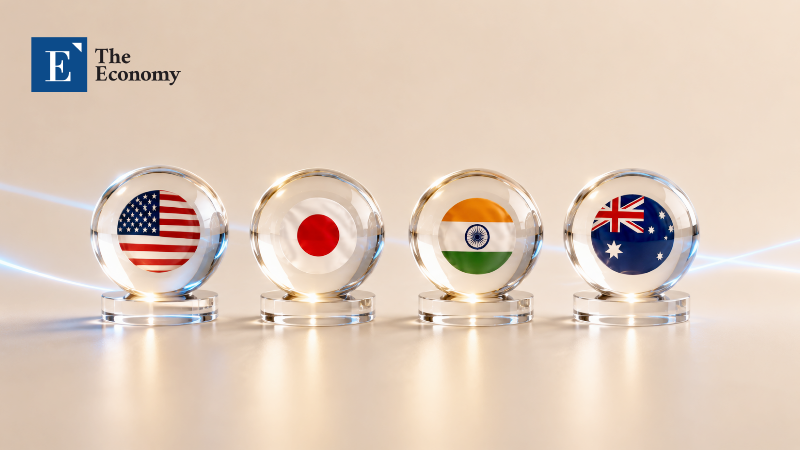
The United States is expanding its China containment strategy beyond the military sphere into the broader domains of economic, technological, and supply chain order. The Quad — the four-nation security framework comprising the United States, Japan, Australia, and India — has recently widened the scope of cooperation to include critical mineral supply chains, energy security, and real-time maritime surveillance systems, while AUKUS — the trilateral nuclear submarine alliance among the United States, the United Kingdom, and Australia — is strengthening cooperation on nuclear submarines and advanced military technologies. The Indo-Pacific strategy is consequently being reorganized into a multilayered structure. Experts believe that as pressure on China intensifies, the U.S.-centered Indo-Pacific alliance architecture is likely to evolve into an even more complex and expansive formation.
Quad Pushes Energy Security Agenda and Critical Minerals Cooperation Framework
According to the Quad foreign ministers’ meeting and joint press conference held at Hyderabad House in New Delhi on the 26th local time, U.S. Secretary of State Marco Rubio, Japanese Foreign Minister Toshimitsu Motegi, Australian Foreign Minister Penny Wong, and Indian External Affairs Minister S. Jaishankar jointly unveiled four key strategic initiatives aimed at promoting prosperity and stability across the Indo-Pacific region. The most strategically significant outcome produced at the meeting was the launch of the “Quad Critical Minerals Initiative.” According to a planning statement released by Indian authorities, the four countries agreed to mobilize up to $20 billion in public- and private-sector financing to fully decouple the mining, processing, and recycling value chains of critical minerals — essential for batteries and advanced weapons systems — from dependence on China.
Energy security has also emerged as a central Quad agenda item following the closure of the Strait of Hormuz amid the Iran war crisis. Australian Foreign Minister Penny Wong emphasized the urgency of four-way coordination, stating, “The world has become more unpredictable, economic volatility is increasing, and we already understand the devastating impact that Iran’s closure of the Strait of Hormuz could have on Indo-Pacific energy security and the broader economy.” In response, the United States decided to host a “Fuel Security Forum” later this year inviting Quad partners, while Japan proposed linking its “Power Asia” framework — a cooperative mechanism for crude oil and petroleum product procurement — with the Quad’s energy initiative.
Strengthening the Maritime Domain Awareness (MDA) framework and expanding real-time surveillance information sharing also emerged as core agenda items. The four Quad members agreed to expand the group’s “Indo-Pacific Maritime Domain Awareness Initiative,” which provides commercial maritime domain awareness data to countries bordering the Indo-Pacific, into the Indian Ocean and establish a comprehensive Common Operating Picture. The initiative marks the first four-way partnership aimed at improving inadequate port capacity across Pacific island regions and is widely interpreted as a direct strategic countermeasure against China’s efforts to expand influence through large-scale loans and naval base construction projects in the region.
Parallel AUKUS-Quad Front Takes Shape
These developments demonstrate that the Quad is evolving beyond a conventional diplomatic-security consultative body into a core economic security pillar underpinning the U.S. Indo-Pacific strategy. Washington is currently operating its China containment strategy through two parallel structures: AUKUS and the Quad. While AUKUS functions as a military blockade framework centered on nuclear-powered submarines and advanced defense technology cooperation designed to restrain Chinese naval expansion into the Pacific, the Quad operates as a platform integrating supply chains, critical minerals, ports, energy, and maritime surveillance.
The two systems also exhibit a clear division of labor. AUKUS serves as the “military deterrence axis,” using submarine capabilities and advanced weapons systems to block China’s blue-water naval expansion, whereas the Quad functions as the “economic security axis,” pressuring the China-centered economic order through supply chain restructuring and strategic asset control. Analysts believe that the recent expansion of the Quad’s agenda into rare earths, energy, ports, and real-time maritime surveillance reflects Washington’s long-term strategy to move beyond a simple diplomatic consultative body and comprehensively contain China’s industrial, logistics, and resource networks.
The membership composition also directly reflects U.S. geopolitical calculations. Japan is a frontline stakeholder in the East China Sea and Taiwan Strait, while India remains a key balancing power engaged in ongoing border tensions with China. Australia serves as a maritime hub linking the Indian Ocean and South Pacific. By connecting these countries, the United States is constructing a multilayered pressure line along China’s periphery. This suggests that Washington is restructuring its China containment strategy into a multilayered alliance architecture spanning the entire Indo-Pacific region. Simultaneously, efforts to integrate military security with supply chains, energy, and maritime logistics into a single strategic space are becoming increasingly pronounced.
China, meanwhile, no longer views the Quad and AUKUS merely as security cooperation bodies. China’s Foreign Ministry and state-run media have strongly criticized recent Quad maritime surveillance cooperation and critical mineral supply chain restructuring efforts as attempts to build an “Asian version of NATO.” In particular, Beijing increasingly views Washington’s move to combine supply chain and resource security with broader security agendas as a long-term pressure strategy targeting China’s industrial and maritime logistics networks. China currently maintains overwhelming dominance in rare earth refining, battery materials, and solar supply chains, which the United States perceives as a potential bottleneck risk for the semiconductor and artificial intelligence industries.
As a result, the Quad’s strategic scope is rapidly expanding beyond supplementary military cooperation. The recently launched critical minerals initiative, energy security framework, and maritime surveillance data-sharing system are all heavily geared toward reducing dependence on China-centered supply chains. In particular, the MDA framework is viewed as a strategic asset extending beyond intelligence cooperation because it connects vessel movements and logistics flows across the South China Sea and Indian Ocean into a continuously trackable network. This indicates that the United States has begun integrating maritime security and supply chain control into a unified strategic domain.

U.S. Intensifies Pressure on China Through S-QUAD
More recently, the S-QUAD — an informal security cooperation grouping centered on the United States, Japan, Australia, and the Philippines — has also begun significantly expanding its operational scope. Unlike a formal military alliance or treaty organization, S-QUAD emerged through defense ministerial meetings and joint maritime activities among the four countries beginning in May 2024. Foreign media outlets and major think tanks characterize it as an “informal cooperative framework” or “minilateral security group” aimed at countering Chinese pressure.
The South China Sea serves as the primary operational theater for S-QUAD. The Philippines has repeatedly faced water cannon attacks, collision threats, and supply blockade pressure from Chinese coast guard and maritime militia forces, while the United States has repeatedly reaffirmed the possible applicability of the U.S.-Philippines Mutual Defense Treaty. With Japan and Australia joining through joint exercises and defense cooperation, S-QUAD is increasingly establishing itself as a practical deterrence framework focused on the Philippine front against Chinese maritime coercion.
Indeed, the four defense ministers held a separate meeting in Singapore last May, jointly emphasizing deeper cooperation in maritime and aerial domains, stronger deterrence and response capabilities, and the preservation of peace and stability across the Indo-Pacific. Japan’s Ministry of Defense subsequently confirmed discussions on institutionalizing the four-way defense ministerial meeting and expressed intentions to expand maritime and aerial activities. This is where S-QUAD diverges from the Quad. While the Quad is expanding into an economic security platform encompassing critical minerals, energy, supply chains, ports, and maritime surveillance, S-QUAD functions as an operational security framework carrying out military and maritime deterrence missions directly in the South China Sea. In other words, Washington is constructing a dual-track structure in which the Quad reduces dependence on China-centered supply chains and strategic resources, while S-QUAD addresses military pressure in waters surrounding the Philippines.
Military security experts are closely watching the possibility that the scale and functional scope of U.S.-led anti-China alliance structures will continue to expand. As China’s maritime expansion, critical mineral control, and dominance over advanced industrial supply chains persist, the United States is expected to further deepen and broaden Indo-Pacific cooperation frameworks centered on allies and partner nations. Recent U.S. national security strategy reports and major think tanks have repeatedly stressed the need to simultaneously strengthen military deterrence, economic security, and technological cooperation mechanisms to counter China. The center of gravity within the Indo-Pacific strategy is also shifting rapidly. Washington is increasingly reorganizing cooperation structures around the integration of supply chains, ports, raw materials, energy, and maritime data into a unified strategic asset framework. Analysts argue that the parallel operation of the Quad, AUKUS, and S-QUAD reflects a long-term U.S. strategy aimed at expanding China containment beyond the military sphere into the broader industrial, technological, and logistics order.
Similar Post