G7 Meeting Exposes a Fragmented International Order, as the West Debates Global Crises While China Showcases an Alternative Framework

Aoife Brennan is a contributing writer for The Economy, with a focus on education, youth, and societal change. Based in Limerick, she holds a degree in political communication from Queen’s University Belfast. Aoife’s work draws connections between cultural narratives and public discourse in Europe and Asia.
Authored On
Modified
Key agenda items at the G7 summit include the Middle East conflict, support for Ukraine, and AI governance
Chinese state media lash out at the G7, calling for a more “open and inclusive” approach
The Shanghai Cooperation Organisation (SCO) stages its own event in parallel with the opening of the G7 summit
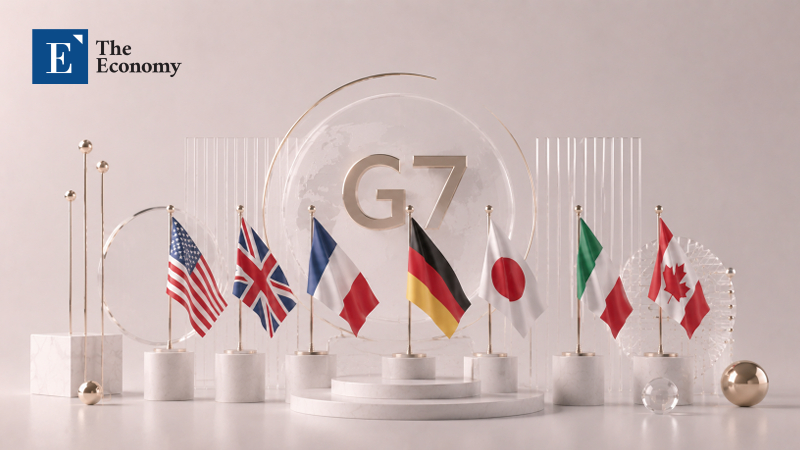
The principal agenda items of the Group of Seven (G7) summit underway in France have come into sharp focus. War, artificial intelligence (AI) governance, and supply-chain realignment—issues at the core of the international order—have taken center stage in discussions among Western powers. At the same time, resistance from the non-Western bloc led by China and Russia has surfaced outside the conference venue. China has characterized the G7 as an “exclusive club of a handful of countries,” promoting multipolarity and representation of the Global South, while leveraging the Shanghai Cooperation Organisation (SCO) to elevate the profile of an alternative platform challenging the Western-led order.
Key Agenda Items at the G7 Summit
According to international media outlets including the Associated Press on June 17 (local time), one of the defining variables of the G7 summit, which has been taking place in Évian-les-Bains, France, since June 15, was the provisional ceasefire agreement between the United States and Iran. U.S. President Donald Trump announced an agreement to end the conflict with Iran shortly before arriving in Évian-les-Bains, effectively steering the summit’s early discussions toward Middle East stability and the reopening of navigation through the Strait of Hormuz. In an official geopolitical statement, G7 leaders described the U.S.-Iran agreement as a “historic opportunity” and expressed support for follow-up diplomatic negotiations aimed at preventing Iran from acquiring nuclear weapons. They also stated that a multinational, defensive maritime security initiative led by France and the United Kingdom could contribute to restoring commercial shipping traffic through the Strait of Hormuz and verifying mine-clearing operations.
Discussions related to Ukraine centered on strengthening pressure on Russia and expanding air-defense assistance. The G7 geopolitical statement reaffirmed its “unwavering support” for Ukraine’s freedom, sovereignty, and territorial integrity and pledged increased support for air-defense capabilities and interception systems. The statement also included provisions covering the potential licensing of military production to expand Ukraine’s defense manufacturing capacity, support for winter energy resilience, and additional sanctions targeting Russia’s wartime economy. Middle Eastern media outlet Al Jazeera reported that President Trump met with Ukrainian President Volodymyr Zelensky, who attended as a guest leader, and stated that he would “do what he can to end the war.” The Guardian reported that European leaders urged Trump to facilitate direct talks between Ukraine and Russia in an effort to break the diplomatic deadlock.
Although overshadowed by wartime developments, AI remained one of the summit’s longer-term strategic issues. According to Reuters, France invited executives from leading AI firms including OpenAI, Google, Anthropic, and Mistral AI to engage with world leaders on technology regulation, AI infrastructure, networks, and online safety. The discussions represent a continuation of the AI and digital agenda adopted by G7 digital and technology ministers during a meeting last month. At that gathering, ministers identified safe AI development, broader AI adoption, digital-sector resilience, resource efficiency, and online protection for minors as priority objectives. Protection of minors online was a particularly strong focus of the French presidency.
China Launches a Scathing Attack on the G7
While Western allies continued deliberations on major international challenges, China openly displayed its hostility toward the G7. Despite being the world’s second-largest economy, China is not a member of the group. The country maintains a one-party Communist political system and imposes significant restrictions on freedom of expression, media freedom, civil liberties, and political rights compared with G7 nations. As a result, it does not share the political values commonly embraced by G7 members. Beyond ideological differences, China and the G7 countries have been engaged in years of disputes over trade, advanced technology, supply chains, and security issues. Tensions have intensified further in recent years over Chinese industrial subsidies, Taiwan, and Beijing’s relationship with Russia.
On June 15, China’s state-run Global Times published a commentary stating that “the G7 summit is often portrayed as a hypocritical, self-interested, and disconnected group,” adding that “as global dynamics evolve and multipolarity accelerates, the G7 is increasingly exhibiting chronic symptoms of misperception and functional decline.” The article argued that despite facing sluggish economic growth, elevated debt levels, declining industrial competitiveness, and deepening social divisions, G7 members remain embroiled in internal disputes and struggle to forge common positions due to declining European trust in the United States.
The Global Times further argued that “rather than reflecting on its declining capabilities and cohesion, the G7 has included topics such as trade imbalances, overcapacity, mineral alliances, and de-risking on its agenda in an effort to contain China.” The commentary emphasized that addressing many of today’s global challenges—including industrial supply-chain restructuring and energy security—requires the participation of the Global South, including China. It also asserted that “at a time when the Global South has become a central force driving global development, it is unrealistic for a group representing less than 10% of the world’s population and a shrinking share of global GDP to portray itself as the ‘leader of the world’ or attempt to package its own interests as ‘international rules.’” The article concluded that today’s global challenges can no longer be managed by a single bloc or a “small-group system,” advocating instead for an equal and orderly multipolar world and a more inclusive model of economic globalization.
SCO Signals Its Anti-Western Orientation
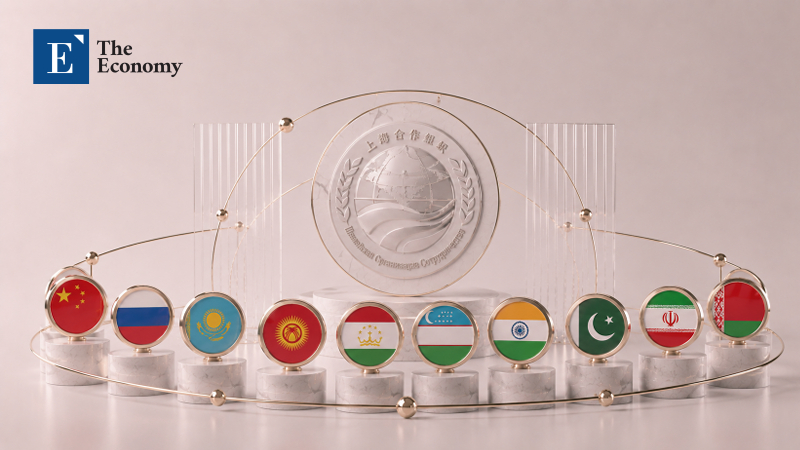
Other countries aligned with the broader anti-Western camp also joined China in pushing back against the G7. On the opening day of the summit, the SCO—led by China and Russia—held a ceremony marking its 25th anniversary. Founded in Shanghai in June 2001 to promote stability in Central Asia, the SCO has increasingly taken on the character of an alternative order to the West as U.S.-China strategic competition has intensified and developing countries across the Global South have joined its ranks. The organization’s founding members were China, Russia, Kazakhstan, Kyrgyzstan, Tajikistan, and Uzbekistan. India, Pakistan, Iran, and Belarus later joined, bringing total membership to ten countries.
The event was more than a commemorative gathering; it served as a showcase for the coalition China has cultivated as a counterweight to Western institutions centered around the G7. While not a military alliance, the SCO has expanded cooperation among member states through summits, meetings of foreign, defense, and security officials, counterterrorism mechanisms, and forums focused on economic, digital, and supply-chain cooperation. In recent years, Russia, Iran, and Belarus—countries that have faced direct confrontation with the West—have increasingly emerged as a core grouping within the organization. Central Asian nations have also moved closer to the SCO on issues ranging from security and energy to logistics. China presents this framework as a model of multipolarity and non-interference in domestic affairs, while Russia has used it as a platform to ease diplomatic isolation under Western sanctions.
Nevertheless, not all SCO members can be considered Chinese allies. India, for example, remains an SCO member while simultaneously deepening security cooperation with the United States, Japan, and Australia. Central Asian countries likewise continue to balance relations between China and Russia. Internal interests across the organization are far from uniform. Russia seeks avenues to circumvent sanctions and preserve diplomatic space; Iran is searching for strategic insulation from Western pressure; and Central Asian states aim to capitalize on both Chinese investment and Russian security influence. From Beijing’s perspective, managing these countries as a flexible alignment united by dissatisfaction with the G7 and the U.S.-led order is more advantageous than attempting to forge a formal military alliance. In practice, the SCO functions less like a NATO-style collective defense arrangement and more like a loose platform through which countries dissatisfied with the West coordinate on specific issues.
Aoife Brennan is a contributing writer for The Economy, with a focus on education, youth, and societal change. Based in Limerick, she holds a degree in political communication from Queen’s University Belfast. Aoife’s work draws connections between cultural narratives and public discourse in Europe and Asia.
Similar Post