The End of the Semiconductor ‘Death Cycle’? The Return of the ‘New Economy’ Narrative

Matthew Reuter is a senior economic correspondent at The Economy, where he covers global financial markets, emerging technologies, and cross-border trade dynamics. With over a decade of experience reporting from major financial hubs—including London, New York, and Hong Kong—Matthew has developed a reputation for breaking complex economic stories into sharp, accessible narratives. Before joining The Economy, he worked at a leading European financial daily, where his investigative reporting on post-crisis banking reforms earned him recognition from the European Press Association. A graduate of the London School of Economics, Matthew holds dual degrees in economics and international relations. He is particularly interested in how data science and AI are reshaping market analysis and policymaking, often blending quantitative insights into his articles. Outside journalism, Matthew frequently moderates panels at global finance summits and guest lectures on financial journalism at top universities.
Authored On
Modified
Memory Industry Reshaped Around HBM
Simultaneous Expansion of Oversupply Risks and Demand Concentration
AI Supercycle Debate Echoes the New Economy Narrative

A growing number of analysts argue that the “death cycle” that has long weighed on the global memory semiconductor industry through repeated booms and busts may be coming to an end. As memory semiconductors evolve into indispensable components in the age of artificial intelligence (AI), led by High Bandwidth Memory (HBM), the industry is expected to experience gradual soft landings rather than severe downturns during periods of weakening demand. Yet expectations that technological innovation can rewrite the rules of economic cycles are not new. The most notable example was the “New Economy” boom that swept through the United States during the internet revolution. At the time, markets were convinced that technological advances would weaken business cycles. That optimism ultimately collapsed alongside the bursting of the dot-com bubble.
UBS “A Mild Downcycle Expected in 2029, With a Soft Landing Rather Than a Collapse”
According to market research firm Counterpoint Research on June 16, global DRAM revenue, including HBM, reached $97 billion in the first quarter of this year, up 80% from the previous quarter. The figure approached the $100 billion mark and surged 260% year-over-year. Samsung Electronics maintained its leadership position with a 38% market share, followed by SK hynix at 29% and U.S.-based Micron Technology at 22%.
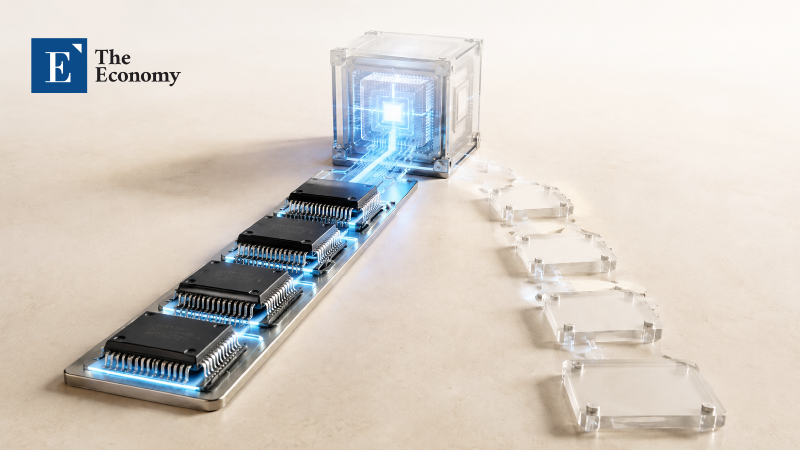
All three companies are survivors that have endured multiple downturn cycles over the past decades. Since 2020, the trio has effectively maintained a degree of pricing discipline through production cuts, output adjustments, and process conversions whenever signs of oversupply emerged in the DRAM and NAND flash markets. Their capital expenditure strategies have also changed. Rather than constructing new fabrication facilities, the companies have focused on conservative capacity expansion through process conversions, shifting commodity DRAM production to HBM and migrating Double Data Rate (DDR) products to DDR5. New fabrication plants can unleash massive supply within two to three years after construction begins, while process conversions deliver productivity gains with far more limited increases in overall supply.
The emergence of HBM, a critical component for AI infrastructure, has further strengthened the industry's fundamentals. Samsung Electronics and SK hynix currently allocate roughly 30% to 40% of their total DRAM output to HBM production. As a result, supply of conventional DRAM used in PCs, mobile devices, and servers has tightened, driving sustained price increases. Market research firm TrendForce projects that memory shortages will persist through 2027, citing AI data center demand and conservative capital spending.
Some analysts believe the boom could last even longer than previously expected. According to Investing.com, global investment bank UBS recently stated in a report that “memory shortages driven by expanding AI infrastructure investment will continue through the first half of 2028.” UBS extended its previous forecast by roughly six months, having earlier projected shortages through the end of next year. The bank added that “a mild downcycle is likely to emerge in 2029,” forecasting a soft landing within a prolonged expansion rather than a sharp downturn reminiscent of previous cycles. UBS cited the fact that HBM capacity from Samsung Electronics, SK hynix, and Micron has already been fully booked for the next three years through long-term contracts. The bank argued that the likelihood of severe price collapses caused by demand forecasting errors has consequently diminished.
Downside Risks Mount Amid Big Tech Dependence and Chinese Competition
Despite the optimism surrounding the semiconductor boom, significant risks remain. Revenue and operating profit dependence on a handful of Big Tech companies has become increasingly concentrated. A single purchasing decision by a small number of hyperscale technology firms now has the potential to influence global memory supply and demand dynamics. SK hynix, for example, is estimated to derive nearly 30% of its revenue from Nvidia. The influence of purchasing volumes and pricing decisions by major customers such as Nvidia and Broadcom is likely to become even more pronounced.
Big Tech efforts to develop proprietary memory solutions also represent a risk factor. Google continues to expand its ecosystem around custom AI server chips known as Tensor Processing Units (TPUs), while Amazon Web Services (AWS) is accelerating deployment of AI infrastructure based on its Trainium and Inferentia platforms. Meta and Microsoft are likewise increasing research into memory architecture optimization to improve AI data center efficiency. Although no technology currently exists that can replace HBM, efforts by customers to reduce dependence on specific suppliers over the long term could weaken the bargaining power of memory manufacturers.
China also remains an important variable. ChangXin Memory Technologies (CXMT), China’s largest DRAM producer, is simultaneously expanding DDR5 production and manufacturing capacity while working to narrow the technology gap with substantial support from the Chinese government. Chinese manufacturers have already established a growing presence in the commodity DRAM segment. While U.S. semiconductor export restrictions continue to limit access to advanced HBM technologies, analysts note that expanded supply of commodity products by Chinese firms could once again intensify pricing pressure in portions of the market.
Industry observers also warn that the capacity expansion race now accelerating amid the AI boom could ultimately create another oversupply cycle over the medium to long term. AI is transforming end-market demand, yet memory semiconductors remain fundamentally a capital-intensive supply industry dependent on massive upfront investment. In that sense, the underlying cyclical nature of the business has not fundamentally changed. Micron, for example, is pursuing approximately $200 billion in new fabrication facilities across Virginia, Idaho, and New York. Industry participants believe that if these large-scale facilities begin operating simultaneously after the current boom while AI hyperscalers slow their investment pace, the market could quickly enter another phase of severe oversupply.
Claims That New Technology Eliminates Economic Cycles Vanished Alongside the Collapse of the ‘New Economy’ Theory
Moreover, the optimism currently circulating in the market rests on a conviction that resembles the New Economy narrative of the late 1990s. During that period, a growing consensus emerged in the United States that the internet and information technology revolution were fundamentally changing the mechanics of the economy. As productivity improved rapidly through the proliferation of personal computers, commercialization of the internet, and growth of the software industry, both Wall Street and academia increasingly argued that the business cycle patterns of the industrial era were weakening. The U.S. economy subsequently enjoyed nearly a decade of expansion following the 1991 recession and absorbed the shocks of the 1997 Asian financial crisis and the 1998 Russian financial crisis relatively quickly.
Alan Greenspan, then chairman of the Federal Reserve, repeatedly stated that IT innovation was driving productivity gains. Markets interpreted those remarks as evidence of a structural improvement in the economy. Unemployment fell to around 4%, while inflationary pressures remained contained. The resulting environment of strong growth and low inflation gave rise to the New Economy narrative, which argued that the United States had entered a fundamentally new stage of economic development.
The stock market reflected these expectations. Investors began assigning greater value to internet user growth and market share potential than to corporate profitability. Even loss-making companies received astronomical valuations based on future growth prospects. As a result, the Nasdaq Composite surged more than 400% between 1995 and early 2000, while optimism that technological innovation would replace the traditional economic order came to dominate financial markets.
Following the collapse of the dot-com bubble in 2000, however, market perceptions changed dramatically. Internet innovation itself proved real, but corporate valuations and investment levels ultimately remained bound by the realities of profitability and cash flow. The 2008 global financial crisis further discredited the notion that business cycles had disappeared. The experience demonstrated that technological progress can raise an economy’s long-term growth potential, but it cannot eliminate investment cycles or asset price volatility.
The current narrative surrounding the memory market’s “AI supercycle” rests on a similar foundation of expectations. A widespread belief has taken hold that supply shortages, long-term contracts, and expanding Big Tech capital expenditures have largely removed the possibility of significant price declines. Yet the sustainability of AI infrastructure investment remains insufficiently tested. JPMorgan estimates that AI-related capital expenditures by major technology firms will rise from $650 billion in 2026 to $1.1 trillion in 2027, while total AI investment could reach $5.5 trillion by 2030. Goldman Sachs likewise projects that hyperscaler investment could climb to $770 billion in 2026, potentially absorbing most operating cash flow.
If AI investment increasingly depends on funding from debt and equity markets rather than internally generated cash flow, memory demand may become more sensitive to financial conditions than to underlying technological demand. The AI infrastructure ecosystem has already become increasingly reliant on debt financing. According to Bloomberg, AI and data center-related debt issuance exceeded $300 billion this year, while an estimated $4.1 trillion of the projected $5.5 trillion in AI capital expenditures through 2030 is expected to be financed through borrowing. Nvidia’s recent large-scale corporate bond issuance further illustrates how financing for AI infrastructure competition is shifting from cash-flow-based funding toward capital market funding. If interest rates, credit spreads, or investor risk appetite deteriorate, HBM long-term contracts and data center orders could face simultaneous reassessment.
Matthew Reuter is a senior economic correspondent at The Economy, where he covers global financial markets, emerging technologies, and cross-border trade dynamics. With over a decade of experience reporting from major financial hubs—including London, New York, and Hong Kong—Matthew has developed a reputation for breaking complex economic stories into sharp, accessible narratives. Before joining The Economy, he worked at a leading European financial daily, where his investigative reporting on post-crisis banking reforms earned him recognition from the European Press Association. A graduate of the London School of Economics, Matthew holds dual degrees in economics and international relations. He is particularly interested in how data science and AI are reshaping market analysis and policymaking, often blending quantitative insights into his articles. Outside journalism, Matthew frequently moderates panels at global finance summits and guest lectures on financial journalism at top universities.
Similar Post