Hybrid Work Productivity Depends on Design, Not Office Days

Working across research, policy, and data-driven analysis, the Editorial Board ensures that published pieces reflect a consistent institutional perspective grounded in quantitative reasoning and long-term structural assessment.
Authored On
Modified
Occasional office contact can strengthen remote teams
No single work model suits every role
Hybrid productivity depends on purposeful design

During a nine-month experiment with a remote customer-services team in Turkey, one office day a month was associated with an 8 percent increase in productivity and a 33 percent reduction in staff turnover. That's a remarkable result given how small an intervention it was. The staff returned to the office one day a month, but over that time kept the same pay, targets, training, shifts and call systems. The only change was one office day a month. But it does not prove a universal prescription for all remote teams. It does prove something more practical. The productivity of hybrid work is less influenced by the number of office days than by what those days can fix. In this case, contact, feedback and trust were re-established. The broader lesson is that remote, hybrid and office work are not antagonistic ideologies. They are operating models. They come with advantages, risks and management costs. The best mode depends on the task, the team and the contract that supports them.
Hybrid Work Productivity Is a Management Outcome
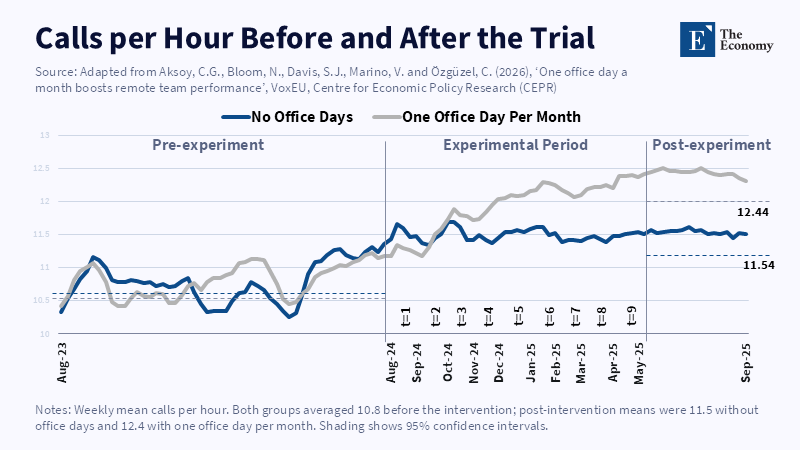
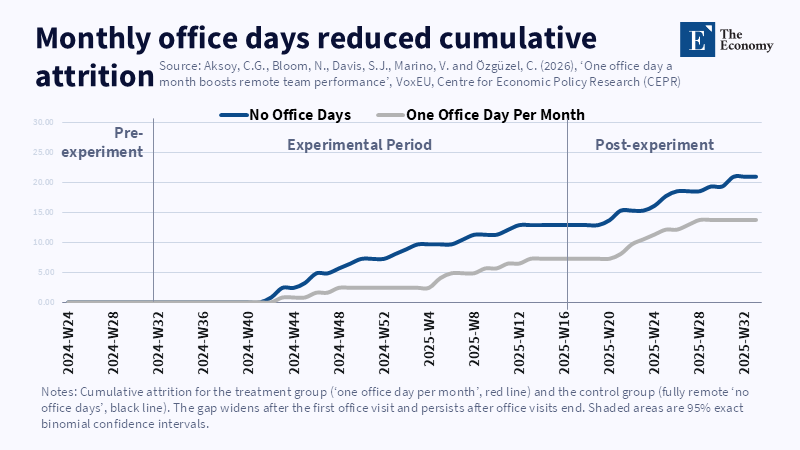
The trial isolates the value of face-to-face from office proximity. The study followed 248 employees of a fully remote inbound call center team. Half were randomly assigned to have one designated in-office day per month; the others remained entirely remote. Pre-study call rates were around 10.8 per hour for both groups. Five months after the visits were stopped, call rates had increased to 12.4 per hour among those with designated days in the office versus 11.5 per hour for the wholly remote group. Customer scores and internal quality assessments did not decline. Employees with designated days also reported an increase of 36 minutes of weekly contact with close colleagues. Turnover was 13.7 percent versus 21 percent. The benefit built gradually and persisted long after the designated days were discontinued. This argues against a short-lived novelty effect. It argues for improved relationship-building, feedback and team bonding.
The useful policy claim is, of course, narrower than "hybrid is best." An office meeting can be valuable when work relies on ongoing communication, but can be completed solo for most of each month. It can enable a manager to see confusion before it becomes an error. It can make subsequent online exchanges go more smoothly because colleagues know who they are talking to, how they use words and what they care about. It can even build a modest stock of trust that makes remote disagreements less expensive. But the same visit may be nearly useless in a team whose members already know one another, a team whose duties are almost entirely independent, or one in which staff are scattered to the far corners. Hybrid productivity improves only when attendance solves a genuine coordination problem: visiting without a clear reason adds expense, disturbance and delay while leaving the fundamental issue unaddressed.
This distinction is important because many organizations still treat place as a stand-in for performance. Managers looking for signs of performance look for occupancy rather than the feedback a work system provides in a timely manner; useful records, fair targets and opportunities for help. While this worked in the old office contract, it is less convincing in a hybrid-remote workplace. A new place-based contract would have to specify much more than hours and rates: where work was to take place, which events required people to be there, how much warning to get, how to be reimbursed, how to measure output and so on. It would also have to make sure remote contributors are not neglected in the office room talk. Flexibility alone does not create productivity in a hybrid setting; the management system does.
The Same Schedule Produces Different Results
One Turkish customer-service experiment cannot determine policy for software teams, hospitals, banks, schools, design studios, or other government bodies. Work content influences the value of place. A call center can produce data on calls per hour, audit scores, or customer survey results. Creative work has longer cycles measures are more elusive. Sometimes junior staff want rapid, tangible feedback; that can be hard to schedule. Senior staff working on high-value, low-volume content need serious time alone. Researchers showed how proximity among software developers increased coding feedback by 18.3 percent and if that attention was given to others, it reduced code productivity. Gains were larger among less experienced engineers. Experienced workers yielded less code when working with colleagues because they migrated to helping. The office may promote learning, but learning can have a short-term penalty.
Role level, therefore, rises to the heart of hybrid design. New hires or those being trained up, or those moving into unfamiliar work or environments, probably need intensive contact for a short while. Those who are deploying established skills on a reasonably full plate probably need less. And managers need office time to give coaching, resolve conflicts and plan, rather than to monitor whether the laptops are switched on. A fixed rule for all staff can hide these distinctions. It may demand a lot of travel for the senior team while leaving the juniors lacking on crucial days. So a more nuanced approach varies contact level with the nature of work and career progression. It can increase proximity on induction, launching a new product, an audit, or a new team structure, then ease back when the pattern settles. The needs of work determine the contact pattern, not vice versa.
National culture and local context also make such findings difficult to transfer. Remote-working arrangements are more prevalent where jobs are digital, house design is conducive to a dedicated at-home workspace, broadband coverage is good and firms have transparent performance management systems. Less so where households are crowded, travel preferences differ, managers depend on direct supervision, or work is oriented around the customer or a machine. A survey of 16,422 college-educated workers from 40 countries conducted in 2025 established that post-2022, the proportion of workers working predominantly from home had plateaued but still varied significantly across them. British data exposes the same domestic dichotomy. As of early 2025, 41 percent of bachelor-qualified workers worked in a hybrid arrangement, in contrast to 4 percent of non-qualified workers. Close to half of those earning 50,000 or more worked exclusively from home, in contrast to 8 percent of those earning less than 20,000. The current public opinion discourse about the office is therefore a discourse about profession, pay, affordability and inequality. A universal precept risks only widening the gap between the people left with the flexibility and the people doing work that can never leave the premises.
Remote, Hybrid and Office Work Each Carry Costs
Going completely remote has obvious benefits. It reduces much travel, allows firms to access a broader talent pool and can offer workers more control over care, health and lifestyle. Even in 2025, homework still represented around one-quarter of paid working days for Americans aged 20 to 64. For British home-workers, that saved an average of 56 minutes on days without travel. That is not nothing. That time can be spent resting, running, caring for family and friends, or undertaking more paid work. Booked remotely, firms can also profit from skills that are hard to find in over-inflated high-cost cities. For some, an entirely remote working arrangement is likely to be ideal, especially for those with quiet requirements, an appropriate home office setup, or the means to endure a lengthy commute. It can also be a prescription for benefiting from less company politics and avoiding the mental stress of nonstop social contact.
Its cost is not less tangible. Fully remote firms can suffer from a lack of social learning, scattered support, thin mental links and long lines of scheduled calls. New staff can feel unsure of whom to turn to. The manager can notice an issue only later when output declines. Some workers feel isolated; others feel over-monitored. A review of US evidence put fully remote work at nearly 10 percent lower productivity than fully in-office work, though lower property costs and broader recruiting might still make the model viable. However, that average cannot be used as a deciding factor for one remote job. It combines firms and jobs. However, it demonstrates why remote work demands careful written protocols, good onboarding, clear aims and forward planning for meetings. Take away the office and you take away an obstacle and a support. Companies need to explicitly recreate useful support remotely.
Full-time office work solves some of those problems at the cost of others. It makes quick questions, coaching and social learning easier. It can enable work with secured systems, tools in hand, live customers and fast group decisions. It can also build a shared context for conflict settlement and shared identity. However, presence in the office is not the same as effective contact. Staff may commute an hour only to sit in 8 hours of video links with engineers in another location. An open office breaks concentration. Long commutes leave less time and energy for work and family. Office norms can also reduce the talent they attract and exclude those who need an office work-life balance. A 2024 RCT with 1612 employees at a Chinese tech corporation found that working from home 2 days a week reduced quit rates by one third and increased satisfaction without dropping output, promotion rates or code lines.
Hybrid work is a blend of these two models, but by itself does not guarantee to unify only their positive aspects. A dysfunctional hybrid system can add hours of commuting to a schedule already packed with online meetings, split workplaces into those that are physically present and those connected through a screen, incentivize showing up over producing and stir resentment when policies are altered without discussion or the stated rationale is "culture," even as the day in the office holds no joint enterprise. Personal worker explanations demonstrate both extremes. Some complain of conflicts with their significant other and lower morale after emerging from momentary contact. Others say it is time and money wasted in commuting, worsened concentration and no water cooler time with the right people. Although anecdotal, worker reports expose the qualitative dimension of the morale penalty that the mean cannot. Hybrid work needs productivity when workers are paid but do not see their payment.
Build the Contract Around the Work
The pragmatic answer is not to say one is best but to charge for management overhead and see if the benefit is justified. Any remote system requires more elaborate documentation, conscious mentoring, sound digital access and planned social contact. The office system requires room, time spent traveling, local recruiting and insulation against intrusions. The hybrid system involves the overhead of any two systems plus the management of the two. Managers need to begin with the issue. Is turnover high? Is learning slow? Are false positives increasing because no one answers questions? Is originality falling, or do they only seem to look worried? The response should be in proportion to the issue. Monthly team days may suffice for a stable service team. Two exhausting weeks may be needed every year for a new product team. Quarterly planning sessions may be all a senior analyst needs. The laboratory setting may be best situated on-site.
The contract must then make that design believable. Attendance will be associated with specific purposes: training, planning, client work and team repair. No surprises on dates. Teams attending together. Remote access is protected for those who cannot be present. Promotion and incentive systems based on recorded output and agreed criteria rather than opportunistic watch. Firms measure a handful of outcomes before and after change: output, quality, absenteeism, attrition, spend on hiring, employee sentiment and the cost of running the office. These metrics are disaggregated by role, length of service and commute distance. The same data is published to staff before the next policy cycle. This is not too much of a measurement. It is the minimum information necessary to evaluate a work model.
One office day a month produced a big return in one remote team because that day created contacts the system lacked. The number is not a universal formula; it is a warning against rigid rules on both sides. Remote work should not be a permanent exile. Hybrid work should not be routine travel without aim. Office work should not be justified by tradition alone. The resilient model will be that which regards the location as integral to job design and employment contract, rather than as a gauge of fidelity. Companies should conduct small tests, quantify the inclusive costs and retain only that which enhances labor productivity. The next phase of hybrid working will not be generated by saturating work with office days. It will be cultivated by making each day, anywhere in the world, tackle a definite challenge.
The views expressed in this article are those of the author(s) and do not necessarily reflect the official position of The Economy or its affiliates.
References
Advisory – Operation Desk (2026) ‘Operations & Transformation Advisory Industry Outlook 2026: Productivity, AI-Native Operating Models, and the Return of Execution Discipline’, Advisory Ranking, 31 January.
Aksoy, C.G., Barrero, J.M., Bloom, N., Davis, S.J., Dolls, M. and Zarate, P. (2025a) ‘The global persistence of work from home’, Proceedings of the National Academy of Sciences, 122(27), e2509892122.
Aksoy, C.G., Bloom, N., Davis, S.J., Marino, V. and Özgüzel, C. (2025b) ‘Fully remote work expands recruitment and boosts productivity’, VoxEU, 1 June.
Aksoy, C.G., Bloom, N., Davis, S.J., Marino, V. and Özgüzel, C. (2026a) ‘The value of one office day a month’, CEPR Discussion Paper, No. 21597.
Aksoy, C.G., Bloom, N., Davis, S.J., Marino, V. and Özgüzel, C. (2026b) ‘One office day a month boosts remote team performance’, VoxEU, 23 June.
Barrero, J.M., Bloom, N. and Davis, S.J. (2023) ‘The evolution of work from home’, Journal of Economic Perspectives, 37(4), pp. 23–50.
Battiston, D., Blanes i Vidal, J. and Kirchmaier, T. (2021) ‘Face-to-face communication in organizations’, The Review of Economic Studies, 88(2), pp. 574–609.
Bloom, N., Han, R. and Liang, J. (2024) ‘Hybrid working from home improves retention without damaging performance’, Nature, 630(8018), pp. 920–925.
Buckman, S.R., Barrero, J.M., Bloom, N. and Davis, S.J. (2025) ‘Measuring work from home’, NBER Working Paper, No. 33508.
Emanuel, N., Harrington, E. and Pallais, A. (2023) ‘The power of proximity to coworkers’, NBER Working Paper, No. 31880, revised December 2025.
Esade (2025) ‘Remote or in-office work? The future lies in a better hybrid model’, Forbes, 20 November.
Office for National Statistics (2024) ‘Who are the hybrid workers?’, Office for National Statistics, 11 November.
Office for National Statistics (2025) ‘Who has access to hybrid work in Great Britain?’, Office for National Statistics, 11 June.
Working across research, policy, and data-driven analysis, the Editorial Board ensures that published pieces reflect a consistent institutional perspective grounded in quantitative reasoning and long-term structural assessment.