The Broadband Problem Is an Attention Problem

Working across research, policy, and data-driven analysis, the Editorial Board ensures that published pieces reflect a consistent institutional perspective grounded in quantitative reasoning and long-term structural assessment.
Authored On
Modified
Faster broadband can reshape the home environment
Caregiver attention is a key developmental channel
Digital restrictions need stronger offline alternatives

A ten-point increase in a young child's cumulative broadband exposure was associated with a decrease in communication, problem-solving, personal-social and socio-emotional scores. That evidence does not prove internet access causes autism. It proves something more valuable to policymakers: high-speed internet can alter the home environment during a crucial period when children develop speech, trust, play and self-control. The risk is not only the screen in a child's hands. It is also the book that remains unopened, the question that goes unanswered, the game that is cut short and the gaze that drifts away. Over the past twenty years, digital policy has focused on access. The task ahead is more challenging. It involves determining what broadband truly contributes to family life and what it quietly displaces. Hence, early childhood internet exposure should be regarded not just as a technology issue, but as an issue of attention and development.
What Uruguay Reveals About Early Childhood Internet Exposure
Uruguay provided a particularly good test of this story. Starting in 2010, the state-owned telecommunications operator ANTEL rolled out fiber-to-the-home across the country. It added coverage to new neighborhoods according to engineering and infrastructure requirements, rather than according to which families wanted higher speeds first. By 2018, fiber reached 83% of eligible households. Researchers were able to study children of the same age living in similar areas but born in different years and therefore exposed to different levels of fiber availability in early childhood. The focus was on children aged zero to five, an age at which language, emotional control, social trust and basic reasoning are learned through repeated interactions with adults and other children. This approach overcomes what is perhaps the biggest flaw with screen studies: the tendency of early adopters to look different from late adopters. In Uruguay, the timing was dictated mainly by the rollout of the network.
Greater cumulative fiber exposure was associated with lower estimated scores in communication, problem-solving, personal-social and socio-emotional domains. Motor development did not seem to follow this same broad pattern. That distinction matters. The most affected domains were those that rely on conversation, response, imitation, shared attention and social practice.
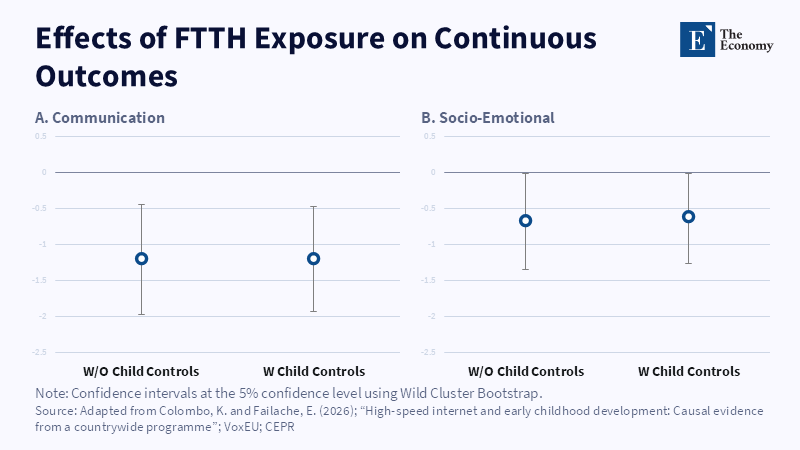
The study neither showed that every child was harmed nor provided evidence that fiber access resulted in a definitive developmental deficit. It found that greater exposure to high-speed internet was associated with lower scores in a wide range of social and cognitive skills. Fiber access is not equivalent to an exact number of minutes online. What occurs in the wider household environment matters and high-speed access can alter parental routines and the time available for slow, one-to-one interaction. A child can lose developmental input without ever holding a phone.
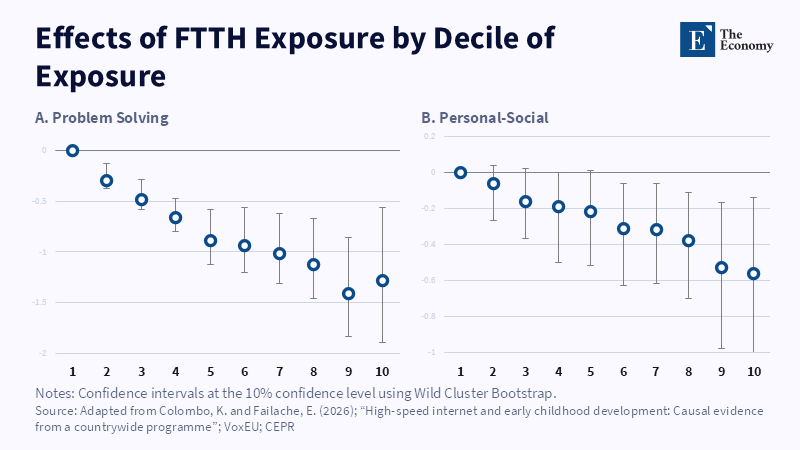
The Main Risk Is Displaced Human Attention
The strongest clue was what changed in the child's environment. Homes with greater fiber availability had fewer children's books, while adult internet use increased. The data did not show a clear increase in the share of children said to spend more than an hour a day on screen media, although that measure had limited precision. Displacement was more revealing. Broadband appeared to have altered activities within homes and what they contained. A parent checking or texting on a device while with a child can unsettle the rhythm of turn-taking in a game. A television running in the background can weaken conversation. A connected adult can be physically there but not fully available for the delicate exchanges through which a child learns words, social cues, turn-taking and patience. This link between early childhood internet exposure and divided attention is a place to begin.
Recent research seems to back this broader perspective. Extensive reviews have associated background TV, inappropriate content and parent device use during routines when a child was present with weaker cognitive and psychosocial outcomes. Shared use with an adult rather than solitary use may be more beneficial; a video call with a grandparent is not an endless feed. A brief educational program discussed with a caregiver differs from passive viewing while the adult remains absorbed in another device. Content, goal, context and social setting all influence effects. Research also links parental device use with poorer prosocial indicators, weaker attachment, more behavioral problems and more child screen time. Although effects are often modest, small disruptions can accumulate across daily early-life interactions.
This is very different from claiming autism can be caused by, transmitted by or spread through high-speed internet. The Uruguay study measured developmental screening outcomes. It did not measure autism. Using it as evidence of a link to autism is false and damaging. The valid question is narrower. It is about young children whose communication and social skills are limited by poorly managed digital exposure. These children, with professional and family support, can practice conversation, play, reading and imitation through shared rituals and routines. Human contact is good for development and should not be portrayed as a cure for autism or used as a rallying cry against digital technology.
Social Media Bans Need a Social Policy Behind Them
Western governments are already heading toward stronger restrictions on children's access to social media. Australia enacted an under-16 ban, while the UK has announced a similar plan. The bans relate to teenagers, not children aged zero to five and target social media, not broadband at home. The Uruguay evidence thus cannot establish that banning social media will enhance children's mental well-being, but it lends weight to why caution makes sense: digital environments can influence outcomes indirectly by altering routines, focus and communication. Waiting for a single diagnosis or a precise measure of screen time risks overlooking the network of harms. A ban can help reduce the pressure to join early, reframe social norms for the years ahead and put the onus on platforms.
Yet restriction is not a replacement. A Chinese review of Australia's policy indicated that young users could just go to other platforms or use VPNs that bypass restrictions. This does not mean bans failed. It shows that banning is not enough. Social needs and concerns do not vanish once an account is closed. They move elsewhere, often into less visible spaces where they are harder to monitor. Critics concerned about privacy, free speech, support and the loss of useful educational tools raise valid points. That is not a good enough reason to leave children with systems designed to capture and convert their attention. These are reasons to regulate design as well as age. Regulation should impose limits on the infinite scroll, autoplay, overnight alerts, targeted recommendations, contact with strangers and harmful content, reducing pressure on children without declaring all digital services equally dangerous.
The deeper test is the space after restriction. A child who is taken out of a feed and left alone has not gained social development. A family ordered to switch off devices and given no safe parks, libraries, childcare, time or money has been given a slogan. Social media constraints should be complemented by a social offer. Sports facilities, local clubs, free play sessions, staffed libraries, arts programs, youth clubs and safe outdoor spaces form part of digital policy by making offline life possible. For under-fives, the same ethos can be extended to shared reading, conversation, singing, outdoor play and device-free meals. The aim is not empty time. It is human exchange restored.
Protect Interaction, Not Digital Exclusion
The practical lesson for early-years services is straightforward. No guidance should end at maximum screen time or at lists of approved apps. Nurseries, clinics, family centers and preschool programs should explain how a child's opportunities for attention can be reduced by an adult's screen. Practitioners could lead by example with simple routines: phones put away during snack time, library books within easy reach, shared rather than individual media and pausing for a response after a child has spoken so that a genuine interaction can be formed. Developmental screening should ask where screens are used, not only for how long; questions could include background TV, whether an adult uses their phone in the play area and whether adults and children view media together. Administrators should assess whether staff have time to read, talk and play, rather than treating these activities as optional.
Policy must underpin the conditions under which attention is possible. A broad campaign cannot tell parents to read more when libraries close early and homes have no books. Governments can fund book distribution, home visits, parent groups, speech and language support, affordable preschool and community play areas alongside broadband expansion. Policy should not blame parents, especially mothers, for pressures they did not create. Many turn to their phones because work is unpredictable, essential services are online, relatives live far away and there is no one to look after the child. A device can provide income, translation, medical advice and communication with loved ones. Guilt is not the remedy; the remedy is reducing the cost of being present. Paid leave, predictable work, family support and safer public spaces can make that presence possible.
The opening finding should now guide collective action. Greater fiber exposure was followed by measurable declines in the very skills that response, talk and mutual attention help to build. This is not a reason to turn the lights out on modern life. Instead, it should serve as a reminder that connection has two meanings. A home can gain faster access at the expense of human encounters. Social media bans can, in theory, set boundaries, but remain incomplete if counts focus only on accounts blocked by service providers and policy ignores whether attention and relationships have been restored. Internet use in early childhood should be assessed by a simple principle: does the service facilitate interaction or does it displace it? The next phase of digital policy should defend books, play, conversation and care in childhood as strongly as it expands digital access.
The views expressed in this article are those of the author(s) and do not necessarily reflect the official position of The Economy or its affiliates.
References
Australian eSafety Commissioner (2026) ‘Social media age restrictions’. Canberra: Australian Government.
Colombo, K. and Failache, E. (2026a) ‘Is high-speed internet detrimental for early childhood development? Evidence from a countrywide program’, Journal of Development Economics, 183, 103843.
Colombo, K. and Failache, E. (2026b) ‘High-speed internet and early childhood development: Causal evidence from a countrywide programme’, VoxEU, 10 July.
Department for Science, Innovation and Technology, Kendall, L. and Starmer, K. (2026) ‘Social media to be banned for under-16s in landmark government move to give kids their childhood back’, GOV.UK, 15 June.
Jiang, X. (2026) ‘Social media bans alone won’t protect kids, Chinese report finds’, Sixth Tone, 8 July.
Kleinman, Z. (2026) ‘How the social media ban could reshape how all of us use the internet’, BBC News, 21 June.
Lee, N.T., Stewart, J. and Oxenstierna, C. (2025) ‘How will bans on social media affect children?’, Brookings Institution, 9 December.
Mallawaarachchi, S., Burley, J., Mavilidi, M., Howard, S.J., Straker, L., Kervin, L., Staton, S., Hayes, N., Machell, A., Torjinski, M., Brady, B., Thomas, G., Horwood, S., White, S.L.J., Zabatiero, J., Rivera, C. and Cliff, D. (2024) ‘Early childhood screen use contexts and cognitive and psychosocial outcomes: A systematic review and meta-analysis’, JAMA Pediatrics, 178(10), pp. 1017–1026.
Toledo-Vargas, M., Chong, K.H., Maddren, C.I., Howard, S.J., Wakefield, B. and Okely, A.D. (2025) ‘Parental technology use in a child’s presence and health and development in the early years: A systematic review and meta-analysis’, JAMA Pediatrics, 179(7), pp. 730–737.
World Health Organization (2025) ‘Autism’, WHO Fact Sheet, 17 September.
Working across research, policy, and data-driven analysis, the Editorial Board ensures that published pieces reflect a consistent institutional perspective grounded in quantitative reasoning and long-term structural assessment.