Remote Work Loneliness Is the New Cost of Flexibility

Working across research, policy, and data-driven analysis, the Editorial Board ensures that published pieces reflect a consistent institutional perspective grounded in quantitative reasoning and long-term structural assessment.
Authored On
Modified
Remote work loneliness shows that flexibility has a hidden social cost
Small talk is not office noise; it is part of how trust and learning move through work
The answer is not office nostalgia, but better social design for hybrid work

One in four workers who are capable of working remotely- that is, the workers who can work without coming to the office- regularly work alone for a full day without interacting with anyone. That is not a small change in daily life. It is an emergency indicator of a work culture that learned to protect focus but never learned to replace the contact. Remote loneliness in the workplace does not imply that workers are worse off at home or that the former offices were humane. It implies that now a portion of what counts as work has been shifted away faster than companies have been able to reshuffle how it is done- the thin layer of greetings, side-remarks, overheard doubts, jokes, pauses and quasi- personal interactions that made others seem real. These little interactions, costly as they may be, provided trust, mood, warning signals and context. A workplace culture that treats them as waste products might gain peace, but will also starve itself of social oxygen.
Remote Work Loneliness Is the Price Hidden in Flexibility
Unfortunately, the remote work debate is still caught in a battle of two catchphrases. On one hand, working from home is freedom, talent retention and cheaper office costs; on the other, it is laziness, weaker culture and less discipline. Neither recognizes a more fundamental problem. Remote work loneliness isn’t a productivity story; it is a communication story. The biggest loss isn’t the conference room; it is the desk chat before the meeting, the walk to the lift, the look that indicates confusion, the casual check-in after a tense call, the weak tie that later makes a tough request easier. Digital work keeps the task visible, but removes many of the human edges that surround a task. Text makes work sharper, but also colder; video translates faces, but not the soft rhythm of contact that emerges when people share space without a reason.

That matters because remote work is no longer a temporary shock. It has settled into a new work equilibrium. Worldwide survey evidence from 2023 to early 2025 indicates that homeworking has returned to about one day a week for college-educated employees, with a somewhat higher frequency observed in North America and parts of Europe. US figures exhibit significant variation depending on survey methodology; even after rigorous adjustment, an aggregated analysis of work points to a remote share of roughly one quarter of all paid workdays for employees aged 20-64. Firms have shown little tendency to reverse the trend widely. Planned return-to-the-office policies as of early 2025 were projected to affect only a small fraction of the overall U.S. Work-from-home ratio. Such social repercussions are more difficult to ignore. Temporary disruptions can be tolerated. A lasting work model needs social design.
Small Talk Is Quiet Infrastructure, Not Office Noise
Small talk is easy for critics to mock, as it rarely appears serious. A remark about the weather, a child, a train delay, or an awkward sandwich might not be work-related. It might become a way to hide cliques, position oneself in status games, or waste time. The more accurate way to think about such communication, instead, is as an unheralded kind of infrastructure. It sustains weaker ties. It informs workers which colleagues are welcoming, which ones are strained, which ones have a clue and which can be trusted with a half-finished query. In a hundred percent remote office, all these cues are lost. An employee never asks a fellow worker a tiny question because it is too formal to send as a message. A manager does not interpret a worker's online silence as concerning, but as normal.
It's not just emotionally based evidence: Social psychology has, for a long time, demonstrated that weak ties and brief encounters have outperformed expectations at improving mood and belonging. Workplace evidence says the same. In a study of engineers, proximity to co-workers generated 22% more online feedback one week into the pandemic, before offices were closed, though the output was digital. This number is significant because it demonstrates that proximity not only contributes to face-to-face interaction but also to digital collaboration, feedback, coaching and informal correction, which are often initiated by low-pressure interaction that lowers the cost of communication and problem-solving. When work is off-site by default, this tacit pathway for feedback and learning is attenuated. This effect will likely be most prominent among newcomers, junior workers and new hires entering a professional environment without the benefit of informally acquired network knowledge. Those workers not only need answers; they need guidance on tone, judgment, timing and the informal structure of who knows what. A dry professional manual can set out expectations, but it cannot stand in for the daily signals that keep a culture on course.
The critique is fair. Not every employee is delighted by more talking. Some perform best at work alone. Personal chit-chat would prove pointless, intrusive and exhausting for many "flying solo" workers. It may even subject them to office politics that they'd rather not endure. That's why compliance can't be the answer-cheerfulness and "fun" should not be mandated. The goal is not to romanticize the office. The goal is to allow choice, at the same time acknowledging that choice carries costs. An employee might opt for a more remote form of work and suffer from remote work loneliness in consequence. The benefits are tangible: no commute, fewer interruptions, increased control. The costs are intangible: fewer weak ties, less casual feedback, reduced sense of belonging and diminished communal feel of the organization as a community. Policy must be able to present both propositions simultaneously.
Remote Work Loneliness Does Not Affect Every Worker the Same Way
The first mistake is to think of remote work as a single state. It isn't. A parent with a long commute, a disabled worker, a caregiver, an extraverted senior manager with many networks and a newly arrived twenty-something in a new city do not all work from the same home. For some people, remote work is a form of true shelter. It alleviates the pain of travel, opens access and makes work possible for people the old office excluded. For others, it is the only regular social interaction they have in a day. The danger of remote work loneliness is that it is invisible when the employee still performs. Deliverables can be completed while social life atrophies. A jam-packed calendar can give the illusion of an overbooked person.
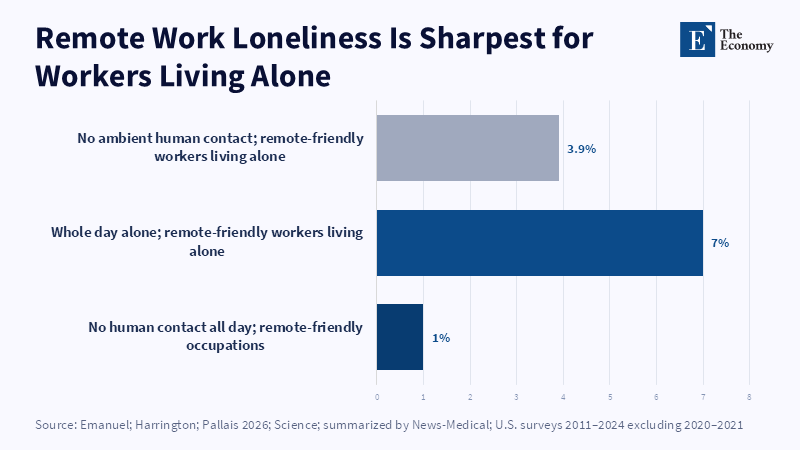
The above pattern has been strongly supported by more recent evidence. Analysis of five nationally representative surveys of U.S. workers conducted in 2011–2024 discovered that workers in jobs that could be performed remotely became more socially isolated following the switch than comparable workers doing jobs that could not be performed remotely in the same fashion. Within a population, the effect size on depression was not enormous for every individual experiencing it, but still significant at the population level. On a common index of psychological distress, the scores increased by about 0.1 standard deviations among remote-capable workers versus non-remote-capable workers. Among individuals living alone, the probability of an entire day spent with no social contact rose by 7 percentage points, or approximately 83%. The researchers also detected a rise in mental-health-care utilization and mental-health-related medication prescriptions, but not a rise in other types of health care, which reduces the likelihood of the finding solely reflecting greater access to healthcare providers.
This is also why an uninformed office mandate is a poor solution. Gallup research presents a paradox: fully remote workers say they are more engaged but thrive less overall than hybrid and on-premise remote-capable workers. Its 2024 global workplace report found loneliness among fully remote workers was higher than among fully on-premise workers. However, despite the potential for distance to harm the social connection that contributes to high functionality, working remotely or in a hybrid environment is popular. The cost savings of time, money, energy and autonomy are compelling enough to surmount here-and-now tradeoffs. The focal policy question is therefore not whether remoteness is good or evil but what groups of workers need in-person interaction, which tasks require shared space and what stages of careers require social scaffolding. Intelligent policy is grounded in that up-front segmentation and poor policy boils a host of issues into one rule and, in doing so, internalizes a social problem into a managerial problem. That does not sit well with workers, who have seen time and again how a mandate that claims to be an act of caring is actually an act of control.
Outside work, the same story. The social lives of some employees may have to be re-created. Jobs, running clubs, volunteering community groups, supervised study groups, car clubs, religious congregations, co-working spaces and side projects can help plug the gap. For ages, weekend fishing trips or backpacking groups have fulfilled that need; a remote culture must adapt the analogy. Yet this must not become an excuse for employers to hand out the responsibility to the worker. A full workday is not socially neutral; conceivably, the company can contribute to it as much as the individual. Adults also require private social lives, but managers retain the ability to help shape the make-up of everyday life.
The Better Policy Is Social Design, Not Return-to-Office Nostalgia
So the feasible response is social design. Hybrid work should not mean aiming to recreate the more chaotic office days, with people commuting just to find themselves on a telepresence call. It should mean intentional days for tasks that require trust, mentoring, conflict resolution, co-creation and onboarding. Off-site days should be shielded for deep work. Managers should normalize random contact without defaulting to old office pathologies, such as defaulting to suspect informal check-ins, peer office hours, rotation between small-team lunches, mentor pairs, coworking credits, or close-to-home meetups. Moving to a remote environment is a hostile environment for social support, so onboarding requires special attention. Organizations should not blindly wait for new workers to pick up cultural signs through Slack tone and schedule invites. They should track social connection as a worker risk metric, alongside burnout, retention and engagement metrics. The goal is not to measure friendships or regulate happiness, but to recognize when remote solitude is coalescing in new-hire, solo worker, recent graduate, or low-trust team groups before it starts translating to turnover, conflicts, or absences.
Policymakers will play a role. Changes in remote work reshape demand for transport, housing, local amenities and public space. They reshape adults' social infrastructure. Adult learning spaces, courts, libraries, community centers, sport and leisure facilities and cheap private-sector coworking spaces matter more where work no longer defaults to casual contact in shared space. Labor policy should foster flexible work rights-it must also support firms to cope with psychosocial risk. The coming wave of remote work policy should look beyond the individual right to work at home and take on a tougher question: what conditions make flexible work socially viable? Sector by sector, the answer will differ: corporate law practice, creative design, software, calling and public administration each need different rhythms. But intuitively, the principle is clear: it's not about making workers in full-time dependent employment cooped up in boxes-it's about enabling flexible work to enhance human autonomy.
Keep the initial statistic in mind. When a quarter of remote-enabled lives alone spend an entire day without any social interaction, the solution is not another communication medium. It is a failure to reconstruct the social fabric of work. The loneliness of remote work is not evidence against the notion of flexibility. It is evidence that the model was implemented as a location rule when it should have been a social rule. The pre-pandemic office was a time waster, but it also provided many with an effortless way to stay in touch. The new work paradigm needs a better deal. Keep the autonomy. Keep the quiet. Maintain the advantages for caregivers, disabled workers, parents and attentive staff. However, plan interactions with the same detail used to design workflows. Flexible work can be humane work. That should be the new norm.
The views expressed in this article are those of the author(s) and do not necessarily reflect the official position of The Economy or its affiliates.
References
Aksoy, C.G., Barrero, J.M., Bloom, N., Davis, S.J., Dolls, M. and Zarate, P. (2025) ‘The global persistence of work from home’, Proceedings of the National Academy of Sciences, 122(27).
Bachchhav, P. (2026) ‘Work from home is wrecking mental health, says new US study’, ThePrint.
Bishop, K. (2022) ‘Is remote work worse for wellbeing than people think?’, BBC Worklife.
Buckman, S.R., Barrero, J.M., Bloom, N. and Davis, S.J. (2025) ‘Measuring work from home’, NBER Working Paper No. 33508.
Emanuel, N., Harrington, E. and Pallais, A. (2026) ‘Home alone: Remote work, isolation, and mental health’, Science.
Emanuel, N., Harrington, E. and Pallais, A. (2026) ‘The power of proximity to coworkers’, The Quarterly Journal of Economics.
Gallup (2024) State of the Global Workplace: 2024 Report. Washington, DC: Gallup.
Mogensen, J.F. (2026) ‘Remote work is making Americans lonelier and sadder, new study suggests’, Scientific American.
Peninsula Group Limited (2025) ‘Ways remote working is damaging your mental health’, Peninsula AU.
Sandstrom, G.M. and Dunn, E.W. (2014) ‘Social interactions and well-being: The surprising power of weak ties’, Personality and Social Psychology Bulletin, 40(7), pp. 910–922.
Working across research, policy, and data-driven analysis, the Editorial Board ensures that published pieces reflect a consistent institutional perspective grounded in quantitative reasoning and long-term structural assessment.