"Power, Land and Water Savings" AI Infrastructure Heads Offshore as China Launches Underwater AI Data Center, Signaling Start of New Competition

Oliver Griffin is a policy and tech reporter at The Economy, focusing on the intersection of artificial intelligence, government regulation, and macroeconomic strategy. Based in Dublin, Oliver has reported extensively on European Union policy shifts and their ripple effects across global markets. Prior to joining The Economy, he covered technology policy for an international think tank, producing research cited by major institutions, including the OECD and IMF. Oliver studied political economy at Trinity College Dublin and later completed a master’s in data journalism at Columbia University. His reporting blends field interviews with rigorous statistical analysis, offering readers a nuanced understanding of how policy decisions shape industries and everyday lives. Beyond his newsroom work, Oliver contributes op-eds on ethics in AI and has been a guest commentator on BBC World and CNBC Europe.
Authored On
Modified
China officially opens offshore wind-powered underwater data center off Shanghai coast
Other countries including South Korea and the United States also pursue subsea AI infrastructure projects
Private-sector companies turn their attention to offshore data centers as early-stage competition intensifies
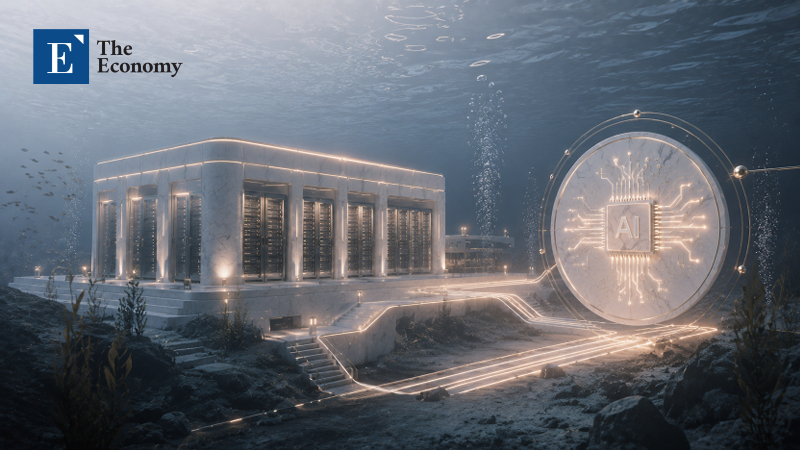
China’s underwater artificial intelligence (AI) data center project has entered full-scale operation. By deploying server units beneath the ocean surface, the facility addresses one of the most persistent constraints facing conventional land-based data centers—limited land availability—while minimizing electricity and water consumption through the use of clean energy and seawater cooling technologies. Similar underwater data center initiatives are emerging across multiple countries, while a growing number of private-sector firms are also moving into offshore infrastructure development.
China’s Underwater Data Center Initiative
According to energy-focused media outlet Oilprice on June 21, China recently officially inaugurated the Shanghai Lingang Underwater Data Center, the world’s first offshore wind-powered underwater data center. The facility was jointly developed by the data center specialist HighCloud Technology Team and state-owned China Communications Construction Company with a combined investment of $238 million. The project was built by installing 24-megawatt (MW) server units 10 meters below the ocean surface more than 16 kilometers off the coast of Shanghai.
The Lingang data center is directly connected to a 200MW offshore wind farm equipped with more than 50 turbines, allowing over 95% of its electricity consumption to be supplied by clean energy sources. Power demand is more than five times lower than that of a conventional land-based data center of comparable scale. The dramatic reduction in energy consumption is enabled by the natural cooling effect of cold seawater surrounding the servers and dissipating heat.
The structure also delivers meaningful reductions in water consumption. Conventional land-based data centers allocate roughly 25% to 40% of their total electricity demand to cooling-water circulation systems designed to remove heat generated by AI computing workloads. The United Nations University Institute for Water, Environment and Health (UNU-INWEH) recently projected that the global water footprint of data centers could reach 9.3 trillion liters by 2030. Underwater data centers, by contrast, utilize seawater indirectly and can prevent equipment overheating without consuming any freshwater resources.
Similar Efforts Emerging Worldwide
China is far from the only country pursuing such initiatives. One of the most notable precedents is Microsoft’s Project Natick, launched during the 2010s. The experimental program involved installing sealed data centers on the seabed. The design utilized freshwater-filled heat exchangers to absorb heat from enclosed servers, while external heat exchangers transferred that heat to surrounding seawater. Microsoft operated its first test facility off the coast of California in 2015 before deploying a larger underwater data center near Scotland’s Orkney Islands in 2018, equipped with 864 servers and 27.6 petabytes (PB) of storage capacity. When the system was retrieved in 2020, the servers demonstrated a failure rate only one-eighth that of conventional land-based data center servers.
South Korea has also introduced a similar initiative. In April, the city of Ulsan announced that it had been selected as the final site for the Ministry of Oceans and Fisheries-led Carbon-Zero Underwater Data Center Standard Model Development Project and would receive approximately $26.7 million in government funding over the next five years. Beginning this year, Ulsan will work with the Korea Institute of Ocean Science and Technology, the lead research organization, to conduct research and development (R&D), including optimal site analysis, basic design work, geotechnical assessments, and engineering aimed at enhancing server cooling performance.
The project is also intended to overcome key limitations of conventional land-based data centers, including high power consumption and land acquisition constraints. Ulsan plans to combine pressure-vessel design technology with ultra-high-efficiency hybrid cooling systems to verify a power usage effectiveness (PUE) level of 1.2 in waters approximately 20 meters deep. Servers and power distribution equipment will be developed using modular standardized specifications to improve economic viability and scalability for future large-scale underwater data center complexes. Development of the model is scheduled for completion in 2030, with full-scale commercialization and underwater data center cluster construction expected to begin in 2031.
Private Sector Also Turns to the Ocean
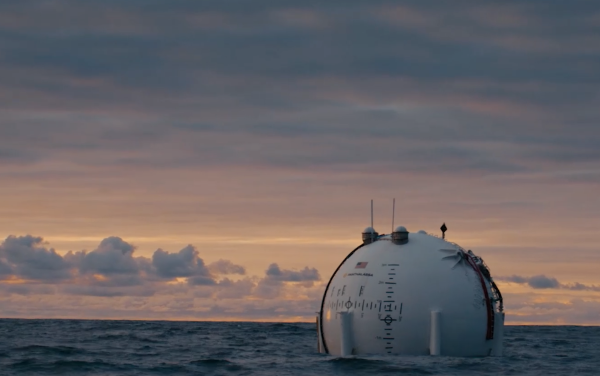
Projects involving data centers located above the ocean surface are also gaining momentum. One example is U.S.-based offshore AI data center startup Pantala, which is developing off-grid infrastructure capable of generating electricity from ocean wave energy and directly utilizing it for AI computing workloads. The concept is built around Pantala’s proprietary AI computing node technology. Floating nodes positioned in open waters generate electricity by drawing water upward through wave motion, storing it under pressure, and releasing it to drive turbines. The resulting power is immediately used to operate AI chips housed within the nodes. Through self-generated electricity, the system addresses the massive energy consumption challenges associated with traditional land-based data centers. Surrounding seawater serves as a free cooling resource, while data transmission is conducted through low-Earth-orbit (LEO) satellites.
Samsung Heavy Industries, one of South Korea’s “Big Three” shipbuilders, also entered the race. At Data Center World (DCW) 2026 in Washington, D.C., last month, the company received Approval in Principle (AiP) from the American Bureau of Shipping (ABS) and Lloyd’s Register (LR) for its internally developed 50MW floating data center (FDC) model. The certification established technological credibility aligned with global industry standards. More recently, a joint development project involving Greek shipowner Capital Clean Energy Carriers, Lloyd’s Register, and Samsung Heavy Industries was launched to advance floating data center design collaboration. Samsung Heavy Industries will be responsible for design and construction technologies, while the shipowner and classification society will cooperate on project development and certification. The company is also pursuing technical collaboration with U.S. AI server specialist Supermicro to ensure stable AI server operations in offshore environments.
Japan is exploring a different approach centered on repurposing used vessels. Mitsui O.S.K. Lines (MOL), one of Japan’s largest shipping companies, has partnered with Hitachi and Hitachi Systems to develop floating data centers converted from secondhand ships. The concept involves transforming decommissioned cargo vessels and car carriers with substantial internal space into data center facilities. The three companies have begun commercial feasibility studies covering demand validation, baseline specifications, and operational procedures, targeting service deployment after 2027. MOL will oversee vessel conversion, negotiations with port authorities, and offshore operational requirements including mooring and maintenance, while Hitachi will evaluate data center design, installation, networking, cybersecurity, and broader IT infrastructure requirements.
Oliver Griffin is a policy and tech reporter at The Economy, focusing on the intersection of artificial intelligence, government regulation, and macroeconomic strategy. Based in Dublin, Oliver has reported extensively on European Union policy shifts and their ripple effects across global markets. Prior to joining The Economy, he covered technology policy for an international think tank, producing research cited by major institutions, including the OECD and IMF. Oliver studied political economy at Trinity College Dublin and later completed a master’s in data journalism at Columbia University. His reporting blends field interviews with rigorous statistical analysis, offering readers a nuanced understanding of how policy decisions shape industries and everyday lives. Beyond his newsroom work, Oliver contributes op-eds on ethics in AI and has been a guest commentator on BBC World and CNBC Europe.
- Previous “Decoupling Is Effectively Impossible” — China Seizes ESS Dominance After Its Battery Ascendancy, Overwhelming Rivals in Both Scale and Technology
- Next “From Trade Dispute to Wartime Posture” China Retaliates Against U.S. Blacklisting With Precision Strikes on Rare Earths and Defense Sector
Similar Post