Taiwan Defence Consensus and the Cost of Political Division

Working across research, policy, and data-driven analysis, the Editorial Board ensures that published pieces reflect a consistent institutional perspective grounded in quantitative reasoning and long-term structural assessment.
Authored On
Modified
Taiwan’s political division is weakening deterrence
Defence spending needs durable cross-party support
Clearer US commitments could reinforce domestic consensus
That one conclusion should cast doubt on all the rest. In the same study, informing subjects that 82% of their fellow citizens would oppose an attack without subsequently implying that they shared an exclusive Taiwanese identity increased individual willingness to fight by almost 22%. This simple finding uncovers a truth that budgets and weapons lists frequently overlook. Credible deterrence requires a common conviction that society will stand firm. If citizens buy into an expectation of surrender, surrender can become reality before a single missile departs, even if other elements show their resolve far more vividly. Thus, Taiwan's most fundamental security challenge is not the balance of forces between it and China, but that the island's politicians lack the support of a national consensus for a credible national security policy. The island has money, technology, diplomatic alliances and functioning government institutions. However, these assets lose force as each key security decision is seen as an act of appalling partisanship. China does not have to create every division; it merely has to exploit preexisting conflicts. A consistent defense policy must therefore link the national consensus to clearer, conditional US support.
Taiwan Defense Consensus Is a Military Capability
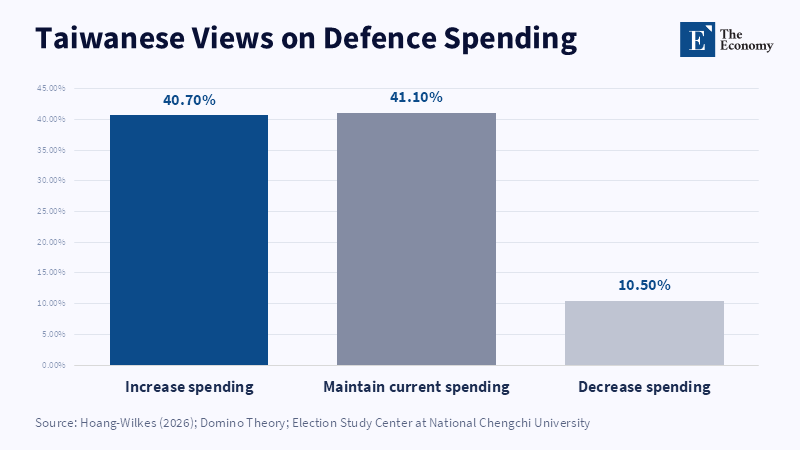
Public opinion in Taiwan isn’t weak or meek, however. The Taiwanese are divided on how best to make the island secure. A late-2025 survey cited 40.7% of respondents in the direction of increasing defense expenditure, 41.1% in the direction of keeping it the same and only 10.5% in the direction of cutting it. Over three-quarters opposed the notion that reducing spending might decrease the chance of war. This poll indicates that the Taiwanese are worried, yet do not see the same solution to the problems. A separate 2026 poll showed 54% supported a United States $40 billion special defense budget, reaching 87% for Democratic Progressive Party members but falling to 27.4% for Kuomintang supporters. There was barely a difference between independents. This gap can’t be taken as average politics, as the same weapons package can be seen as protective by one camp and dangerous by another. The Taiwanese security consensus needs to save itself from that same insecurity, not undo it.
The six-month squabble over the special appropriation revealed the problem. The final bill was eventually agreed at around $25 billion, around $15 billion less than the initial request. A smaller budget does not necessarily mean a strategic setback. Legislators, appropriately, should challenge the costs, the delivery schedule and the military use of resources. But what proved damaging was the lack of a trusted process for reaching agreement. Each delay provided a message on the level of national commitment. Each compromise provided a restatement to the other side that one is reckless, the other disloyal. This kind of dynamic erodes deterrence even if the final level of expenditure remains large. An adversary observes not just how many missiles Taiwan buys but whether the political system can sustain casualties, how willing they are to approve emergency funds and hence how credible a force they can project over time. A contingent that requires a certain percentage of votes across a generation is more credible than one that exists only at the mercy of a presidential election. Political continuity is a dimension of military preparedness.
The pressure is mounting as this line of argument continues. The Chinese military made 3764 crossings into Taiwan's de facto air defense identification zone in 2025 - a 22.4% jump from 2024. The annual attack rate since May 2024 has been more than double the pre-May 2024 rate for 2022-24. Such operations stretch response times, break down crews and make abnormal pressure feel average. They also carry political value. Beijing wants Taiwanese voters to conclude that standing up to the PRC costs too much, that support may be lacking and that time is likely on China's side. More weapons are important in this context, but public confidence is essential as well. A Taiwan defense consensus would deprive Beijing of that opening, demonstrating that political competition can persist without turning national survival into an election issue every two years.
Polarisation Gives Beijing a Target Before War Begins
Willingness to believe in self-defense is affected by identity, trust and expectations of outside support. Studies show support for self-defense is far higher among voters for the ruling party than among voters for the main opposition. The divergence can deepen over a foreign crisis. It doesn't mean one side cares for Taiwan and the other doesn't. It means each side interprets risk through a different narrative. One narrative says the more formidable its self-defense, the more costly any attack on Taiwan. The other says the more clearly Taiwan shows it is aligned militarily, the more likely it will be pulled into a foreign war. Both narratives invoke real fears. But when they ossify into competing political identities, citizens start to doubt one another. That doubt, in turn, renders military service, civil defense and emergency planning all the more difficult. A consensus on how to defend Taiwan has to make shared survival more important than competing ideologies.
Chinese influence operations are most successful in such an environment: research from late 2025 on media activity found hundreds of thousands of videos from Chinese Communist Party-associated accounts. About 18,000 discussed Taiwan and 2,730 featured 57 Taiwanese figures. The important point is not that all these critical voices are being monitored by Beijing-they are not; that would be false and would undermine democracy-but that China is able to select, repeat and morph current fault lines to create the appearance of a reason why Taiwan cannot be self-governing. It can claim that routine oversight is sabotage or that something normally perceived as simple defense is preparation for war. In such a situation, domestic actors will then be echoing those perceptions for their own military or political agenda. But how to distinguish the foreign pressure from the domestic media? The answer is not censorship but a public mechanism that makes verification of defense decisions easier and makes distortions more obvious.
That process should start with a multi-year, multipartisan compact. It should establish a floor for spending; it should enumerate the capabilities that merit justification and require public reporting upon their delivery. It should establish an ongoing legislative oversight committee, with access to classified briefings. It should establish that it will not end the debate. It should cause debate to be based on performance tests, instead of the terminology of insiders and loyalty. Taiwan's 2024 tax revenue(GDP) was 14.8%. It is far below other developed nations' typical levels. A credible program must be ambitious but sustainable.
The United States Needs Conditional Clarity
No division in Taiwan can be disentangled from distrust in the US. A 2026 poll showed that only 24% of respondents considered the US a reliable partner. Some 35% expected American aid in a crisis, about 40% did not. The gap between supporters of the ruling Democratic Progressive Party and the opposition Kuomintang was even more obvious. Strategic ambiguity established room for the US to forestall both a Chinese invasion and unilateral changes to the balance of power. It also fuels in Taiwan what has become a domestic debate. Proponents of increased military spending demand assurances of action, while skeptics believe Washington will compel Taiwanese officials to buy arms without offering any protection in return. Both groups have evidence of an uncertain world on their side: ambiguity is no longer merely a foreign-policy decision. It is now also an element of internal competition.
The best alternative is conditional clarity. This would not guarantee that the United States would go to war if Taiwan were attacked. But an announced set of likely responses to specific forms of coercion would be more meaningful. Chinese quarantine, a blockade, a cyber campaign and a general attack are clearly not equivalent. Washington should indicate what combination of economic, intelligence, logistical and military steps an escalatory path to each step might involve. It should also be more specific about arms deliveries, cooperative planning and sharing energy, communications and port-strengthening measures. The conditional commitment should include clear conditions. The island should refrain from action that may change its standing without due process, maintain civilian control and meet set defense readiness standards. The United States should avoid precipitant action and equivocation. Conditional clarity would help avoid complacency while spurring no panic. It would give the Taiwanese consensus supporting consensus a more solid foundation than private undertakings and campaign-cycle campaigns.
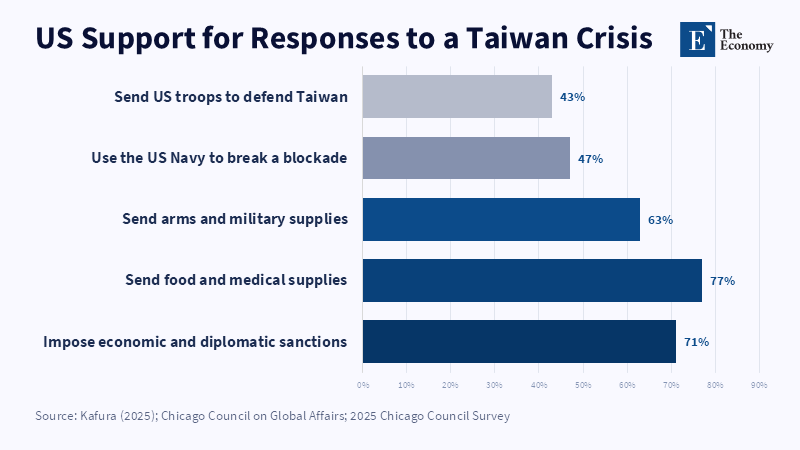
Others will argue that more transparent commitments could draw Beijing. Still others will argue that a cross-party consensus will mute the doubters or mandate retrenchment of social expenditures. These concerns are valid but do not mount a challenge. Explicit procedures and commitments differ from a blank check. A national commitment can offer space for recognition of other views, yet set explicit minimum commitments. Funding can scale up in proven increments. Action can be reinforced with evidence while building consensus. American community backing takes the form of a measured stair-step. In 2025, 77% agreed to provide Taiwan with food and medicine in case of an attack, 71% supported economic penalties, 63% supported equipping the Taiwanese military, 54% agreed to send the navy to defeat the blockade and 39% recommended deploying troops. At each step, more consensus backs incremental actions. Strong commitments fare better than ambitious ones because they can sustain down-to-earth debate.
Build the Taiwan Defense Consensus Before the Crisis
A functional compact should also link defense, resilience and democratic confidence. Taiwan might establish a funding floor over five years, gradually rising from the planned share of 3.32% of GDP in the near future, once delivery and training goals are achieved. An independent office can issue brief reports of progress on stocks and drones, reserve training, cybersecurity and repair capability. By consensus, leading parties can all endorse a stable non-partisan civil defense authority. Local politicians can select commands to administer comparable civil-defense standards; there should be no party difference across the island. Hospitals, provincial authorities, energy companies and mobile phone operators must discover their own corporate duties before disaster strikes. None of this needs agreements on national identity or on long-term relations with China. It needs agreement that electoral competition should not be allowed to undermine the systems that must sustain human life. This is the attainable essence of a Taiwan defense consensus.
The United States should restitch that tacit agreement with some of its own discipline. President Donald Trump faces a difficult choice, as putative conflict over Taiwan would risk mushrooming into a struggle for maritime access, industrial strength and alliance certainty. The Battle of Trafalgar altered the global order, but today's war would not result in a singular, definitive shift in command. In today's world, centres of power are supply chains, data networks, capital markets, microchips and coalitions, yet one war in the Taiwan Strait could reshape those systems for a generation. So unclear assurances make that disaster more likely and invite miscalculation.
The initial finding is back with a vengeance. Among respondents without an exclusive Taiwanese identity, a 22% increase in the willingness to fight was attributable to one factor: believing that 'other people in Taiwan would also fight.' That's the cheapest deterrent that Taiwan can develop; it can't be ordered into place. It must be achieved through honest threat assessments, generous budgets and a demonstrated, committed readiness that survives the headlines. Beijing's advantage is not only its military capability but the expectation that Taiwan would enter into a crisis divided over the point of fighting and doubtful of American assistance. Taiwan and the United States should crush that expectation now. A consensus on Taiwan's defense, while not eliminating the risk of conflict, can eliminate the assumption that pressure alone will convince the island to surrender. That's where coercion begins; that's where credible deterrence has to begin.
The views expressed in this article are those of the author(s) and do not necessarily reflect the official position of The Economy or its affiliates.
References
Advisory Ranking (2026) ‘Top 20 Crisis & Security Advisory 2026’, Advisory Ranking, 1 April.
Grano, S.A. (2026) ‘National security without consensus: Taiwan’s domestic politics through 2028’, Asia Society Policy Institute, 3 June.
Hoang-Wilkes, J. (2026) ‘Taiwanese public cautious on defense spending: Poll’, Domino Theory, 3 June.
Hsiung, C.-H. (2026) ‘Taiwan’s defence deadlock is weakening deterrence’, East Asia Forum, 25 June.
Iannone, A. (2026) ‘Taiwan’s deeper vulnerability is politics at home’, The Interpreter, Lowy Institute, 24 April.
Kafura, C. (2025) ‘Americans grow more supportive of aiding Taiwan in a China crisis’, Chicago Council on Global Affairs, 17 November.
Liao, J.C. and Marcrum, K. (2026) ‘Between Beijing and the budget: The domestic realities of Taiwan’s defense spending drama’, War on the Rocks, 2 June.
Lin, B., Hart, B., Li, L. and Tinsley, T. (2026) ‘Tracking China’s increased military activities in the Indo-Pacific in 2025’, ChinaPower, Center for Strategic and International Studies, 5 February.
Ministry of Finance, Republic of China (Taiwan) (2025) Analysis of Tax Revenue Collection in 2024. Taipei: Ministry of Finance.
Nachman, L. and Yen, W.-T. (2026) ‘How partisan is Taiwan’s security debate?’, Brookings Institution, 28 May.
Pomfret, J. and Lee, Y. (2026) ‘China turns Taiwan’s own voices against it in information war’, Reuters, 17 April.
Working across research, policy, and data-driven analysis, the Editorial Board ensures that published pieces reflect a consistent institutional perspective grounded in quantitative reasoning and long-term structural assessment.