[Longevity and Inequality] When Growth Stops Sharing: AI, Work, and the New Longevity Gap

Keith Lee is Professor of AI and Finance at the Gordon School of Business, Swiss Institute of Artificial Intelligence (SIAI). His primary research lies in financial mathematics and AI-driven computational science, with a focus on quantitative modeling of complex economic and financial systems. His work integrates machine learning, stochastic modeling, and data-centric methods to study structural transformations in markets and institutions.
His work examines the broader socioeconomic consequences of artificial intelligence, including labor markets, public finance, demographic change, and institutional adaptation.
He holds a PhD in Mathematical Finance from Boston University, and previously earned an MSc in Finance and Economics from the London School of Economics. He completed his undergraduate studies in Economics at Seoul National University under the Korea Foundation for Advanced Studies scholarship program.
Authored On
Modified
AI can extend healthy life while eroding the job security that pays for it
A small group gains from AI, while others lose both work and access to care
Sharing AI's health gains requires sharing its productivity gains too

Conference context
This article was written by Professor Keith Lee of Swiss Institute of Artificial Intelligence as a public-facing follow-up to his presentation, “Unemployed Growth and the Emerging Inequality of Longevity,” delivered at the conference Inequalities in Longevity, held at Fondazione Giorgio Cini in Venice on 3–4 July 2026. It develops the presentation’s central argument—that AI may extend healthy life while simultaneously widening the economic inequalities that determine who benefits from those advances—with additional evidence and policy analysis for The Economy Review.
Watch the original conference presentation: Keith Lee at Fondazione Giorgio Cini on YouTube
Artificial intelligence gets discussed in two separate conversations. One is medical and it is hopeful. AI can speed up scientific discovery, sharpen diagnosis and expand how long and how well people can live. The other is economic and it is more uneasy. AI can reorganize work, concentrate the gains from productivity and weaken the job security that pays for healthcare, housing and retirement. These two stories are not separate at all. They are connected and the connection runs straight through the labor market.
Unemployed Growth: A New Kind of Labour Shock
This pattern can be called unemployed growth. It means growth in output and productivity that does not come with a matching rise in stable human employment. It does not require mass job losses. It can happen even alongside net job creation. The central idea is that unequal augmentation is likely to arrive before full automation does. Before robots or fully autonomous systems replace human workers at scale, companies can already use AI to make a smaller group of employees far more productive. Research, drafting, coding and customer service can all be compressed without adding headcount. If demand does not grow as fast as capability does, firms have every reason to consolidate roles instead of multiplying them. Output rises. Secure jobs, wages and bargaining power do not rise with it.
This shift matters for who benefits and who does not. AI tends to automate routine tasks, such as scheduling, search, or first drafts. It tends to leave judgment, negotiation and client relationships with the human worker. That can strengthen people who already hold expertise and authority inside an organization. It can also remove the very tasks junior workers once used to learn a trade and prove themselves. The near-term risk is not simply fewer jobs overall. It is a shift of valuable work toward a smaller group, paired with a weaker path for everyone else to become valuable in the first place. Over time, workers on the winning side gain more than higher pay. They gain better assignments, stronger networks and more say over strategic decisions. Workers on the other side may cycle through weaker jobs, gaps in employment, or gig work that offers little insurance or pension support. A temporary gap in productivity can turn into a lasting gap in wealth and that gap tends to grow wider the longer it goes unaddressed.
There is a clear line between this pattern and the older story of full automation. A conventional automation narrative imagines a future point when machines replace whole jobs outright. Unemployed growth describes something happening now, where smaller AI-enabled teams simply produce more without hiring more. The unit of change is not the occupation. It is the task, the workflow and the bargaining power tied to it. A firm facing this choice tends to consolidate roles and concentrate its most valuable work in fewer hands, rather than substitute capital for labor in one dramatic move. The outcome for workers is not a simple split between employed and unemployed. It is a spectrum, running from strong complementarity with AI at one end to stalled careers and lower quality work at the other. This distinction matters because the distributional damage begins well before any full automation event would ever arrive.
How Labour Inequality Becomes a Longevity Gap
The scale of exposure is large. The International Monetary Fund estimates that about 60 percent of jobs in advanced economies are exposed to AI. That figure falls to 40 percent in emerging markets and 26 percent in low-income countries. Exposure is not the same as replacement, since many exposed workers may benefit through complementarity rather than losing out. The International Labor Organization offers a related estimate. Close to one in four jobs worldwide carry some exposure to generative AI. Task-level change is more likely than full occupational loss. The World Economic Forum projects 170 million jobs created and 92 million displaced worldwide between 2025 and 2030. That leaves a net gain of 78 million jobs. This positive net figure still hides a great deal of disruption. Ninety-two million displaced positions mean large personal changes in skill, income and geography. A new job in a different city or sector rarely compensates the person whose career is interrupted right now.
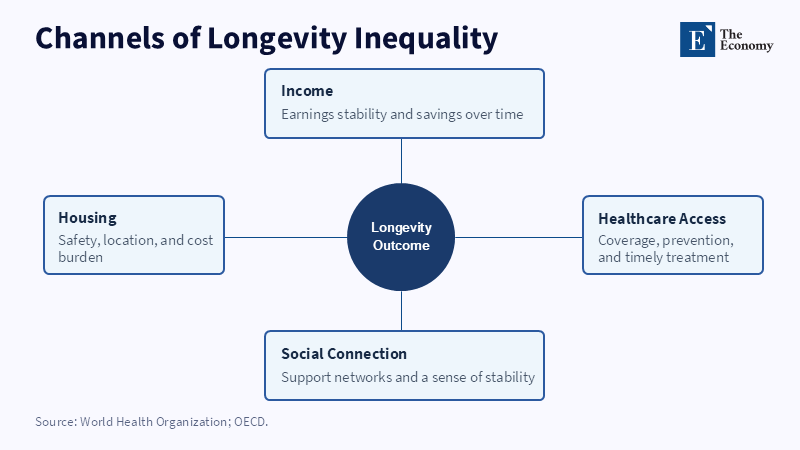
From here, labor market inequality becomes a longevity gap. Health depends on far more than medicine alone. The World Health Organization defines social determinants of health as the conditions in which people are born, grow, work and age. It also includes their access to money and power. The OECD makes a similar point. Gaps in education, employment and earnings build up across a person's whole life. The existing income gradient in longevity is already large. Raj Chetty and colleagues studied 1.4 billion person-year records in the United States. At age 40, the richest one percent of men lived 14.6 years longer than the poorest one percent. The gap for women was 10.1 years. AI does not need to create this divide. It enters a world where the divide already exists. It can widen that divide further if productivity gains flow mainly to capital owners and highly adaptable workers, while wages and job security weaken for everyone else. Interrupted careers reduce savings and pension contributions. Employment instability raises stress and cuts into a person's ability to pay for prevention, safe housing and good food. The effect builds up over time rather than striking all at once. Early advantage compounds into better jobs and stronger retirement security. Early disadvantage compounds into repeated setbacks and chronic uncertainty.
The Divide Inside AI Enabled Healthcare
A second, related divide sits inside AI-enabled healthcare itself. Even genuine medical progress will not reach everyone equally. One group may have stable income, strong insurance, good digital literacy and clinicians who can interpret an algorithm's recommendation. Another group may have fragmented medical records and limited digital access. That second group may have little practical ability to act on an early warning, even when the technology correctly identifies a real risk. Research on digital health in the United States finds that access, use and comprehension gaps are more common among people with lower income and less education. These gaps are tied to worse self-rated health. Data itself can carry old bias forward. If a model is trained mostly on people who are wealthy, insured and digitally visible, it may simply perform worse for people who are none of those things. A well-known case studied by Ziad Obermeyer and colleagues showed this directly. A healthcare algorithm underestimated the medical needs of Black patients, because it used healthcare cost as a stand-in for illness.
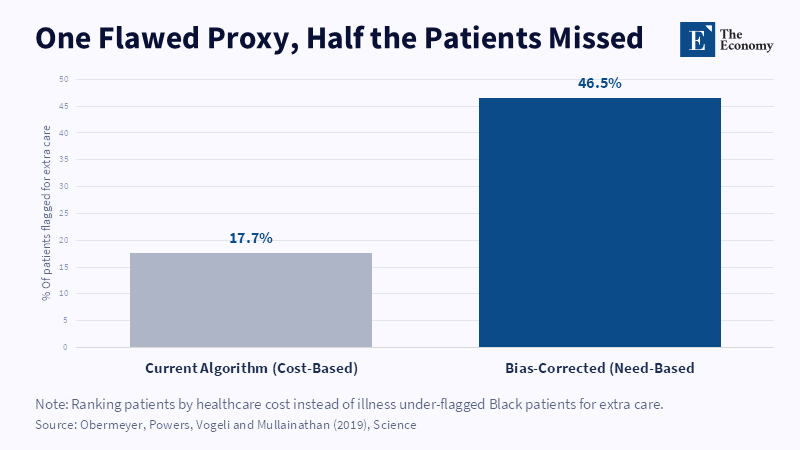
Cost already reflected unequal access to care in the first place. AI systems increasingly decide who gets screened or referred for follow-up care. This kind of hidden bias becomes a gatekeeping problem and it carries real consequences for who receives timely treatment.
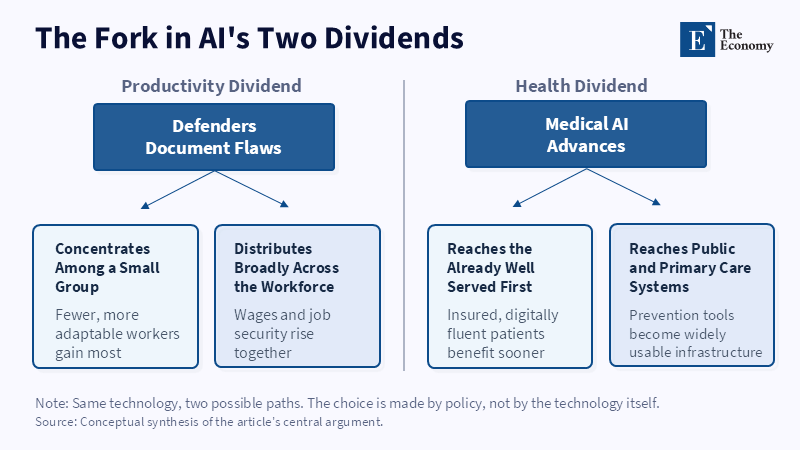
Three lessons stand out for policy. First, longevity inequality builds up across a person's whole life. It moves through income, housing, healthcare and social connection, rather than through any single event. AI should be understood as something that can strengthen or weaken each of these channels. It should not be treated as a separate topic sitting on its own. Second, average progress and fair distribution are not the same thing. A society can see higher average productivity and longer average lifespans, while the gap between the best off and worst off keeps growing wider underneath those averages. The goal should not be to slow down medical AI. The real goal should be making sure its benefits are not limited to people who are already advantaged. Third, adapting to this shift needs more than training programs alone. Workers may also need time, help moving into new roles, redesigned jobs and benefits that follow them between positions. Health systems need data that represents everyone, along with regular checks for bias. Pension systems need to account for interrupted careers and newer, less stable forms of work.
AI will shape how long people live in two separate ways. The first runs through biology and the second runs through the structure of work and income. The first channel can push out the frontier of healthy aging. The second channel decides who actually gets to reach that frontier. The real risk ahead is not unemployment on its own. It is unequal longevity, produced by growth that leaves broad employment behind. The task for policy is to distribute both of AI's dividends. These are the gains in productivity and the gains in health. Both need to reach widely enough that technological progress becomes shared longevity, rather than a new and deeper divide between those who benefit and those who do not. A strategy that celebrates faster discovery while ignoring who gets left out of the labor market risks producing longer lives for some and longer insecurity for everyone else.
Publication note
This article develops arguments originally presented by the author at the conference Inequalities in Longevity, held at Fondazione Giorgio Cini in Venice on 3–4 July 2026. It was independently published by The Economy Review and is not an official transcript, abstract, or part of the conference proceedings. Reference to the conference describes the intellectual origin of the article and does not imply institutional endorsement or partnership. The analysis, interpretations, and conclusions are those of the author.
References
Cazzaniga, M., Jaumotte, F., Li, L., Melina, G., Panton, A. J., Pizzinelli, C., Rockall, E. J., and Tavares, M. M. (2024) Gen-AI: Artificial Intelligence and the Future of Work. IMF Staff Discussion Note SDN/2024/001. Washington, DC: International Monetary Fund.
Chetty, R., Stepner, M., Abraham, S., Lin, S., Scuderi, B., Turner, N., Bergeron, A., and Cutler, D. (2016) 'The association between income and life expectancy in the United States, 2001-2014', JAMA, 315(16), pp. 1750-1766.
Gmyrek, P., Berg, J., Kaminski, K., Konopczynski, F., Ladna, A., Nafradi, B., Roslaniec, K., and Troszynski, M. (2025) Generative AI and Jobs: A Refined Global Index of Occupational Exposure. ILO Working Paper 140. Geneva: International Labour Organization.
Hasanzadeh, F., Josephson, C. B., and White, J. A. (2025) 'Bias recognition and mitigation strategies in artificial intelligence healthcare applications', npj Digital Medicine.
Obermeyer, Z., Powers, B., Vogeli, C., and Mullainathan, S. (2019) 'Dissecting racial bias in an algorithm used to manage the health of populations', Science, 366(6464), pp. 447-453.
OECD (2017) Preventing Ageing Unequally. Paris: OECD Publishing.
World Economic Forum (2025) The Future of Jobs Report 2025. Geneva: World Economic Forum.
World Health Organization (2024) Social Determinants of Health.
Yang, R., Gao, S., and Jiang, Y. (2024) 'Digital divide as a determinant of health in the U.S. older adults: prevalence, trends, and risk factors', BMC Geriatrics, 24, article 1.
Keith Lee is Professor of AI and Finance at the Gordon School of Business, Swiss Institute of Artificial Intelligence (SIAI). His primary research lies in financial mathematics and AI-driven computational science, with a focus on quantitative modeling of complex economic and financial systems. His work integrates machine learning, stochastic modeling, and data-centric methods to study structural transformations in markets and institutions.
His work examines the broader socioeconomic consequences of artificial intelligence, including labor markets, public finance, demographic change, and institutional adaptation.
He holds a PhD in Mathematical Finance from Boston University, and previously earned an MSc in Finance and Economics from the London School of Economics. He completed his undergraduate studies in Economics at Seoul National University under the Korea Foundation for Advanced Studies scholarship program.