Defense Burden Sharing Works Best With Strategy, Not Pressure

Working across research, policy, and data-driven analysis, the Editorial Board ensures that published pieces reflect a consistent institutional perspective grounded in quantitative reasoning and long-term structural assessment.
Authored On
Modified
Trump's Korea drill cut undercuts NATO's disciplined burden-sharing gains
Seoul responded with avoidance, not compliance, bypassing Washington entirely
Structured timelines work; personal impulse-driven pressure does not

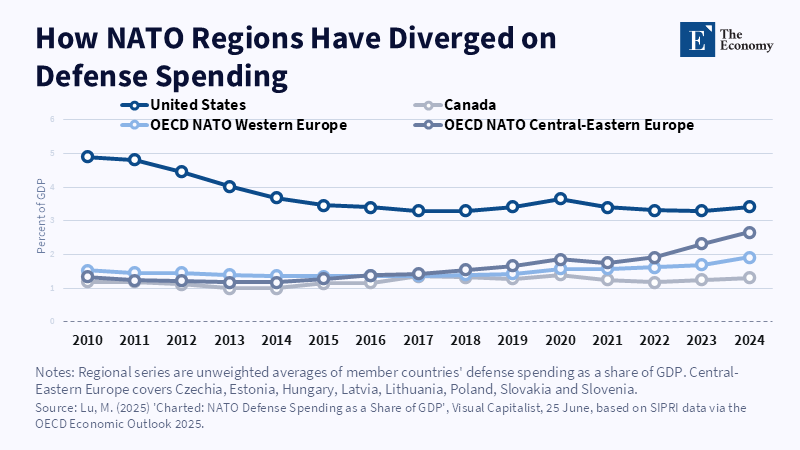
In 2025, European allied forces and Canada increased their defense spending by nearly 20 percent in real terms, the largest annual jump since 1953. All thirty-two NATO members have now exceeded the old target of 2 percent of GDP, while the Hague Agreement set a new horizon at 5 percent by 2035. This is the most tangible proof that defense burden-sharing can work when it is based on binding timetables and institutional pressure. A week later, a post on Truth Social was enough to overturn part of this picture. President Trump ordered the restriction of joint exercises with South Korea because Seoul refused to help in the war against Iran, citing his "very good" relationship with Kim Jong Un. The contrast between the two moments reveals something deeper about the way Washington is negotiating with its allies today.
South Korea Tests the Limits of Alliance Pressure
The annual Ulchi Freedom Shield exercise this year was due to end on August 27, with the participation of about eighteen thousand South Korean soldiers and a total of twenty-eight thousand American forces remaining on the peninsula. President Trump asked for it to be shortened hours before it began, writing that the exercises "send a completely inappropriate and hostile signal" to North Korea, a country he described as "non-threatening and respectful" throughout his second term. The official justification combined two completely disparate arguments: Seoul's refusal to support U.S. operations against Iran and the president's personal assessment of Kim Jong Un. The exercise finally ended on August 21, six days earlier than the original schedule.
The reaction from experts was immediate. Victor Cha, head of the Korea program at the Center for Strategic and International Studies, noted that no alternative activity can replace live shooting and joint exercises. Leif-Eric Easley, of Ewha Womans University, warned that the cut could damage the alliance's coordination and delay the transfer of blame to Seoul. Senator Mark Kelly called the decision short-sighted. The most interesting element is not the criticism itself, but the fact that the decision came three days after Foreign Minister Marco Rubio had called South Korea an "irreplaceable partner" and spoke of a "historic new era" of cooperation. The speed with which the official line has been reversed shows how little weight institutional commitments carry when they clash with a momentary personal assessment.
When Allies Start Planning Around Washington
Earlier that month, South Korean President Lee Jae-myung completed the longest international tour of his tenure without making a stop in Washington. It started in San Francisco, where he hosted an AI summit with OpenAI CEO Sam Altman, Dario Amodei, Nvidia President Jensen Huang and Hock Tan. It continued in Brazil, Chile and Argentina, with Germany as the final stop. It was the first time in two decades that a South Korean president visited American soil without meeting the American president.
The choice was not an accidental omission of protocol. An analysis for the Carnegie Endowment describes the tour as an attempt to organize Korean diplomacy around the geography of the computing power economy, rather than around managing the relationship with Pyongyang and Washington. Seoul sought access to critical raw materials in Latin America and technological legitimacy in Silicon Valley, building alternative networks of dependency. When an ally learns to plan its diplomacy around the unpredictability of its interlocutor, the very logic of the alliance changes character. It is no longer about coordination, it is about risk management.
NATO Shows What Structured Burden Sharing Can Achieve
At the Hague summit in June 2025, all thirty-two NATO members pledged to invest 5 percent of GDP annually in defense and related sectors by 2035, with a mid-term review in 2029. The pledge is already paying off: European allied forces and Canada have increased their defense spending by nearly 20 percent in real terms in one year, the biggest annual jump since 1953. It is a defense burden-sharing based on a timetable, a quantified target and a control mechanism, not on an individual communication.
Alexander Noyes and Jesse Humpal's analysis of Brookings adds a dimension that is often overlooked: increasing spending is not enough if allies lack the resilience to operate in disruption. Rail hubs, port cranes, fuel and telecommunications networks make up the operational system of aid and a cyberattack against them can delay the arrival of forces by several days, a time that may prove strategically decisive. The authors propose targeted U.S. support to strengthen this resilience, tied to clear priorities and allied co-investment. This is exactly the kind of planning that was absent from Seoul's treatment, where a decades-old partnership was cut short within hours without any prior consultation with the Pentagon itself.
The Indo-Pacific Problem: Paying More, Trusting Less
In September 2024, Seoul and Washington finalized the twelfth Special Agreement of Measures, covering the period from 2026 to 2030. South Korea will pay 1.52 trillion won in 2026, about $1.14 billion, an increase of 8.3 percent over the previous year, with future increases linked to inflation and limited to 5 percent per year. This contribution corresponds to about 0.057 percent of Korean GDP, proportionally greater than the corresponding Japanese or German contribution, for the maintenance of about twenty-eight thousand five hundred US troops on the peninsula.
This agreement is precisely the kind of structured defense burden-sharing that produces stable results, with a multi-year horizon, an increased ceiling and a predictable calculation method. It didn't come from a post on social media, it came from eight rounds of negotiations. The contradiction is obvious: at the same time that the institutional cost framework functions normally, military cooperation in practice proves vulnerable to a single personal reaction. In the Indo-Pacific, where distance makes any refueling delay more costly, this inconsistency between economic and operational cooperation weighs doubly. An ally can pay properly and at the same time doubt whether the alliance will work when needed.
From Pressure Politics to a Durable Burden-Sharing Strategy
The Korean precedent shows what the American side needs in each region. In Europe, the Hague commitment must be accompanied by the kind of resilience investment proposed by the Brookings analysis, so that increased spending translates into real capacity rather than numbers on paper. In the Indo-Pacific, the model of the Korean Special Agreement of Measures can be extended to infrastructure resilience commitments, along the lines of the port and energy proposals already under consideration for Europe. In both cases, defense burden-sharing works when it combines a clear goal, timeline and mutual investment, not when it depends on the mood of a particular day.
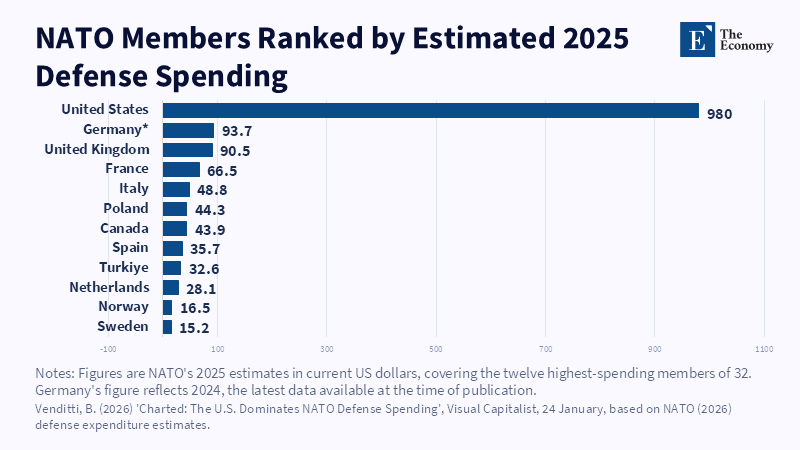
Some analysts argue that pressure tactics, such as cutting drills, extract concessions faster than slow institutional negotiations. The facts themselves do not confirm this view. The Korean response to the threat was not a concession, it was an avoidance: a tour that ostentatiously bypassed Washington. In contrast, the largest increase in defense spending in NATO's history came from a binding timetable and mid-term review, not from the threat of a surprise. Pressure without planning produces distance instead of compliance, while institutional pressure with clear rules produces measurable progress. This difference is not a detail of style, it is a matter of efficiency.
The two-speed image remains the central lesson. NATO recorded a 20 percent increase in spending in a year thanks to structure and timing, while a decades-old alliance in Asia was shaken within hours by a personal post. The distribution of defense burdens does not need more spectacle, it needs consistency. U.S. strategy in Europe, the Indo-Pacific and any other region where Washington is asking for more from its allies must be built on commitments that survive a bad day, not on moods that change with one post. Allies who learn to plan around unpredictability do not build trust; they build alternatives. The next crisis will show which approach survived.
This article reflects the analytical judgment of The Economy Editorial Board and does not constitute policy advice or the official position of any affiliated institution.
References
Atlantic Council (2026) NATO defense spending tracker. Washington, DC: Atlantic Council.
CNN (2026) Trump says US will reduce joint military exercises with key ally South Korea. Atlanta: Cable News Network, 16 August.
Draudt-Véjares, D. (2026) Why Korea's president skipped Washington for Silicon Valley and Brasília. Washington, DC: Carnegie Endowment for International Peace, Emissary, 13 August.
Jett, J., Kim, S., Gains, M. and Alba, M. (2026) U.S. military drills with South Korea are cut short after surprise Trump order. New York: NBC News, 19 August.
Korea Herald (2024) S. Korea, US clinch 2026 to 2030 defense cost-sharing deal in pre-election push. Seoul: The Korea Herald, 4 October.
North Atlantic Treaty Organization (2025) The Hague Summit Declaration. Brussels: NATO, 25 June.
North Atlantic Treaty Organization (2026) Defence investment and NATO's 5% commitment. Brussels: NATO.
Noyes, A. and Humpal, J. R. (2026) How to actually share America's defense burden with allies. Washington, DC: Brookings Institution, 5 August.
Working across research, policy, and data-driven analysis, the Editorial Board ensures that published pieces reflect a consistent institutional perspective grounded in quantitative reasoning and long-term structural assessment.