4.Europe’s Security Dilemma

Working across research, policy, and data-driven analysis, the Editorial Board ensures that published pieces reflect a consistent institutional perspective grounded in quantitative reasoning and long-term structural assessment.
EU autonomy, U.S. guarantees, NATO credibility
If Ukraine is the battlefield and Washington the guarantor, Europe is the arena in which the long-term consequences will be absorbed.
For decades, Europe’s security model rested on a paradox. The continent sought strategic maturity while relying on American protection. It expanded political and economic integration internally, while outsourcing ultimate military deterrence externally. This arrangement proved efficient. It allowed European states to reduce defense expenditures, deepen welfare commitments, and prioritize regulatory and economic integration over hard power projection.
The war in Ukraine has disrupted this equilibrium.
Europe now faces a security dilemma of its own making: how to reconcile aspirations for strategic autonomy with continued dependence on U.S. guarantees. The question is not whether NATO remains central—it does—but whether its credibility can be sustained without a structural rebalancing of responsibility.
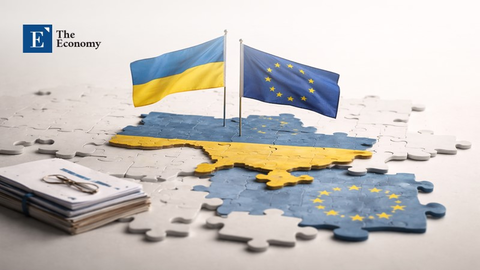
At the institutional level, two overlapping frameworks coexist. The European Union embodies economic integration, regulatory power, and, increasingly, defense-industrial coordination. NATO embodies collective defense, nuclear deterrence, and operational command structure. In theory, these frameworks are complementary. In practice, they reflect different political logics and levels of sovereignty.
Calls for “European strategic autonomy” have intensified since 2022. The concept implies greater defense spending, stronger indigenous industrial capacity, and enhanced decision-making independence. Yet autonomy, if interpreted as strategic separation from the United States, risks undermining the very deterrence architecture that has preserved peace in Western Europe for generations. Autonomy without capability is rhetorical; autonomy without alliance cohesion may be destabilizing.
Simultaneously, reliance on U.S. guarantees carries its own vulnerabilities. American domestic politics introduce uncertainty into long-term planning. Electoral cycles influence foreign policy posture. Fiscal constraints and Indo-Pacific prioritization compete for attention and resources. European policymakers must therefore assess not only American capacity, but American consistency.
The eastern members of the European Union and NATO perceive these dilemmas with particular urgency. For Poland, the Baltic states, and others in Central and Eastern Europe, the credibility of deterrence is existential. Their strategic cultures are shaped by proximity to Russia and historical memory of occupation. They favor rapid militarization, forward deployment, and deepened transatlantic integration.
Western and Southern European states often balance this urgency with economic considerations, energy policy constraints, and broader diplomatic engagement strategies. The result is a layered Europe: unified in principle, differentiated in threat perception.
NATO’s credibility now depends on more than treaty language. It depends on force posture, logistical readiness, industrial replenishment capacity, and political unity. The alliance has expanded to include Finland and Sweden, strengthening its northern flank. Yet enlargement alone does not resolve the question of burden-sharing. If deterrence requires sustained investment at scale, European fiscal and political systems must adapt.
The European Union’s role is evolving in parallel. Sanctions coordination, joint procurement initiatives, and reconstruction planning for Ukraine signal a shift toward more explicit security functions. But the EU was not designed as a military alliance. Its decision-making processes are slower and more consensus-driven. Bridging the gap between economic power and military capability remains a structural challenge.
This chapter examines Europe’s security dilemma as an institutional crossroads. It analyzes the tensions between autonomy and alliance, between integration and sovereignty, between deterrence credibility and fiscal constraint. It also considers whether the war has catalyzed a genuine transformation in European strategic culture—or merely a temporary adjustment under pressure.
The central question is whether Europe is prepared to internalize a greater share of the cost of order. If American guarantees remain indispensable, Europe must strengthen the foundations upon which those guarantees rest. If autonomy becomes the objective, Europe must accept the financial and political burdens associated with independent deterrence.
The security architecture of the continent is no longer insulated by optimism. It is being recalibrated under stress. The outcome will determine not only NATO’s future, but the balance between transatlantic cohesion and European self-reliance.
Order in Europe has long depended on a division of labor. That division is now under renegotiation. Whether the result is reinforcement or fragmentation will shape the continent’s stability for decades to come.
Working across research, policy, and data-driven analysis, the Editorial Board ensures that published pieces reflect a consistent institutional perspective grounded in quantitative reasoning and long-term structural assessment.