“From Memory Game-Changers to AI Neural Chips” Chinese Semiconductors Break Through U.S. Curbs, Accelerating an All-Out Push for Technological Supremacy

Matthew Reuter is a senior economic correspondent at The Economy, where he covers global financial markets, emerging technologies, and cross-border trade dynamics. With over a decade of experience reporting from major financial hubs—including London, New York, and Hong Kong—Matthew has developed a reputation for breaking complex economic stories into sharp, accessible narratives. Before joining The Economy, he worked at a leading European financial daily, where his investigative reporting on post-crisis banking reforms earned him recognition from the European Press Association. A graduate of the London School of Economics, Matthew holds dual degrees in economics and international relations. He is particularly interested in how data science and AI are reshaping market analysis and policymaking, often blending quantitative insights into his articles. Outside journalism, Matthew frequently moderates panels at global finance summits and guest lectures on financial journalism at top universities.
Authored On
Modified
Chinese Semiconductor Advances Defy U.S. Export Restrictions
Next-Generation Computing Architectures Reshape the Technology Paradigm
Expanded Patent Offensive and Tighter Research Controls Reinforce Technological Leadership Strategy
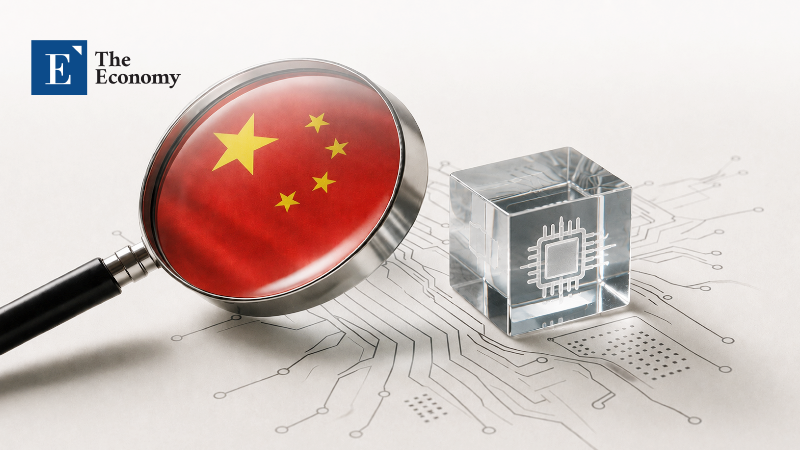
China is accelerating the development of a self-sufficient ecosystem spanning memory semiconductors, artificial intelligence (AI) chips, and next-generation computing technologies. Despite U.S. export restrictions on advanced semiconductor equipment, the country is advancing its DRAM and NAND technologies while simultaneously stepping up development of next-generation chips and large-scale patent acquisition through universities and research institutes. At the same time, Beijing is expanding research and development (R&D) investment and strengthening control over critical technologies, further enhancing its position in the global race for future semiconductor leadership.
China Expands Semiconductor Ecosystem to Narrow Technology Gap
According to the South China Morning Post (SCMP) on July 6, construction recently began under strict secrecy on a state-of-the-art R&D production line at ChangXin Memory Technologies (CXMT) in Hefei, Anhui Province, widely regarded as the heart of China's semiconductor industry. The project is designed to develop and manufacture next-generation "bonded DRAM," a technology capable of dramatically improving both memory performance and capacity and widely viewed as a potential "game changer" for the memory semiconductor industry. China is also aggressively moving into Compute Express Link (CXL) DRAM, often described as the post-HBM generation of memory technology. Building on its experience mass-producing server-grade DDR5 memory, CXMT has formally announced its entry into the CXL 3.0 market. The company is also deepening cooperation with domestic fabless chip designer Montage Technology and other partners to secure controller technology, one of the most critical components of the ecosystem.
Only two years ago, Chinese memory makers including DRAM specialist CXMT and NAND flash producer Yangtze Memory Technologies Co. (YMTC) were largely confined to manufacturing low-end chips while recording annual losses amounting to billions of dollars. At the time, China's share of the global DRAM market was too small even to be officially measured. By the first quarter of this year, however, CXMT's global DRAM market share had surged to 8%, reflecting tangible results from Beijing's drive for semiconductor self-sufficiency. The company has advanced to the point where it is now being mentioned as a potential new DRAM supplier for Apple, a company well known for imposing exceptionally stringent supplier qualification standards.
What has drawn particular attention is that China has begun staking out leadership in next-generation technologies despite sweeping U.S. restrictions. Although Beijing faced major obstacles after U.S. sanctions effectively blocked imports of ASML's advanced extreme ultraviolet (EUV) lithography systems—equipment considered indispensable for leading-edge semiconductor manufacturing—it has rapidly developed alternative approaches. CXMT is now reportedly on the verge of launching its own HBM products by employing every available technique, including sophisticated multi-patterning processes that maximize the capabilities of legacy manufacturing nodes. The company has also converted roughly 20% of its production capacity to dedicated HBM manufacturing while making development of HBM3 and HBM3E a strategic priority.
Nor is the conventional DRAM market immune from China's advance. Chinese suppliers are mounting an increasingly visible challenge in the DDR5 segment, now the mainstream memory standard for modern servers and PCs. Ongoing global memory shortages fueled by the semiconductor supercycle have further increased demand for Chinese-made products. Warning signs have already emerged in the NAND flash market. Samsung Electronics and SK hynix currently dominate the high-value segment—including enterprise solid-state drives (eSSDs)—with NAND products in the upper-200-layer to 300-layer range. However, as the industry moves toward ultra-high-layer NAND exceeding 400 layers, manufacturers are encountering fundamental physical limitations, making wafer-to-wafer (W2W) hybrid bonding an essential production technology.
This advanced back-end packaging process directly bonds two semiconductor wafers without conductive bumps, vertically connecting circuitry to achieve significantly higher performance. YMTC currently holds the industry's strongest patent position in this field. The company became the first in the world to commercialize its proprietary Xtacking technology, successfully mass-producing NAND products from 160 layers through its latest 270-layer offerings. YMTC holds 119 core patents related to the technology, significantly outpacing South Korean competitors, including Samsung Electronics with 83 patents and SK hynix with 11 patents as of 2023. Such is YMTC's technological advantage that Samsung, the global NAND market leader, reportedly entered into a patent licensing agreement with the Chinese company to facilitate development of next-generation V10 NAND exceeding 430 layers using a triple-stack architecture.
Having strengthened its competitiveness in memory technologies, China is now accelerating efforts to establish new AI chip design methodologies and system architectures. Huawei's "Tau Law," unveiled in May, is widely viewed as having the potential to reshape the competitive landscape of AI semiconductors. Rather than focusing on chip miniaturization—the primary strategy pursued by South Korean and U.S. companies—the technology takes an entirely different approach by reducing data movement latency to enhance overall system performance.
Peking University and Chinese Academy of Sciences Develop Brain-Inspired Next-Generation Chip
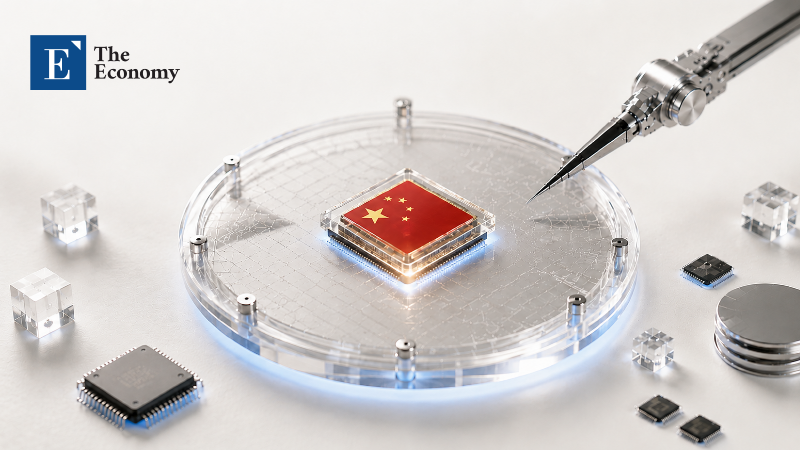
China is also delivering meaningful breakthroughs in next-generation semiconductors. According to The Wall Street Journal, a joint research team led by Professor Yang Yuchao of Peking University's School of Integrated Circuits and researchers from the Chinese Academy of Sciences (CAS) recently published in Science, one of the world's most prestigious academic journals, what they described as the world's first integrated artificial neural network-based 40nm Computing-in-Memory (CIM) semiconductor device. The chip overcomes the physical limitations of conventional computer architectures while demonstrating a framework capable of reconstructing the highly complex surface structure of the human brain in less than 0.5 seconds. In terms of computational performance, it reportedly delivers processing efficiency ranging from 50 times to as much as 478 times that of Nvidia's industry-standard A100 high-performance GPU system.
The human brain contains billions of neurons packed within the limited space of the skull, maximizing its surface area through an intricate network of folds and grooves. Conventional von Neumann computer architecture separates processors (CPUs and GPUs) from memory, forcing data to shuttle continuously between the two during computation. This creates significant latency and power consumption, particularly when processing massive brain-structure datasets over extended periods. As a result, real-time rendering of fine neural surface structures has traditionally required server infrastructure costing hundreds of millions of dollars.
The Chinese research team overcame this bottleneck by directly embedding a neurodynamics system into a next-generation memory array. More notably, the researchers transformed what had long been regarded as a critical weakness of phase-change memristors—a next-generation memory technology—into a computational advantage. Rather than treating conductance drift, or fluctuations in electrical current over time that destabilize stored data, as a flaw, they leveraged the phenomenon to perform highly precise calculations on continuously changing brain signals. In a commentary published in Science, leading scholars at Germany's Jülich Research Centre praised the achievement, comparing China's new memory paradigm to "processing fresh milk directly at a dairy farm instead of repeatedly transporting crude oil to a distant refinery," highlighting its fundamentally different approach to computing efficiency.
Research Controls and Patent Offensive Mirror Strategies of Technology Leaders
Perhaps more striking is China's growing adoption of strategies long employed by leading technology powers such as the United States. Whereas Chinese researchers previously focused on publishing papers in leading international journals to gain global recognition, Beijing has increasingly shifted toward preventing the overseas disclosure of critical technologies. According to the Financial Times, the Chinese government is considering reducing or eliminating the additional credit historically awarded to university faculty and researchers for publishing papers in prestigious international journals. Chinese academics have traditionally received advantages in hiring, promotions, and research funding evaluations for publishing in journals such as Nature and Cell. However, growing concerns that academic publications could serve as channels for industrial and technological leakage have prompted authorities to consider tightening restrictions on overseas journal submissions.
Beijing has already strengthened oversight of overseas academic publishing since August of last year while encouraging researchers to publish influential work in domestic journals instead. Against this backdrop, an executive at an international scientific publishing company said the number of manuscripts submitted from China has declined since the beginning of this year. The trend reflects the reality that, as strategic competition between China and the United States intensifies, scientific research has increasingly become intertwined with national security concerns. China's rapid technological progress has also contributed to the policy shift. Dennis Simon, a senior fellow at the Quincy Institute, noted, "China's scientific system has evolved beyond a catch-up model aimed at narrowing the gap with advanced economies and has matured into one befitting a major technological power. Managing knowledge has now become central to safeguarding national security and enhancing the country's scientific standing."
China is also borrowing another hallmark strategy of leading technology powers by converting R&D achievements into overwhelming patent volume. According to the U.S. National Science Board's Science and Engineering Indicators 2026 report, Chinese inventors secured 82,708 international AI patent families in 2024, ranking first globally. China also led the world in semiconductor patents with 21,329 filings during the same period. It ranked first in quantum information technology with 4,319 patent families and recorded 57,146 biotechnology patent families—more than six times the 8,891 filed by the United States, which ranked second.
This competitiveness has been underpinned by massive government investment. China's R&D expenditure reached $1.03 trillion in 2024, surpassing the United States' $1.01 trillion for the first time. In 2000, China accounted for only 5% of global R&D spending, while the United States dominated with 39%, underscoring the dramatic reversal over the past two decades. China also accounted for 31% of the world's approximately 3.5 million science and engineering publications in 2024, far ahead of the United States at 12% and India at 7%. In talent development, China surpassed the United States as early as 2019 in the annual number of doctoral degrees awarded in science and engineering.
Matthew Reuter is a senior economic correspondent at The Economy, where he covers global financial markets, emerging technologies, and cross-border trade dynamics. With over a decade of experience reporting from major financial hubs—including London, New York, and Hong Kong—Matthew has developed a reputation for breaking complex economic stories into sharp, accessible narratives. Before joining The Economy, he worked at a leading European financial daily, where his investigative reporting on post-crisis banking reforms earned him recognition from the European Press Association. A graduate of the London School of Economics, Matthew holds dual degrees in economics and international relations. He is particularly interested in how data science and AI are reshaping market analysis and policymaking, often blending quantitative insights into his articles. Outside journalism, Matthew frequently moderates panels at global finance summits and guest lectures on financial journalism at top universities.
Similar Post