WFH Jobs Are Becoming the Missing Family Policy

Working across research, policy, and data-driven analysis, the Editorial Board ensures that published pieces reflect a consistent institutional perspective grounded in quantitative reasoning and long-term structural assessment.
Authored On
Modified
WFH jobs reduce the career cost of motherhood
Partner flexibility makes the effect stronger
Flexible work should be treated as family policy, not a perk

A 77 percent offset in the earnings penalty at birth should transform the tone of motherhood in the labor market. When Work-From-Home jobs can offset most of the wage penalty after a first birth, the once-inevitable "leaning in" rhetoric by women begins to sound increasingly irrelevant. The main problem isn't aspiration. It's friction. It's the parent-teacher conference, the commute, the train delay and the unrecognized premiums for shoehorning paid and unpaid labor into the same, inflexible schedule. WFH jobs don't make motherhood costless. (No job design can.) They just help cut the cost at the moment it's being incurred; they give mothers more months working, fewer months scraping the bottom of a part-time peg, fewer years of their careers cut short and increased flexibility for another child as a motherhood credit instead of motherhood guilt.
WFH jobs combat the motherhood penalty at its source
The motherhood penalty has long been viewed as a knot of norms, bias, costs of child care and household bargaining. These forces still carry weight. But new evidence suggests a more fundamental answer. A substantial part of the penalty is encoded in the very physical architecture of the work itself. The traditional office job was built upon the premise that an able worker leaves home on schedule, arrives at work on schedule and remains at the ready for a full shift. It is optimal for workers who experience no daily caregiving shock and most costly to mothers, in particular, after children arrive. Working from home jobs change that assumption. Rather than relaxing standards for workers, they change how the same work is done.
The most striking evidence is from very recent administrative records in Italy. It combines WFH contracts, employer records, parent links, fertility records and firm controls. The headline is persuasive: more exposure to WFH jobs reduces mothers' post-partum earnings losses. The source of the gain is more weeks in the labor market, less movement into part-time schedules, less movement into parental leave and better career progression thereafter. The most relevant estimate is simple: having a WFH contract offsets about 77 percent of the wage penalty around childbirth. That is not a small "balancing" effect. It is a large correction to the labor market for childbirth. It indicates that a large share of the motherhood penalty is not biologically fixed and not even susceptible to change by taste. It is the by-product of a workplace system that makes scheduling conflicts costly.
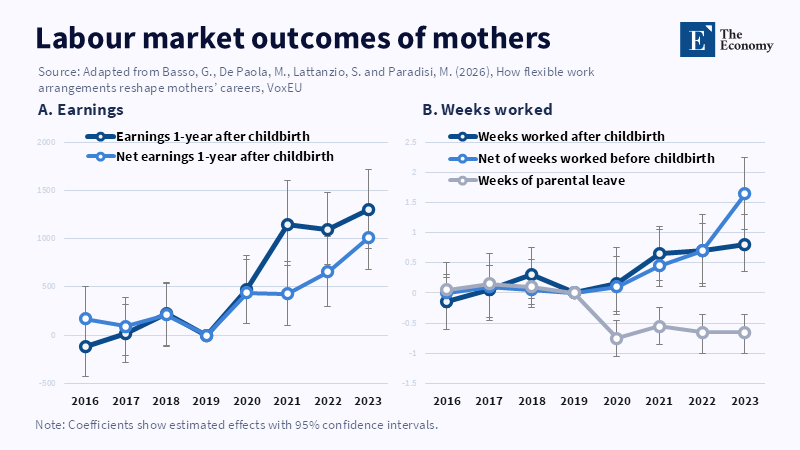
This is why the policy value of WFH jobs exceeds the interest in the office environment that is generally discussed. Flexible work is often treated as a perk by firms. For mothers, it acts more as wage insurance because it helps sustain career progress at a point in time when the labor market otherwise sanctions it. It also affects who among women benefits the most from it. The extent of the Italian evidence appears higher among young mothers, among lower-earning mothers, among commuting mothers and among mothers with jobs where an excess of working hours benefits pay. The latter result is important because it indicates that flexible jobs are best at relieving constraints where those are the strongest (heavy workload, for example). It also suggests that the availability of WFH jobs can be more effective against inequality within female workers than against inequality between women and men.
Spouse WFH jobs make flexibility a family resource
Perhaps the most significant result is not about mothers' own WFH jobs but about the jobs of their partners. Mothers' earnings loss also disappears when a father or spouse has a remote-work job. Fathers' own wages are unaffected by childbirth. What does this suggest? It suggests that it's not only a mother who goes to a softer job. This suggests that WFH changes the household’s time budget, not only the mother’s job choice. A partner who can handle a sick child, a nursery pickup, or a delivery window gives the mother more room to stay attached to paid work. In this sense, WFH works best when it is not treated as a mothers-only benefit.
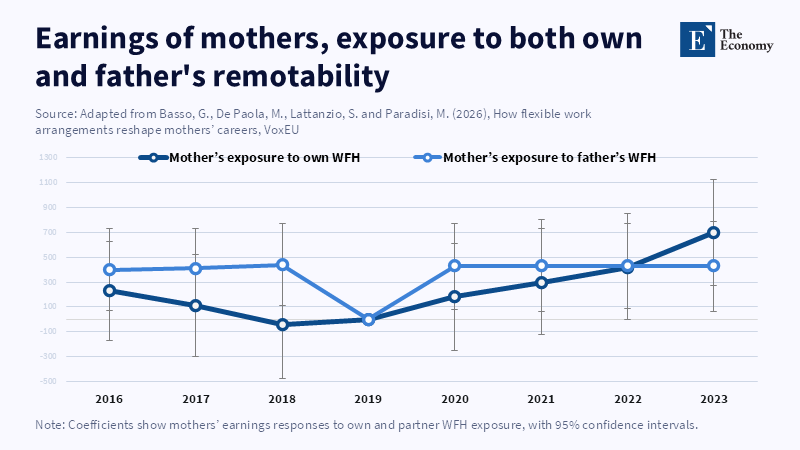
This is a concern that is easily overlooked. If flexible work is associated with mothers, it risks falling into the "old" part-time trap. Employers can interpret the imprecise signals of flexibility as an indicator of lower commitment levels. Men might not seek out the arrangements. Managers might consciously or unconsciously reserve such arrangements for employees who specifically request them, not those who want a normal, modern schedule. The optimal modification is actually quite different. Jobs that lend themselves to WFH should be identified as appropriate arrangements in general: for men as well as women, for single parents and dual-career couples, for households that include two mothers, two fathers, one man and one woman, or a non-mom caregiver or caretaker of either sex. The objective is not to prescribe one well-functioning model of a family. The goal is to lower the costs and prevalence of care shocks regardless of household configuration.
This is where fertility enters the argument. Fertility is often brought up as a financial problem. Money matters, but free time might matter more. The fertility rate across OECD economies has fallen well below replacement across many wealthy nations and in the EU, the rate was approaching 1.34 births per woman by 2024. Birth subsidies do very little to help address a crunch that one has every day of the week. It cannot pick up a newborn at 4 pm. It cannot erase a long commute. WFH jobs can reduce the real income penalty associated with having a child, because they diminish the number of hours that need to be paid for, yet can be used for parenting. Cross-country evidence using 38 sample countries finds that people working from home at least once a week have both experienced and higher expected fertility. In cohabiting couples where both partners work from home at least once a week, lifetime completed fertility will be around 0.32 children higher, compared to comparable couples where neither partner worked from home, which is a sizable effect in a realm where numerous state and local governments invest money to bring about such demographic changes.
The cash value of WFH jobs is real, but not the whole story
The value of WFH jobs is not in the abstract. Workers price it. Recent evidence on tech job selection suggests that employees would be willing to sacrifice roughly 25 percent of their pay to avoid a five-day commute. This translates to $60,000 annually in the sample studied. Survey research and a few studies of job choice in the past cited a value ten-fold smaller, roughly five per cent to ten per cent of wages, so the exact value depends on the sample and research design. But the sign is clear. WFH jobs are never free-there is always a cash value for workers and that cost is higher if the commute is longer, the needs for child and infirm care increase, or the substituted job options are less attractive.
For women, this will matter because the private value of flexibility will not be distributed equally. Remote work saves more than lunch money and fuel. A study of 27 countries found that a work-from-home day saves an average of 72 minutes of commuting time. Workers apply a bit of that saved time to being paid, a bit to relaxation and a bit to care. For parents, the care share becomes particularly significant. Those minutes are sitting in that one perfectly timed space between a full-time job that has a time squeeze and a job that can't be done once a child arrives. That's why anonymous worker forums often sound so much more desperate than management surveys. Some workers say they'd need substantial pay raises to go back to the office. Those small voices may be far from clean data, but they proclaim a truth: workers are experiencing WFH jobs as money, time, health and family continuity all at once.
A tougher inequality problem remains. Working from home is concentrated among workers with higher wages and higher education. In 40 countries, work from home has taken a new level after the COVID-19 lockdowns. Workers with a college degree spend, on average, about one day per week working from home and in English language countries, this is much higher than in mid to high-income European regions. If the net wages of WFH workers in France are significantly higher than those of on-site workers, based on raw data. In most cases, that is a reflection of selection on higher-paid jobs and stronger workers after holding for lagged wages; the WFH wage premium narrows to zero. That should not undermine the WFH jobs' case, but reframe it. For this form of job quality, mostly captured by workers with bargaining power, the challenge is to ensure access. The risk is not that WFH jobs are overvalued, but they are yet another benefit for those who are already familiar with the bargaining game.
The productivity critique is weaker than the design critique
The common objections to WFH jobs are that they decrease output, learning, loyalty or creativity. Some of that is valid. For many professions, remote work inhibits mentoring. New workers and early-career employees may depend on weak networks. Some jobs cannot be delivered remotely. Some supervisors manage remotely poorly, with a relentless stream of meetings and no right to switch off. But such shortcomings are a matter of design and not evidence of the superiority of office work. A large technology firm conducted a significant randomized experiment of hybrid work arrangements and concluded that with two days at home, there was no effect on post-experiment performance or promotion. Compared to a purely office-based regime, two days at home significantly reduced the chance an employee would quit in the follow-up period (by approximately one-third). The category effects were strongest for women, for non-managers and for those with a very long commute; precisely the workforce segment that should be prioritized for a desire to open some days.
The takeaway is not that every role should be 100% remote. The takeaway is that blunt return-to-office mandates are throwing away a vital labor-market input. Hybrid offices, where you work from home some days but not others, can maintain the social side of the office without the cost of turning up every day. Managers in firms that are offering flexibility should carefully monitor output, not chair time. Firms should compare pay, promotion and turnover between men and women and between those with or without children after the policy change and treat this as part of workforce planning. The government should incorporate WFH-enabled jobs into labor-market infrastructure along with childcare, parental leave, transport and broadband access. A role that can be done from home but is limited to the office is effectively a tax on care.
The most difficult objection would be that WFH cannot help cleaners, drivers, retail workers, nurses and teachers. That is right. But that is also not at all an argument against WFH. It is an argument against making WFH the only family policy. Paralleling reforms for the on-site jobs would be predictable schedules, paid sick leave, affordable childcare, shift selection and reduced commuting. For remote-suitable jobs, the reform would be to institutionalize flexibility as normative, negotiated one worker at a time. Equity does not mean withholding flexibility from office workers because other workers do not have it. Equity means creating the matching form of flexibility in each sector.
WFH jobs should be treated as family policy, not a perk
The flaw is to split work design from family policy. Work design should have been concurrent with family policy. Governments try to raise fertility with cash. Firms seek to pay workers to stay. Women should have been given better support before those problems become private burdens. WFH jobs reveal the flaw. They prove that there can be one institutional rule that pays mothers, benefits households, assists dual carers and reduces fertility costs. Therefore, WFH jobs must become a normal part of family policy because they change the timing and location rules that make care expensive. They are not a soft perk. They are more like a practical labor-market tool.
The next step must be targeted at precision. It should delineate remote eligibility by task, not by bureaucratic scheduler state-of-mind. Can hybrid, family-friendly contract language be written into eligible roles? Mothers' and fathers' agencies should marshal every argument in favor of normal WFH days for both parents, because partner flexibility supports mothers' labor-market attachment. Firms should protect remote workers from promotion penalties and treat flexibility as a retention tool. The states should support broadband, digital management skills and care infrastructures so that WFH jobs do not threaten to barricade middle-class privilege. The remaining question: will firms and policymakers permit such flexible work to become normal, fair and durable?
The views expressed in this article are those of the author(s) and do not necessarily reflect the official position of The Economy or its affiliates.
References
Advisory - Strategy Desk (2026) ‘Top 20 Workforce Strategy Advisory 2026’, Advisory Ranking, 28 April.
Aksoy, C.G., Barrero, J.M., Bloom, N., Davis, S.J., Dolls, M. and Zarate, P. (2023) ‘Time savings when working from home’, AEA Papers and Proceedings, 113, pp. 597–603.
Azpúrua, A.E. (2025) ‘Remote Work or More Pay: What Tech Workers Value in One Chart’, Harvard Business School Working Knowledge, 9 December.
Basso, G., De Paola, M., Lattanzio, S. and Paradisi, M. (2026) ‘How flexible work arrangements reshape mothers’ careers’, VoxEU, 5 June.
Basso, G., De Paola, M., Lattanzio, S. and Paradisi, M. (2026) Workplace Flexibility and the Motherhood Penalty: Evidence from the Diffusion of Remote Work. WorkINPS Papers No. 122.
Blind user (2026) ‘How much do you value a remote job?’, Blind WFH & RTO Forum, 3 March.
Bloom, N., Han, R. and Liang, J. (2024) ‘Hybrid working from home improves retention without damaging performance’, Nature, 630, pp. 920–925.
Cullen, Z.B., Pakzad-Hurson, B. and Perez-Truglia, R. (2025) Home Sweet Home: How Much Do Employees Value Remote Work? NBER Working Paper No. 33383.
Davis, S.J., Aksoy, C.G., Barrero, J.M., Bloom, N., Cranney, K., Dolls, M. and Zarate, P. (2026) ‘Remote work can blunt the fertility decline’, VoxEU, 25 March.
Eurostat (2026) ‘EU fertility rate at 1.34 live births per woman in 2024’, Eurostat News, 6 March.
Healthcare Ranking Editor (2023) ‘Hospitals, Clinics & Care Providers Outlook 2023’, Healthcare Ranking, 28 January.
Li, H., Sauvagnat, J. and Schmitz, T. (2026) ‘The work-from-home wage premium’, VoxEU, 24 February.
Li, H., Sauvagnat, J. and Schmitz, T. (2026) The Work-from-home Wage Premium. Federal Reserve Bank of San Francisco Working Paper 2026-02.
OECD (2024) Society at a Glance 2024: OECD Social Indicators. Paris: OECD Publishing.
Ranking News Editor (2026) ‘National Competitiveness Indices and Their Role in Economic Policy Reform’, The Ranking News, 16 March.
Working across research, policy, and data-driven analysis, the Editorial Board ensures that published pieces reflect a consistent institutional perspective grounded in quantitative reasoning and long-term structural assessment.