[Oil to Conflict] When Governments Fail to Mediate Resource Wealth: Three Warnings from the Front Line

Working across research, policy, and data-driven analysis, the Editorial Board ensures that published pieces reflect a consistent institutional perspective grounded in quantitative reasoning and long-term structural assessment.
Authored On
Modified
Three countries, one pattern: delay and resource wealth turns violent
Nigeria, Mozambique and Peru all had warning and ignored it
Unmediated resource wealth is what destabilizes, not resource wealth itself
Sixteen thousand. That is the estimated number of neonatal deaths linked every year to oil pollution in Nigeria's Niger Delta, in a region that has produced petroleum for close to seventy years. Life expectancy there sits near 41 years, twenty years below the national average. This is not the story of a resource curse that struck without warning. It is the story of a state that had decades to build a workable system for sharing resource wealth and managing local grievance and did not. Oil price shocks and resource booms do not create conflict on their own. They create pressure. What decides whether that pressure turns into unrest is whether a government mediates, invests and shares power in time. The cases below show what happens when it does not.
When Mediation Fails, Violence Fills the Gap
A resource boom does not have to end in violence. Where governments respond quickly, share rents transparently and treat nearby communities as stakeholders rather than obstacles, the same conditions that fuel conflict elsewhere can instead fund development. The difference between these two outcomes rarely comes down to the resource itself. It comes down to institutional response. Weak land rights, opaque revenue flows, absent local government and heavy-handed security deployments turn a valuable discovery into a source of grievance rather than growth.
The three cases that follow, drawn from oil, gas and mining, span very different regions and political systems. What links them is a pattern of state failure that repeats with striking consistency. A resource becomes valuable. Local communities see limited benefit and mounting harm. Complaints go unresolved for years. Security forces arrive to protect infrastructure rather than to protect people. Eventually, the grievance hardens into sustained unrest that no amount of belated compensation can quickly undo. None of these outcomes was inevitable. Each reflects a specific set of choices, made and unmade, by a government that could have acted differently.
Niger Delta: Decades of Broken Promises
Nigeria's oil-producing Niger Delta remains one of the starkest examples of unresolved resource conflict anywhere in the world. National regulators recorded 732 oil spills across the region in 2024, a 28% increase on the previous year, with sabotage and theft cited as the dominant cause in the majority of cases. A separate satellite-based tracking system counted 589 spills that year, releasing an estimated 19,000 barrels and 1,162 spills the year before that. Independent researchers using radar imagery found that mangrove forests across the delta have been dying at a rate of more than 5,600 hectares a year since 2016, a scale of ecological loss equivalent to dozens of football pitches disappearing every day.
The government agency created in 2012 specifically to clean up pollution in Ogoniland, one of the delta's worst-affected areas, has made only limited progress more than a decade later, according to independent assessments of the programme. Local frustration over stalled remediation, unresolved compensation claims and continued gas flaring has fed a long-running cycle of pipeline sabotage, illegal refining and militant activity that in turn produces further spills, further pollution and further grievance. A 2023 study commissioned by a delta state government described the cumulative effect on public health as amounting to environmental devastation. The pattern is nearly forty years old. What has changed less than the technology of extraction is the state's capacity, or willingness, to mediate the conflict its own regulatory failures keep reproducing.
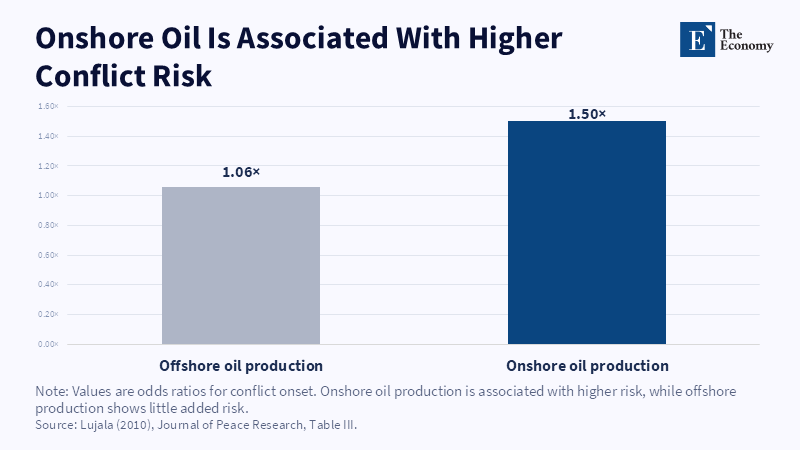
Cabo Delgado: Gas Wealth Meets an Absent State
Mozambique's northern Cabo Delgado province sits on some of Africa's largest natural gas reserves, discovered in 2010 and now the subject of one of the continent's biggest single foreign investments. Since an insurgency began in the region in 2017, more than 6,100 people have been killed, according to independent conflict trackers, including 364 in the most recent full year of data. The violence has forced well over a million people from their homes at various points in the conflict, with tens of thousands displaced again in single incidents as recently as the past year. Humanitarian agencies operating in the province describe funding for the response as covering less than a fifth of what is needed, leaving displaced families without adequate shelter, water, or healthcare even as fresh waves of displacement continue.
The government's response has combined foreign troop deployments with a resumption of the stalled gas project, but has done little to resolve the underlying grievances that gave the insurgency its initial foothold, including land dispossession, unmet compensation promises and the visible gap between gas wealth and local poverty. Communities near the project site staged protests in 2024 after waiting more than a year for compensation they had been promised. Allegations that security forces protecting the gas facility were involved in serious abuses against civilians have since triggered criminal investigations in Mozambique and formal complaints filed abroad. Whatever the outcome of those investigations, the sequence is familiar: a resource discovery, a security response focused on protecting infrastructure rather than people and a local population left to conclude that the state's priorities lie elsewhere.
Peru's Mining Corridor: Chronic Conflict Without Resolution
Peru offers a different kind of warning, not a single dramatic insurgency but a chronic, grinding pattern of unresolved local disputes. The country's human rights ombudsman has tracked several hundred active social conflicts nationally in every recent monthly report, with mining consistently the largest single category. In one recent count, conflicts tied to mining made up close to two-thirds of all active socio-environmental disputes nationwide, concentrated heavily in the southern mining corridor running through Cusco, Apurímac and Puno. Mining generates a substantial share of Peru's export earnings and tax revenue, yet the ombudsman's own data show that more than half of the country's social conflicts have gone unresolved for over three years and in some monthly reports for considerably longer.
The pattern in specific flashpoint communities, including long-running disputes over water contamination and land access near several major copper and gold operations, shows the same features found in Nigeria and Mozambique: distrust built up over legacy environmental damage, unmet promises from earlier project phases and a state seen locally as siding with investors during disputes. Government mediators are regularly deployed to individual conflicts and dialogue processes are opened for a majority of active cases at any given time, yet the overall conflict count has stayed in a broadly similar range for years rather than trending down. This is arguably the most instructive case of the three, since it shows that mediation efforts without follow-through and enforceable local benefit-sharing can coexist with a resource conflict problem that never actually resolves, only cycles.
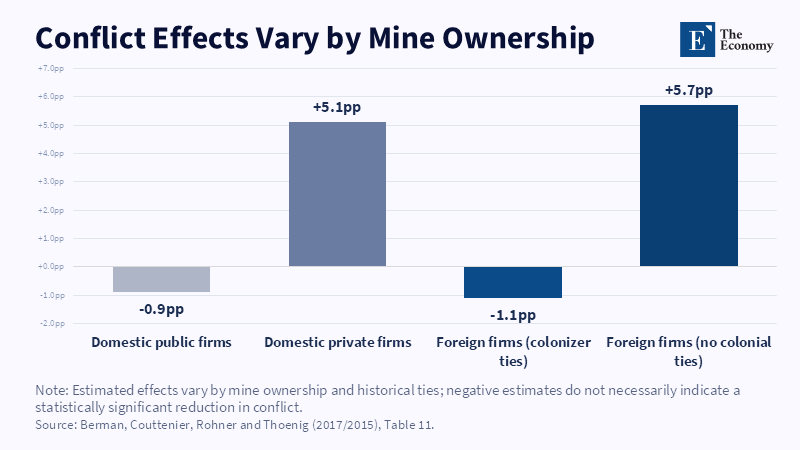
The Common Thread and What It Demands of Governments
Read together, these three cases show that the specific resource, whether crude oil, liquefied natural gas, or copper and gold, matters far less than the quality of the institutional response around it. In each case, a government had clear early warning: pollution data in Nigeria, land disputes in Mozambique and a formal, published conflict-tracking system in Peru that has flagged mining as the dominant source of unrest for years. In each case, that warning was not translated into a mediation process capable of resolving grievances before they hardened. Security spending consistently outpaced spending on remediation, compensation, or local development, reinforcing the perception that the state exists to protect the resource rather than the people living beside it.
The lesson for policymakers elsewhere is not that resource wealth is inherently destabilising. It is that unmediated resource wealth is. Where compensation is paid promptly and transparently, where environmental damage is remediated rather than documented and left and where local communities have a genuine channel to raise grievances before they escalate, resource booms can fund the very institutions needed to manage them. Where those channels are absent or hollow, as in each case examined here, the same boom becomes a recurring source of instability that outlasts any single price cycle. Governments facing a new resource discovery or price shock would do well to treat these three cases not as distant cautionary tales, but as a fairly precise description of the path they are already on unless mediation capacity is built before, not after, the unrest begins.
Nigeria, Mozambique and Peru did not arrive at sustained resource conflict through bad luck. They arrived there through a shared sequence of delayed compensation, weak remediation and security responses aimed at infrastructure rather than people, repeated across decades in one case and years in the others. The pattern is now well enough documented that no government facing a new resource boom can credibly claim it was unforeseeable. What remains genuinely uncertain is whether that documentation will change behaviour before the next discovery, or only after the next community has already lost patience with waiting.
The views expressed in this article are those of the author(s) and do not necessarily reflect the official position of The Economy or its affiliates.
References
Berman, N., Couttenier, M., Rohner, D. and Thoenig, M. (2017) 'This mine is mine! How minerals fuel conflicts in Africa', American Economic Review, 107(6), pp. 1564-1610.
Business and Human Rights Centre (2026) Mozambique: Cabo Delgado conflict death toll tops 6,100 amid ongoing violence, child abductions, and TotalEnergies' planned $20bn gas project resumption. London: Business and Human Rights Resource Centre.
CooperAcción (2025) ¿Cómo van las concesiones mineras en el Perú? Lima: CooperAcción.
Defensoría del Pueblo (2024) Reporte de conflictos sociales n.° 240, febrero 2024. Lima: Defensoría del Pueblo.
Defensoría del Pueblo (2025) Reporte de conflictos sociales n.° 257, julio 2025. Lima: Defensoría del Pueblo.
European Center for Constitutional and Human Rights (2025) The price of gas in Mozambique: Accusations of complicity in war crimes against TotalEnergies. Berlin: ECCHR.
Lujala, P. (2010) 'The spoils of nature: Armed civil conflict and rebel access to natural resources', Journal of Peace Research, 47(1), pp. 15-28.
Nairametrics (2025) 'Nigeria recorded over 589 oil spills in 2024, most caused by oil theft', Nairametrics, 17 January.
National Upstream Petroleum Regulatory Commission (2025) 'Sabotage caused 66% of oil spills in Niger Delta in 2024', reported in Arise News, 3 August.
Nwokolo, A. (2018) Oil price shocks and civil conflict: Evidence from Nigeria. HiCN Working Paper 274. Brighton: Households in Conflict Network, Institute of Development Studies, University of Sussex.
O'Farrell, J. et al. (2025) 'Study reveals extent of ecological damage from Niger Delta oil spills', University of Galway research summary, reported in Phys.org, 17 February.
Peru Support Group (2021) The Defensoría registers 195 conflicts in its latest tally. London: Peru Support Group.
Sustainable Development Institute and Centre for Research on Multinational Corporations (2024) Big oil is deserting the polluted Niger Delta. Reported in Earth Island Journal.
United Nations Office for the Coordination of Humanitarian Affairs (2026) Mozambique humanitarian response plan 2026: Mid-year update. Maputo: OCHA.
Working across research, policy, and data-driven analysis, the Editorial Board ensures that published pieces reflect a consistent institutional perspective grounded in quantitative reasoning and long-term structural assessment.