[Oil to Conflict] Oil Price Shocks Are Power Shocks: Why Governments Must Redraw Their Conflict Maps

Working across research, policy, and data-driven analysis, the Editorial Board ensures that published pieces reflect a consistent institutional perspective grounded in quantitative reasoning and long-term structural assessment.
Authored On
Modified
Oil price shocks redraw local power, not just budgets
Conflict clusters around oilfields even when national numbers stay calm
Governments are watching the wrong map

Between February and April 2026, the price of a barrel of crude oil jumped from $68 to $104. That is a rise of more than half in eight weeks. For an oil field sitting quietly under a poor rural district, this is not an abstract market move. The ground underneath it just became far more valuable. New research covering 131 low- and middle-income countries between 1989 and 2021 finds that a 55 percent rise in oil prices raises the monthly chance of conflict in oil-bearing areas by roughly 7.7 percent. Across a full boom cycle, that risk can climb by close to 46%. Yet national conflict statistics barely move. This gap between the local picture and the national one is not a data glitch. It is a warning that oil price shocks are, above all, shocks to who holds power on the ground.
Oil Price Shocks Redraw Local Power, Not Just Budgets
Most public debate about oil price shocks stays at the macro level. Analysts ask how a price spike feeds into inflation, how central banks should respond and how much growth a country will lose or gain. These questions matter and they deserve the attention they get. But they miss something that happens well before any of it reaches a finance ministry. A sharp rise in the value of a resource changes who wants to control the land where it sits. It changes what a local warlord, a militia, a state security unit, or a community group stands to gain from that control. None of this shows up in a GDP forecast. It shows up on a map, at the level of a single valley, oilfield, or pipeline corridor.
This is why oil price shocks deserve to be treated as shocks to the domestic distribution of power rather than simple shocks to national income. When the price of oil rises, it does two separate things at once. First, it raises the value of controlling the territory that holds the resource, which sharpens the incentive to fight over that territory. Second, in places where local communities feel they see little benefit from rising oil wealth, it can deepen resentment over how the gains are shared, turning visible infrastructure such as pipelines and refineries into flashpoints for protest and sabotage. These are different mechanisms, with different actors, different targets and different remedies. Treating them as one undifferentiated "oil and conflict" story is part of why the evidence has looked so muddled for so long.
The Numbers Behind the Local Power Shift
The pattern becomes clear once researchers compare oil-bearing land with non-oil land inside the same country and month, as global prices move. One recent study built a monthly grid of roughly 55 by 55 kilometre cells across the sample countries, pairing conflict event data with detailed maps of oilfields, extraction sites, refineries and pipelines. The design rules out confounding from national politics or global shocks, since it holds the country and month fixed. Comparing the lowest oil price in the sample period with its peak roughly a decade later, the predicted probability of conflict in oil-bearing cells rose by close to 46%, while the risk in neighbouring, non-oil cells fell. This decline in surrounding areas is the missing piece of the puzzle. Conflict is not simply added somewhere; it is pulled toward the prize and pulled away from places without one.
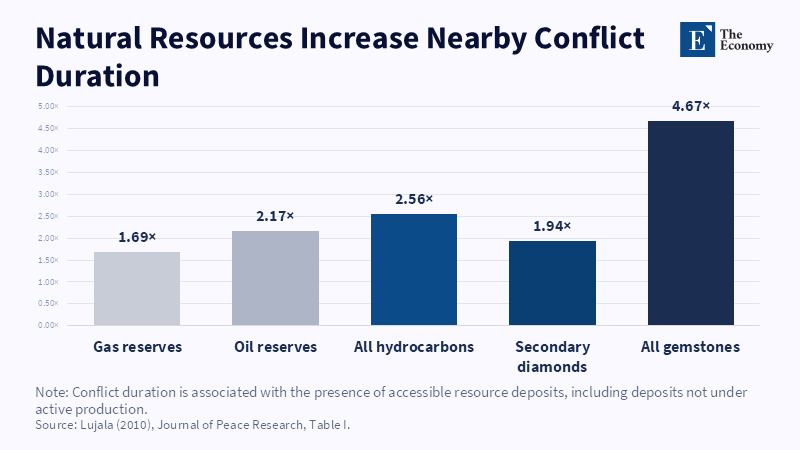
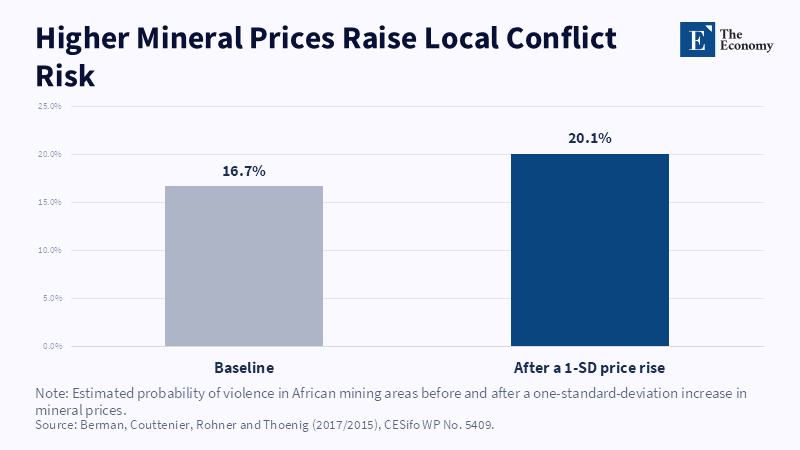
This spatial reallocation explains why decades of country-level studies reached such contradictory conclusions. Averaged across an entire nation, a large local increase in one set of cells and a modest decline spread across many surrounding cells can net out to almost nothing. A widely cited review of more than 350 studies on commodity prices and conflict found no reliable average effect across all the natural experiments it examined, which is exactly what this cancelling-out would predict. The same logic applies beyond oil. A separate body of work on mineral price booms in Africa found that the 2000s surge in metal prices may account for a meaningful share of conflict across the continent, concentrated near mining sites rather than spread evenly across borders. Oil is not a special case. It is one instance of a broader pattern involving concentrated, high-value resources.
Beyond Oil: Any Concentrated Resource Can Trigger the Same Shift
The same logic extends well past petroleum. A resource is more likely to generate this kind of local power shift when it is geographically concentrated, hard to move, highly valuable, controllable by a small number of actors, easy to tax or loot and located in regions that already feel excluded from national politics. Diamonds, timber, cobalt and gold all fit this description in different settings and the evidence largely agrees. Agricultural commodities behave differently, since a price rise there tends to raise the earnings of ordinary farmers and fighters alike, which increases the opportunity cost of taking up arms rather than reducing it. Studies of coffee and cocoa prices in several conflict-affected regions have found exactly this pacifying effect, in sharp contrast to the destabilising effect of a boom in oil, minerals, or timber.
Nor does this dynamic respect national borders. Formal modelling of resource-driven conflict between neighbouring states shows that a country with valuable, geographically exposed resources near a shared border faces a higher likelihood of inter-state conflict, particularly when the resource-rich country is militarily weaker than its neighbour. A domestic power shift caused by an oil discovery or a price boom can therefore ripple outward, changing the calculus of a neighbouring government as well as domestic factions. Border regions, already the areas furthest from a capital's oversight, sit at the intersection of both risks. This is a second reason why local, granular monitoring matters more than aggregate risk indices: cross-border tension often starts exactly where domestic tension is easiest to overlook.
What Governments Should Actually Track
If oil price shocks are power shocks, then the standard toolkit of national risk ratings and country-level conflict counts is not fit for purpose. A government serious about anticipating unrest needs to track its extraction sites, processing infrastructure and undeveloped fields as separate categories, since the evidence shows they respond to price changes in different ways and at different speeds. It needs to combine global price movements with a granular map of where resource exposure actually sits, rather than applying one national risk score to an entire territory. It should pay particular attention to communities near resource sites that already feel politically excluded, since grievance and opportunity reinforce each other in exactly these places.
Ownership structure matters just as much as geography. Where extraction is dominated by state-owned firms, price booms tend to produce sharper local power struggles than where foreign or private firms hold the assets, likely because domestically controlled rents are more visibly contested within national politics. Distinguishing between organised armed conflict, civil protest, sabotage and violence against civilians is not a bureaucratic nicety; each of these responds to different triggers and calls for a different government response. Finally, security deployments themselves need to be monitored for their side effects. Sending more troops to protect a pipeline can, in some settings, become a new source of local grievance rather than a solution, particularly where those forces are seen as protecting outside interests rather than the surrounding community.
Answering the Skeptics
A natural objection is that if national conflict statistics show little change during oil booms, the risk described here must be overstated. This objection gets the causality backwards. National statistics look calm precisely because a sharp local increase in one type of cell is offset by a decline in the many cells around it, not because nothing is happening. Researchers have tested this reallocation story against a battery of checks, including a placebo test using coconut oil prices, which are unrelated to territorial value and correctly show no effect. The pattern survives when the ten largest oil producers are excluded from the sample, which rules out the possibility that a handful of major producing states are driving the entire result.
A second objection holds that this is a story about oil alone and has limited relevance elsewhere. The evidence does not support that reading. The same mechanism, a rise in the value of controlling a fixed, valuable, extractable asset, applies to minerals, diamonds and other spatially concentrated resources, with broadly similar results across very different regions and time periods. What changes across resource types is not whether the mechanism operates, but how strongly, depending on ownership structure, how easily the resource can be taxed or looted and how excluded the surrounding population already feels from national decision-making. That is not a reason for fatalism. It is a fairly precise list of the conditions a government can actually monitor and, in some cases, change.
Oil markets will keep swinging and the next price shock is only a matter of time. The choice facing governments is not whether prices will move, but whether their conflict monitoring will move with them. A national risk score updated once a quarter cannot see a militia recalculating its odds around a single oilfield within weeks of a price spike. What can see it is a monitoring system built around resource sites, infrastructure type, ownership and the communities living nearest to the rents. Building that system before the next boom, rather than during it, is the clearest lesson this evidence has to offer. The next sharp rise in oil prices will redraw someone's map of local power. The only open question is whether any government will be watching the right map when it happens.
The views expressed in this article are those of the author(s) and do not necessarily reflect the official position of The Economy or its affiliates.
References
Andersen, J.J., Nordvik, F.M. and Tesei, A. (2022) 'Oil price shocks and conflict escalation: Onshore versus offshore', Journal of Conflict Resolution, 66(2), pp. 327-356.
Bazzi, S. and Blattman, C. (2014) 'Economic shocks and conflict: Evidence from commodity prices', American Economic Journal: Macroeconomics, 6(4), pp. 1-38.
Berman, N., Couttenier, M., Rohner, D. and Thoenig, M. (2017) 'This mine is mine! How minerals fuel conflicts in Africa', American Economic Review, 107(6), pp. 1564-1610.
Blair, G., Christensen, D. and Rudkin, A. (2021) 'Do commodity price shocks cause armed conflict? A meta-analysis of natural experiments', American Political Science Review, 115(2), pp. 709-716.
Caselli, F., Morelli, M. and Rohner, D. (2013) The geography of inter-state resource wars. NBER Working Paper No. 18978. Cambridge, MA: National Bureau of Economic Research.
Cotet, A.M. and Tsui, K.K. (2013) 'Oil and conflict: What does the cross country evidence really show?', American Economic Journal: Macroeconomics, 5(1), pp. 49-80.
Dal Bó, E. and Dal Bó, P. (2011) 'Workers, warriors, and criminals: Social conflict in general equilibrium', Journal of the European Economic Association, 9(4), pp. 646-677.
Dreher, A., Pan, J. and Herrmann, M. (2026) Refineries, pipelines and petroleum fields: The impact of oil on conflict around the world. CEPR Discussion Paper No. 21648. London: Centre for Economic Policy Research.
Dube, O. and Vargas, J.F. (2013) 'Commodity price shocks and civil conflict: Evidence from Colombia', Review of Economic Studies, 80(4), pp. 1384-1421.
The Economy Research (2026) 'Iran's postwar settlement: Sanctions relief, private-sector reopening, and the political economy of regime survival', The Economy Research, 3 May.
Lujala, P. (2010) 'The spoils of nature: Armed civil conflict and rebel access to natural resources', Journal of Peace Research, 47(1), pp. 15-28.
McGuirk, E. and Burke, M. (2020) 'The economic origins of conflict in Africa', Journal of Political Economy, 128(10), pp. 3940-3997.
Miguel, E., Satyanath, S. and Sergenti, E. (2004) 'Economic shocks and civil conflict: An instrumental variables approach', Journal of Political Economy, 112(4), pp. 725-753.
World Bank (2026) Commodity markets outlook, April 2026. Washington, DC: World Bank.
Working across research, policy, and data-driven analysis, the Editorial Board ensures that published pieces reflect a consistent institutional perspective grounded in quantitative reasoning and long-term structural assessment.