Time-to-Power Is the New Test of AI State Capacity

Working across research, policy, and data-driven analysis, the Editorial Board ensures that published pieces reflect a consistent institutional perspective grounded in quantitative reasoning and long-term structural assessment.
Authored On
Modified
Time-to-power now shapes the economics of AI infrastructure
Faster deployment can strengthen innovation but also shift grid costs to the public
Governments need coordinated, transparent rules that reward speed without weakening fairness or reliability.

By 2024, data-centres consumed 22 percent of all metered electricity in Ireland. Urban dwellings accounted for 18 percent. That comparison encapsulates the new politics of artificial intelligence in one sentence. AI is presented as software that can be rolled out with better algorithms, cheaper gadgets and broader availability. Its fastest gains, however, depend on power stations, transmission links, permits, land and cooling systems and state-of-the-art chips. The policy yardstick is thus time-to-power: the interval from a serious project proposal to the moment when its chips begin useful computation. A shorter interval can increase private revenues and accelerate national AI development. But speed alone is no public strategy. A country can approve infrastructure projects more quickly and pass on grid costs, undermining reliability and prolonging dependence on imported hardware. The true battle in AI infrastructure is therefore not over who builds at what cost. It is over which governments can convert electricity into compute swiftly, fairly and securely. Time-to-power has become a dimension of state capacity.
Time-to-Power Is More Than a Cost Metric
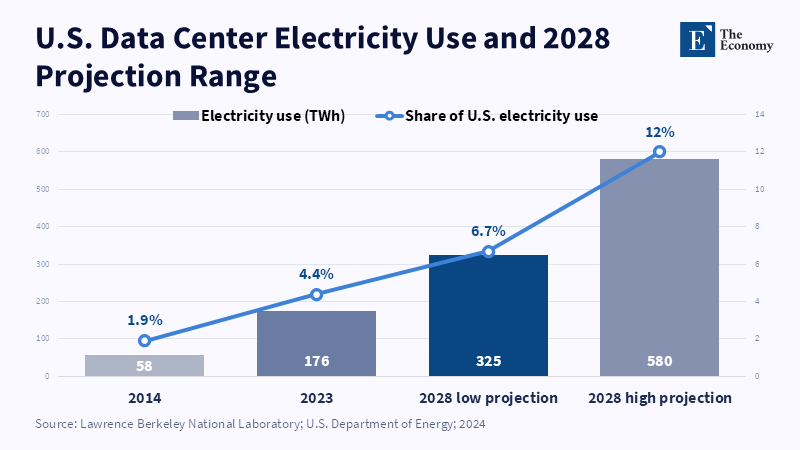
The magnitude of the power transition makes delays matter more than in earlier IT booms. Global data-centre electricity use was roughly 415 terawatt-hours in 2024. The International Energy Agency expects the figure to reach 945 terawatt-hours by 2030. AI is the chief cause of growth. In the US, data center power demand was around 176 terawatt-hours in 2023, accounting for 4.4% of total demand. The projected range for 2028 is much broader: 325-580 terawatt-hours, or 6.7-12 percent of supply. These loads are far too large to be placed on the fringe of the grid. They are sizable industrial loads arriving at places where additional generation, transmission lines and transformer stations already require years to deploy. Hence, time-to-power must be understood not just as the speed with which a data center can be constructed. It also measures whether the energy infrastructure, planning systems and financial markets can all move together.
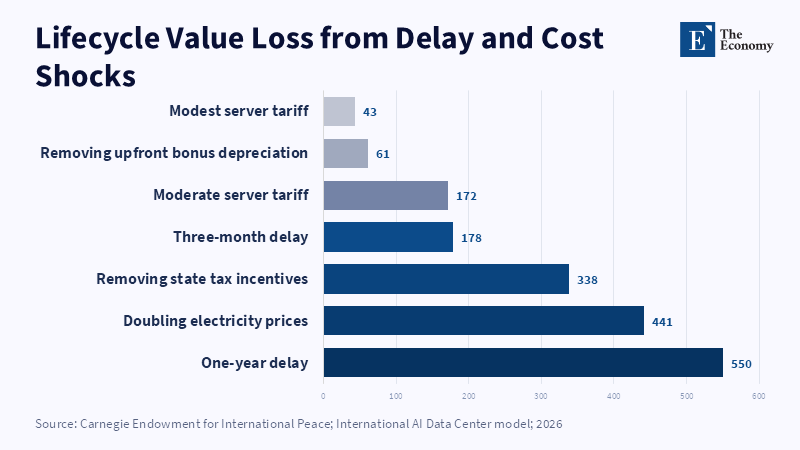
The dollar impact is also greater than many policy discussions would suggest. A cross-national model of a 100-megawatt AI data center suggests that a one-year delay in bringing a given project online could reduce its value by about $550 million over its lifespan. In the same model, a doubling of electricity prices decreased the project's value by approximately $441 million; the removal of common state tax incentives reduced it by roughly $338 million; and a moderate import tax on servers cut it by roughly $172 million. Exact figures depend, naturally, on estimates of revenue and usage, as well as the discount rate applied. The hierarchy remains clear. Early availability enables more computational output to be sold sooner. Its operator can begin developing products, testing commercial prototypes and delivering services before the competition's project is even authorized. That is why time-to-power must be a core element in AI development policy. It connects investment to research speed, product introduction and market creation.
The countrywide productivity effect extends well beyond the revenue generated by a single server. Computation that is available earlier can fund broad research teams, startup businesses, novel laboratories and government agencies. Delayed compute pushes those users towards foreign providers. Over the long term, this leads to the migration of skills, data and consumption to power-abundant locations. No devastating loss of technological capacity occurs after one delay. Instead, relentless loss of options occurs. Local enterprises pay elevated costs, consume more resources, or have limited access to infrastructure. Data scientists await the necessary capacity or relocate their work. Public agencies obtain more technology services, but on terms negotiated elsewhere. A country may still utilize state-of-the-art AI. But it possesses less power and influence over digital costs, infrastructure and safety measures. Time-to-power is therefore a form of economic leverage. It determines who has the capacity to lead on digital advancements and who only has to be a customer.
Rapid Time-to-Power Still Has Pitfalls
The case for greater speed remains strong, but it can be misused. A policymaker might hear that delays destroy value and officials might rush approvals, offer full tax rebates, or pledge power before the grid can handle it. That mistake conflates faster decisions with stronger system capacity. The worst delays frequently stem from poor coordination, inconsistent grid analyses, speculative applications and absent transmission facilities. Eliminating rudimentary hurdles only shifts burdens onto the public. The infrastructure might open earlier, but households will face increased charges, emissions mandates will be harder to implement, or backup power sources will expand. The aim should not be the fastest conceivable time, but rather the most realistic time achievable without compromising affordability, dependability, or popular consensus.
Virginia illustrates the reasoning behind this conclusion. The state has experienced significant construction activity, generated substantial tax receipts and fostered a bustling data center ecosystem. Its official review also revealed that this rapid growth has substantially increased power demand. Additional generation and transmission will involve initially prohibitive costs and certain burdens could be shifted to those who did not induce the demand increase. Its analysis also found that Virginia's sales tax exemption on data center hardware was valued at around $928 million during the 2023 fiscal year. This does not imply that the initiative was without merit. It affirms that public support is already large enough to justify conditions. Tax concessions should not be simply incentives to establish a project, but instead ensure faster delivery of new power, additional grid assets, demand, side flexibility, quantifiable tax and employment commitments and safeguards against stranded investments.
The need on the supply side is equally compelling. In the US in 2023, power industry projects took a median of about five years to move from an interconnection request to commercial operation. By the end of that year, approximately 2,600 gigawatt of generation and storage capacity sought access to the grid, although many of these prospective infrastructure projects will not eventuate. These queues remain remnants of a slower period. They now host genuine projects, subpar proposals and duplicative demands competing for the same engineering and planning resources. No AI power infrastructure can rely on a grid that analyzes projects individually for years on end. Queue reform, firm entry requirements and coordinated regional planning are central to on-time implementation. So are accelerated approvals of inter-regional links and clustered supply of essential infrastructure. If bottlenecks are to be eliminated, then they must be eliminated, not subsidized.
A Public Pact on Time-to-Power
A credible, fast-tracking system should start by recasting a basic bargain. A proponent seeking priority should provide public benefits that reduce the cost or risk of rapid deployment. This can involve financing dedicated grid upgrades, contracting new low-carbon power, accepting interruption during rare periods of system stress, posting financial security against canceled projects, meeting fixed construction milestones and establishing safeguards against stranded capacity. It can also include a predetermined schedule for site opening. A site that misses the deadline should forfeit its position. Such regulations would distinguish credible projects from speculative applications and would channel scarce planning assets towards projects likely to operate. They would also give municipalities an objective justification for prioritizing one site over another. Presumed time-to-power must then be the result of optimal prioritization, not lax standards.
Electricity retail rates must be more predictable as well. Heavy consumers should be charged for the adjustments required to bring their loads online, including the risk that additional infrastructure cannot be recovered if demand does not materialize. Separate tariffs, long-term capacity commitments and minimum payments could mitigate that risk and shield households and smaller firms from increased power bills arising from concentrated data-centre demand. This does not imply the end of enterprise growth. Transparent pricing can accelerate investment, since utilities, utility regulators and urban governments acquire certainty of payment. Such clarity would also minimize misconceptions that citizens would end up footing the bill for private servers. In contrast, unclear cost allocation encourages disputes and public opposition. An effective time-to-power policy should therefore make the public bargain explicit before execution.
The third element should be disclosure. The lack of consistent figures on AI's electricity and water consumption persists because firms publish scant detail about specific facilities, models or workloads. Governments need not acquire proprietary specifications to monitor the industry. They need standardized figures for the anticipated peak electricity load, annual electricity use, backup power needs, water consumption, power source and load flexibility. After operations begin, initial forecasts should be compared against actual data. This allows system planners to plan their infrastructure and incentives accordingly. It enables communities to judge projects using the same core parameters. Most importantly, it exposes a central weakness in data centre policymaking: expressed efficiency talk that downplays the lack of a uniform indicator for the user load imposed.
Available federal funds should be invested with prudence. Seeing that marginal tax and electricity-cost savings often involve a narrow set of projects, blanket funds simply reimburse companies for objectives they already seek. A more effective policy aims to resolve joint issues. Transmission, substations, transformer supply and workforce training, digital permitting and widespread regional planning can serve a host of applicants along with other sectors. Incentivizing space and investment for private firms should remain narrow and conditional. It should resolve a common market failure or secure a public asset. Each compensatory reward should also be accompanied by an audit period and a clawback clause that recovers funds when commitments are not met. This limits government involvement to infrequent shifts and reduces the risk of costly bidding wars. Instead of supporting a data center, then, the best incentive would be a rapid build-up of new sources, additional power network links and predictable demand-side flexibility. That is the most cemented long-term success.
Democratic Time-to-Power Requires Coordination
Effective democratic time-to-power must be characterized by pragmatic arrangements. No single democratic country controls every part of the overall compute chain. Cutting-edge computer chips, state-of-the-art chip manufacturing, cloud, complex systems, critical components, power equipment and qualified personnel are propagated across different parts of the world. That renders national speed vital but incomplete. Allies must then agree on indicators that facilitate affordable, interoperable projects across borders. Bilateral arrangements may encompass data centers that meet assessments for aggregation, continuity, safety, emissions reporting and local power infrastructure. Joint purchasing can prevent shortages of transformers or other hardware. Collective safety analysis could prevent mundane repetitions. The strategy should not be an extravagant, giant plan but an interconnected web in which every person contributes a piece of the infrastructure and profits from its existence.
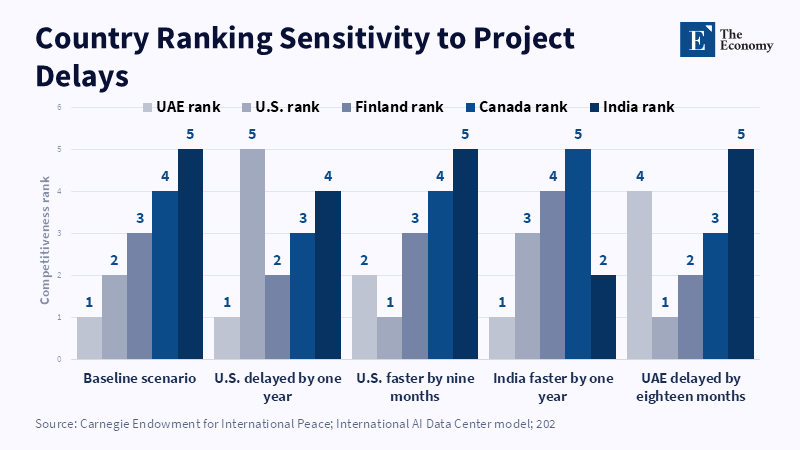
Coordinating them also corrects an inevitable concern. A focus on national computing can resemble a strategy of endless piggybacking and nation-state containment. It does not need to be so. Its rationale is founded on stability and compliance requirements. An expanded set of nominally trusted territories reduces the risk that a single grid failure, an authoritarian upheaval, or an external ban will inhibit modern capacity. Common reporting standards also make it more difficult for firms to seek the weakest oversight. Multinational standards can still enable national authorities to prioritize their energy plans, legislation and land preservation policies. Competition must continue, though on a more transparent basis of social obligations. time-to-power becomes a shared strategic capability rather than an effort to relax every restriction. That provides the most sustainable competitive advantage: affordable land and light expansion.
Ireland's 22 percent statistic ought to serve as a reminder. It's a reminder of how swiftly the next generation of digital power can become a dominant claim on a nation's energy grid. Its significance says more about the necessity of refraining from the house's digital planning than it does about the necessity of ceasing AI data centers. National governments should then measure time-to-power publish the main causes of delay, impose quick tracks in advance and link faster approvals to clear public conditions. These should reward additional power, broad grid capacity, end-user flexibility, unambiguous disclosures and equitable distribution of costs. Speed remains important, since even a year of delay can cost hundreds of millions of dollars and cripple the whole research process. However, the AI infrastructure leaders will not be the governments that merely approve projects first. The leaders will be the ones who can build quickly without leaving the public to absorb the hidden costs.
This article is based on an original research article published by The Economy Research. For the original version, please refer to Time-to-Power: The Hidden Economics of AI Infrastructure.
The views expressed in this article are those of the author(s) and do not necessarily reflect the official position of The Economy or its affiliates.
References
Central Statistics Office (2025) Data Centres Metered Electricity Consumption 2024. Cork: Central Statistics Office.
Federal Energy Regulatory Commission (2023) Improvements to Generator Interconnection Procedures and Agreements, Order No. 2023. Washington, DC: Federal Energy Regulatory Commission.
International Energy Agency (2025) Energy and AI. Paris: International Energy Agency.
Joint Legislative Audit and Review Commission (2024) Data Centers in Virginia. Richmond, VA: Joint Legislative Audit and Review Commission.
Phillips-Robins, A., Tawil, T. and Winter-Levy, S. (2026) The Compute Coalition: How to Build the Future of AI in the Free World. Washington, DC: Carnegie Endowment for International Peace.
Rand, J., Manderlink, N., Gorman, W., Wiser, R.H., Seel, J., Kemp, J.M., Jeong, S. and Kahrl, F. (2024) Queued Up: 2024 Edition—Characteristics of Power Plants Seeking Transmission Interconnection as of the End of 2023. Berkeley, CA: Lawrence Berkeley National Laboratory.
Shehabi, A., Smith, S.J., Hubbard, A., Newkirk, A., Lei, N., Siddik, M.A.B., Holecek, B., Koomey, J.G., Masanet, E.R. and Sartor, D.A. (2024) 2024 United States Data Center Energy Usage Report. Berkeley, CA: Lawrence Berkeley National Laboratory.
The Economy Research Editorial (2026) ‘Time-to-Power: The Hidden Economics of AI Infrastructure’, The Economy Research, 18 June.
U.S. Government Accountability Office (2025) Artificial Intelligence: Generative AI’s Environmental and Human Effects. Washington, DC: U.S. Government Accountability Office.
Working across research, policy, and data-driven analysis, the Editorial Board ensures that published pieces reflect a consistent institutional perspective grounded in quantitative reasoning and long-term structural assessment.