Climate Immobility: When Heat Takes Away the Right to Leave

Working across research, policy, and data-driven analysis, the Editorial Board ensures that published pieces reflect a consistent institutional perspective grounded in quantitative reasoning and long-term structural assessment.
Authored On
Modified
Climate stress does not always push people to migrate
It can weaken the income and health needed to leave
Climate immobility should become a core test of climate justice

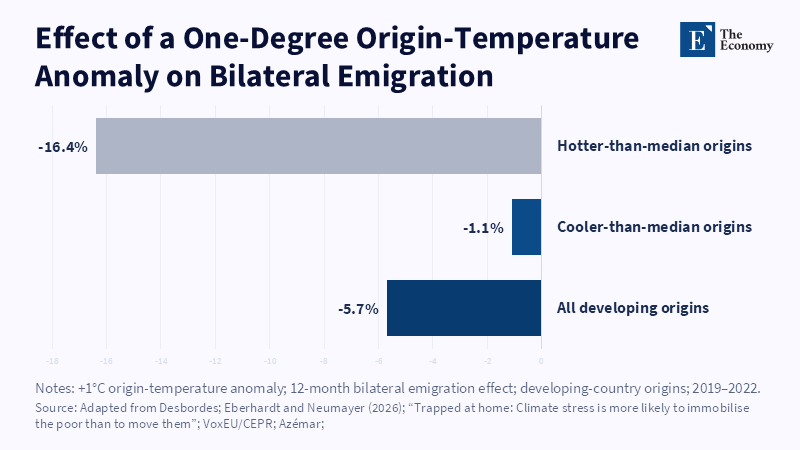
A one-degree increase above a country’s normal temperature can reduce international emigration by approximately 5.7 percent over the following year. In the hottest developing countries, the loss can be as high as roughly 16 percent. That is the statistic that should reframe the climate migration debate. Heat, in fact, does not need to push people across borders. It can instead take away the ability to move at all. The most destitute households first lose income. Their health may also deteriorate through heat exposure, poor nutrition, lost work and untreated sickness. Meanwhile, the cost of travel, visas, accommodation and job searches remains high. Climate immobility is therefore not a voluntary decision to remain. It is often a forced loss of options. The key policy error is not just that impoverished populations might be displaced. It is that many will not be able to reach safety even as the lesser of two evils becomes increasingly unsafe each year. The typical story of migration always starts with pressure at home and ends with pressure or attraction in the destination. In recognizing the need for financial resources, it ignores two difficult challenges: one, is the individual healthy and strong enough to undertake the move, find a job and be without work or care for a while? Second, is there enough money to finance the move? A secure occupation back home can have the advantage over an uncertain destination, even when local conditions are deteriorating. Poor health gives the story a starker and more serious tone. Climate change can increase the desire to leave while simultaneously reducing the ability to do so. The result is that the most vulnerable are the most invisible in border crossings.
The Two Gates of Climate Immobility
Migration has always been selective. Migration is often a virtuous circle: the more robust and empowered leave their home areas and enter a new place where they can flourish, thrive and then return stronger. Long-term research from Indonesia has provided evidence of health selection prior to internal migration, which exists even after unobserved household differences were accounted for. Other British evidence has shown health and deprivation directly influence migration flows and destinations. This does not mean individual migrants are healthy. In the case of refugee resettlement, aging populations or people moving for care, then this tends not to be the case. In voluntary labor migration, bodily strength generally pays dividends. Migration may involve grueling treks and fluctuating housing, heavy physical labor and delayed access to benefits. A disabling disease can turn every stage into an obstacle. Climate immobility materializes where heat diminishes health while migration systems still expect a robust, employable, solvent traveler.
Jobs are the second gate. A stable job in a vulnerable area can still provide food, shelter and social ties. Under these conditions, a person can choose to stay regardless of safety; no safer option exists. It is not a choice between a bad and a good climate. It is between a known income and a costly gamble. That is why migration may actually be positively related to income before declining at higher levels. The majority of poor families want to migrate but cannot afford the next step. Research across 116 countries found that hotter conditions increased urban and international migration from middle-income countries but diminished both forms of movement from poorer countries. It was not just exposure that mattered, since that was consistent across the map. It was the ability to convert distress into action, to transform it into motion.
This selection can produce a major error in public debate. Those seen at the borders are those who arrived. They reveal little about those who could not move. A low rate of migration commonly can mean either genuine stability or blocked mobility. It is impossible to distinguish between these two except through data on health, income, debt, unemployment or migration aspirations. It is difficult to interpret the image of healthy migrants as meaning that migration is a health advantage, even when it is actually one. Some benefits are real, but the initial sample was selectively healthier; those who were quite sick and those with heavy care responsibilities would be much less likely to move at all. Climate immobility is exacerbated by the fact that less mobile households are the same ones who experience greater heat and declining savings at the same time. Thus, while a legal entry pathway seems, as usual, to try to open the right door, over time the household might no longer qualify for employment or medical criteria. Climate immobility is partly engendered by demographic and medical rules that reward readiness just when the most exposed have begun to lose it.
Heat Turns Climate Immobility into a Poverty Trap
New monthly figures make it harder to dismiss. A key paper tracked bilateral flows from 2019 to 2022 from 127 developing country origins to 180 destinations. It drew on privacy-protected location histories of Facebook users totaling around three billion people. Across the sample, it estimated 39.1 million international moves in 2022 among those countries. To identify weather shocks, it matched every route against itself and accounted for stable route differences, seasonal effects and global monthly shocks. A one-degree anomaly at origin reduced emigration over the following year by roughly 5.7 percent. Its effect was close to zero for colder origins, but for hotter ones reached about 16 percent. Rainfall showed no clear effect. This was not a general claim that warming anywhere causes people to move. Rather, it demonstrated that heat has the potential to impede costly international migration in low-income settings: people who already have little may have limited options.
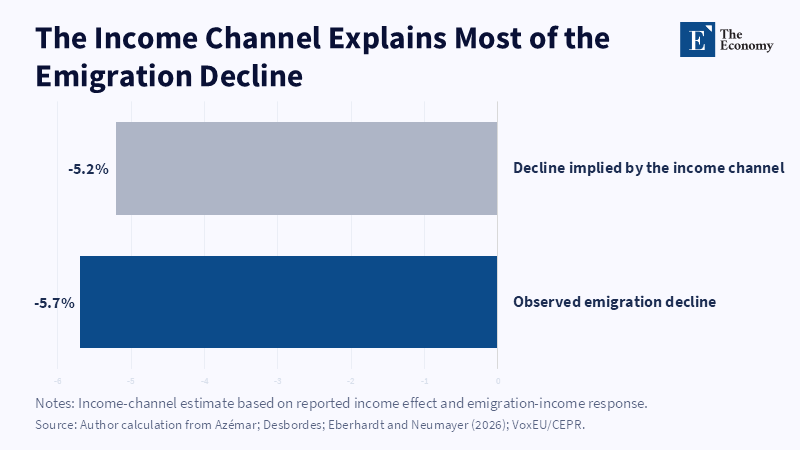
Income data account for much of the decline. That study found that a 1-degree annual temperature anomaly reduced local income per person by around 2 percent. The findings suggest each 1 percent climate-related decline in origin income translated into about a 2.6 percent decrease in emigration. The heightened response to wealthier destinations is consistent with the cost argument. Reaching a richer destination requires costs such as transport, paperwork, deposits and time without income, which raises the cost of migration. Climate stress therefore acts as both a push factor and a drain on resources. Earlier models offered a similar caution. Under medium development and climate scenarios, climate change could cut emigration among the very poorest by over 10 percent by 2100. Under more severe scenarios, the shortfall could be 35 percent. These are estimates, not predictions, yet they highlight the extent of the bind.
The trap can deepen. Heat reduces farm production, cuts working hours and increases costs of health care. Reduced income constrains savings and erodes the capacity to meet migration expenses. Reduced departures mean reduced remittances to households that remain, eroding yet another source of food, medicine, school fees and reconstruction money. In other words, a household can be triply trapped – pressed by the worsening dry seasons, by vicious cycles of reduced income and by a vicious circle of lost remittance flows – within only a few shocks. Entire regions can suffer through these mechanisms. Selective migration leaves behind older, poorer and less healthy residents and shrinking tax bases. Climate immobility is therefore not a private hardship. It can reshape the aging, health and fiscal profile of exposed communities. Border counts can read fewer migrants at precisely the time of human insecurity.
Arrival Does Not End the Health Test
Health selection persists after migration. U.S., Canadian and Australian reviews show that new economic migrants are often healthier than the native-born population and that this advantage tends to diminish after 10-20 years. By old age, immigrant groups may have a high prevalence of disability, long-term health conditions and specific morbidities. A similar story was found in a 2025 German study. The advantage was established early, yet health declined more rapidly across the life course, especially among women and people with lower educational attainment. These findings undermine the simplistic notion that these migrants have solved their health problems by moving to a safe destination. There may be a health advantage in one context from moving to a rich country that simultaneously entails a health disadvantage through barriers to treatment and jobs, discrimination, high-risk housing and social isolation. Climate immobility and post-migration health decline are therefore two related strands of a common process of selection.
Timely access to care may decide whether a move is feasible. A 2025 review of European evidence highlighted persistent barriers in relation to language, legal status, cost, low awareness of health systems and fear of deportation. In one of the studies included, 70% of surveyed immigrants considered their knowledge of health insurance to be poor or very poor; over a third were not sure of their coverage and nearly 15% did not know how to access the healthcare system. Though the results cannot be generalized to all migrants, they demonstrate how even a treatable condition can turn into an employment and housing crisis. Language barriers may hinder appointments, consent to treatment, medication adherence and follow-up visits. Migrant employment policies, which recruit healthy workers but provide limited post-arrival healthcare, may shift rather than reduce costs and deter migrants with known health conditions from moving through legal pathways.
Climate Immobility Needs a Mobility Policy
A robust response needs to safeguard the right to remain and the right to depart. Financing adaptation must enable heat-safe work, primary care, sanitation and income protection for exposed populations. Local adaptation is still not enough. Mobility must become a planned form of adaptation. Legal channels can be linked to real labor demand, matching jobs with prospective migrants in the home country and offering portable rights upon arrival. Small grants, inexpensive loans and state-backed travel funds need only cover the initial costs of movement. Health screening should connect people to care rather than exclude them. Destination arrangements should include interpreters, transparent insurance procedures and prompt primary care. Inter-regional routes might make most sense because they cost less and maintain family relations. The objective is not to force people out. It is to keep poverty and disease from determining who can.
Measurement needs to change too. Early-warning systems often monitor displacements when people have left a flood, fire or storm, but rarely count those who stay behind because they have no money, health or destination. Governments should include mobility questions in household, labor and health surveys in climate-vulnerable areas. These would report the intention to move, the preferred destination, the likely expenses, health-imposed travel limits and the reasons for giving up. The data should be disaggregated by age, sex, disability, income and legal status, revealing where climate immobility is becoming forced rather than chosen. The data could also inform operational responses; a household without funds for initial travel has very different needs from one with a frail elder or disabled relative or one coping with a complex-to-treat long-term health condition. Better measurement would not turn every misfortune into a migration flow, but it would prevent low movement from being mistaken for low need.
Critics may warn that easier mobility brings a flood or a flight of the skilled from exposed areas. However, the evidence suggests a more nuanced threat. Climate stress does not unleash a single flood. It may propel those with resources and bar those without. Managed channels can mitigate that disparity, particularly when combined with training contracts, circular migrations and support for source communities. The greatest threat now is a world where only the healthy and well-funded flee or adapt through relocation. The opening statistic delivers a hard message: when abnormal heat rises by one degree, international migration is likely to fall instead of increase. Climate immobility should become a central indicator in climate policy. States must monitor not just who moves, but who wishes to move, who is priced out and who is too sick to travel. If a right to sanctuary exists, the cost of reaching it must remain within reach.
The views expressed in this article are those of the author(s) and do not necessarily reflect the official position of The Economy or its affiliates.
References
Allegri, C., Barbiano di Belgiojoso, E. and Rimoldi, S.M.L. (2025) ‘Immigrants’ self-perceived barriers to healthcare: A systematic review of quantitative evidence in European countries’, Health Policy, 154, 105268.
Azémar, C., Desbordes, R., Eberhardt, M. and Neumayer, E. (2026a) ‘Trapped at home: Climate stress is more likely to immobilise the poor than to move them’, VoxEU, 11 July.
Azémar, C., Desbordes, R., Eberhardt, M. and Neumayer, E. (2026b) ‘Trapped at home: Weather shocks, income, and international migration’, CEPR Discussion Paper No. 21634. London: Centre for Economic Policy Research.
Benveniste, H., Oppenheimer, M. and Fleurbaey, M. (2022) ‘Climate change increases resource-constrained international immobility’, Nature Climate Change, 12(7), pp. 634–641.
Cattaneo, C. and Peri, G. (2016) ‘The migration response to increasing temperatures’, Journal of Development Economics, 122, pp. 127–146.
Chi, G., Abel, G.J., Johnston, D., Giraudy, E. and Bailey, M. (2025) ‘Measuring global migration flows using online data’, Proceedings of the National Academy of Sciences, 122(18), e2409418122.
Loi, S., Li, P. and Myrskylä, M. (2025) ‘Unequal weathering: How immigrants’ health advantage vanishes over the life-course’, Journal of Migration and Health, 11, 100303.
Lu, Y. (2008) ‘Test of the healthy migrant hypothesis: A longitudinal analysis of health selectivity of internal migration in Indonesia’, Social Science & Medicine, 67(8), pp. 1331–1339.
Markides, K.S. and Rote, S. (2019) ‘The healthy immigrant effect and aging in the United States and other Western countries’, The Gerontologist, 59(2), pp. 205–214.
Norman, P., Boyle, P. and Rees, P. (2005) ‘Selective migration, health and deprivation: A longitudinal analysis’, Social Science & Medicine, 60(12), pp. 2755–2771.
Working across research, policy, and data-driven analysis, the Editorial Board ensures that published pieces reflect a consistent institutional perspective grounded in quantitative reasoning and long-term structural assessment.