Europe’s AI Boom Needs Merit-Based AI Adoption

Working across research, policy, and data-driven analysis, the Editorial Board ensures that published pieces reflect a consistent institutional perspective grounded in quantitative reasoning and long-term structural assessment.
Authored On
Modified
Europe’s AI use is rising faster than its depth of implementation
Domestic peer pressure can trigger adoption but cannot prove value
Policy should reward measured outcomes and shared evidence

Only 7 percent of firms in a euro-area survey said they used AI extensively at the end of 2025. More than 60 percent said they used it, but not extensively. Therein lies the most obvious signal in Europe's AI debate. Its reach is expanding. Accounts are being opened. The pilots are being launched. Yet intensive use remains rare. Europe may consequently achieve significant adoption targets and deliver much less productivity than envisaged. The key policy challenge is now how to move firms beyond emulation towards merit-based AI choices: the use of an AI application that enhances an existing process because it is tested, not because a competitor announces it. Peer pressure may prompt a first experiment, but it cannot determine what works, how much it costs, or whether deployment makes sense. Europe needs a unified market for reliable evidence, not merely a unified market for software, services and capital.
Merit-Based AI Adoption Starts Where the Headline Numbers End
The headline trend appears clear. The share of EU companies adopting at least one type of AI technology increased from 8.1 percent in 2023 to 13.5 percent in 2024 and 20 percent in 2025. In just two years, the share of reported adoption more than doubled. Denmark reached 42 percent, followed by Finland with 37.8 percent and Sweden with 35 percent. Still, this shows that AI diffusion is no longer a marginal event. It does not show that firms reconfigured work, increased their output and created long-lasting capabilities. A once-a-week chatbot and an AI system embedded in pricing, manufacturing, maintenance, logistics, or product design are both counted as adoption. The economic value is not the same. Merit-based AI adoption differs at exactly this point: it tests whether the tool changes a workflow, whether the change survives a pilot, and whether the result can be isolated against the old system A policy that rewards reported AI adoption may artificially boost activity levels. One that rewards effective use helps build capabilities.
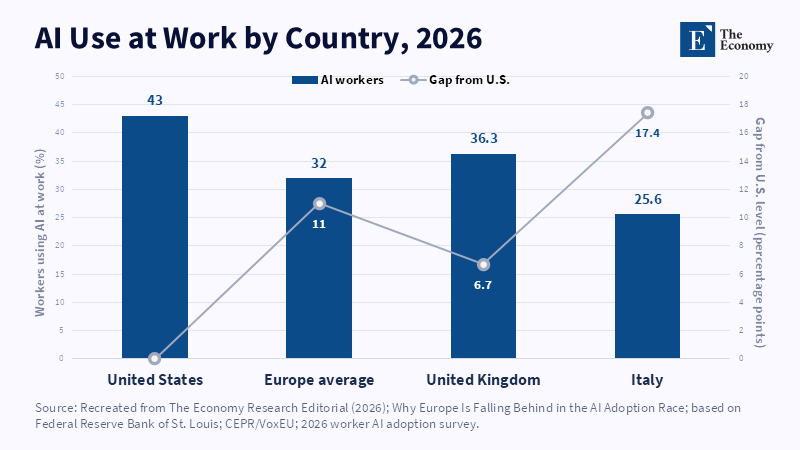
A second set of numbers makes the same point. The European Investment Bank found that 37 percent of EU firms used generative AI in 2025, almost the same share as the 36 percent reported in the United States. Its survey counts use differently from Eurostat, so the levels should not be merged into one series. Yet the breadth of use differed. Among AI-using firms, 81 percent of US businesses applied it in more than two business areas, compared with 55 percent in Europe. Europe has narrowed the access gap while retaining a depth gap. That is progress, but it is not parity. It suggests that many European firms have entered the AI market without yet embedding AI in the firm’s operating model. The distinction also explains why capital alone cannot settle the adoption problem. Funding can pay for licenses, consultants, data work and new staff. It cannot tell a manager which process deserves change. More capital may accelerate good experiments. It can also fund a larger wave of defensive purchases. Merit-based AI adoption needs finance, but it also needs proof.
Peer Pressure Can Open the Door, but It Cannot Choose the Room
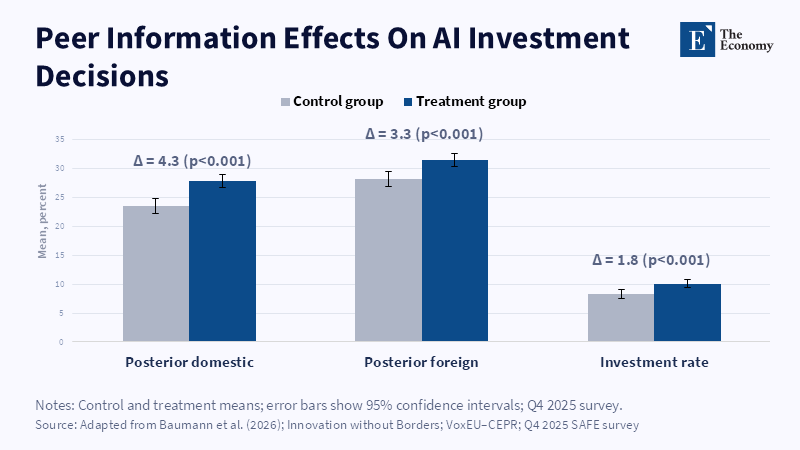
Managers do not make their technological choices in isolation. They observe similar firms that attract the same customers, employ workers from the same pool and operate under the same rules. Evidence from 3,316 firms in twelve EU countries demonstrates how deeply these local anchors matter. Managers’ estimates of AI investment among domestic peers were, on average, 14 percentage points below the actual share. Their estimates of foreign peers’ investment were 7 points below the actual share. When firms were given accurate data on peer investment levels, their own expected rate of AI investment increased by 1.8 percentage points. A one-point increase in the perceived share of domestic peers investing in AI lifted the firm’s expected investment rate by 0.57 percentage points. The equivalent effect for foreign peers was practically zero. The Single Market enables cross-border flows of goods and information. Yet the market response to AI appears stubbornly national.
This is not evidence that managers are irrational. Domestic peers are often the most relevant comparators. Their prices, purchases, language, payrolls and procurement practices can signal that a technology has become cheaper and safer. Such behavior can signal value. The problem arises when that signal is mistaken for evidence of value. The peer’s decision implies nothing about value. It does not imply that the peer made the right decision. It may mean that the peer is learning, wasting money, pleasing a board, following vendor advice, or trying to appear up to date. This is when peer pressure is a good thing, pushing a cautious firm to examine a tool. This is when peer pressure turns dangerous, when imitation replaces a clear business case. Managers should treat competitors’ adoption only as a reason to investigate further. The first question should be what the tool actually did, rather than who else has it.
Differences across firms in use and value are also clear. In late 2025, 38 percent of euro-area firms said they used AI to a moderate or large extent, while 33 percent used AI very rarely or at some experimental level. Of those that do not use AI, 30 percent said AI was not useful for their business. Around 20 percent of these respondents cited lack of skills or incompatibility with existing systems. Awareness of AI alone will not remove these barriers; no amount of promotional campaigns will convince a firm that does not have clean data, good software, or staff time or skills to derive value from AI. The same survey of firms found that those with extensive AI use expected the biggest increases in turnover and fixed investment compared with those with no AI use after accounting for factors such as size, sector and geography. This result does not establish causality. It nevertheless shows that the heaviest users differ from firms that are merely testing AI. That difference is highly relevant to national and EU policy.
Europe Needs a Single Market for AI Evidence
Most market reforms in Europe lean toward integration: the flow of capital, data, services, persons and enterprises. That agenda matters. In 2025, the EIB Investment Survey found that 62 percent of firms still rated the EU market for their main product as fragmented. Fragmentation increases the fixed costs of scaling and weakens competitive pressure from abroad. Closer integration should also smooth the flow of usable evidence. An Italian manager should gain from a proven use case in Austria or Finland just as from a nearby rival. Today, borders are open to information but not necessarily to proof. Vendors show off their testimonials. Firms protect operational data. Governments report participation and funding. Few systems show which applications produced results, in what contexts, at what prices, with what risks. The true blind spot is not a third promotional portal. It is a trusted evidence market for merit-based AI adoption.
This could be created by a European AI Evidence Commons. The name is less significant than the purpose. Publicly sponsored pilots would produce a series of brief, templated outcome records. Upon completion, each record would state the sector, task, baseline, tool type, integration cost, training hours, error rate, staff response and measured outcome. Break-even or negative pilots would also be included. Sensitive information could remain private, while methods and result ranges would be shared. Results would be grouped by firm size and process, not simply by nation. A modest Spanish auto parts producer could then compare a maintenance case to others across several member states. A Greek services firm could see whether an automated helpdesk cut handling time without reducing quality. This would turn information diffusion into operational learning. It would also break the myth that valuable AI applications exist only in Europe's biggest countries, even when investment remains geographically uneven.
The proposal is not an appeal for one definitive score to determine which technology is good. AI performance is very task-dependent. That is made clear in controlled studies. Customer-support agents given a generative AI assistant resolved about 14 percent more issues per hour on average, with the biggest improvements for less experienced workers. In a different study, consultants working with GPT-4 completed more tasks, worked faster and produced higher-quality work on tasks within the tool's capability boundary. Performance declined when the task was outside that boundary and users over-trusted the tool. The policy conclusion is not that every company should emulate customer support or consulting organizations. It is that results depend on a fit between the tool, the task, the worker and the process. Merit-based AI adoption must be assessed at that level.
Broad generalizations about AI offer little guidance for investment. Knowledge also becomes more valuable, however, when firms are able to make use of it. An analysis using data on 14,143 UK firms found that adoption of AI was associated with innovation when the firm used it alongside its own Research and Development. Collaborations with customers, suppliers, consultants and academics also led to innovations, but the results were mixed depending on the nature of the partner. This is a valuable lesson in the limits of passive diffusion. Maintaining a database of case studies will not change a firm that does not have the trained personnel, a reliable data system, or the organizational authority to implement a change in workflow. The same is true for the evidence system. It will have to sit alongside additional practical support. Shared test laboratories, sector specialists, training for workers and small implementation grants will help firms take outside knowledge and produce local change. Managers do not need protection; they need better evidence.
Make Merit-Based AI Adoption the Test for Public Support
Public funding needs to stop equating purchase with success. Funds, tax incentives and digital vouchers should be disbursed gradually. The initial disbursement could be used to support diagnosis and an initial pilot. The next installment can only take place if there is an identified benchmark and a specific goal, such as reducing waste, speeding processing, cutting errors, increasing sales conversion, or improving equipment uptime. The final installment can support scaling only if the firm can demonstrate credible benefits or if there is a strong learning result. A failed pilot should not be penalized if it produces useful evidence. Failure turns into inefficiency only if there is no measurement or sharing of evidence. This approach would support experimentation without rewarding imitation. It would establish a review point, shielding smaller companies from incurring costs on tools chosen out of fear. In Q2 2025, 34 percent of euro-area firms said that they had invested in AI, with AI accounting for an average of 5.6 percent of their overall investment. That is already enough to require discipline.
Those who criticize may say measurement will slow adoption. The real risk is rapid adoption without learning. A light evidence standard need not require a major audit. Time, defects, sales, energy, downtime or customer responses are usually tracked by individual firms anyway. The difficult part is establishing a before-and-after comparison. Some may say firms will not reveal their results. Public money can help secure limited disclosure and even anonymized ranges should suffice. Another claim is that Europe should first develop deeper capital pools. However, capital without evidence can reinforce the same local herd dynamics. The defining quality of the single market is not a large group of firms acquiring identical AI tools simultaneously; it is the existence of shared evidence from one country that guides a better decision elsewhere. The rate of AI adoption in Europe is accelerating rapidly. The next milestone should not be a larger user count but a greater proportion of all firms being able, in simple terms, to state what AI actually enhanced and why the improvement should last.
The views expressed in this article are those of the author(s) and do not necessarily reflect the official position of The Economy or its affiliates.
References
Baumann, U., Cullen, Z.B., Faia, E., Ferrando, A., Perez-Truglia, R. and Rariga, J. (2026a) ‘Innovation without borders’, VoxEU, 11 July.
Baumann, U., Cullen, Z.B., Faia, E., Ferrando, A., Perez-Truglia, R. and Rariga, J. (2026b) Innovation without Borders? The Geography of Technological Diffusion. NBER Working Paper No. 35314. Cambridge, MA: National Bureau of Economic Research.
Bick, A., Blandin, A., Deming, D.J., Fuchs-Schündeln, N. and Jessen, J. (2026) Mind the Gap: AI Adoption in Europe and the U.S. NBER Working Paper No. 34995. Cambridge, MA: National Bureau of Economic Research.
Brynjolfsson, E., Li, D. and Raymond, L.R. (2025) ‘Generative AI at work’, The Quarterly Journal of Economics, 140(2), pp. 889–942.
D’Amico, E., Belitski, M., Braga, A. and Savoie, R. (2025) ‘Enhancing knowledge spillover of innovation through artificial intelligence: an empirical investigation’, The Journal of Technology Transfer, advance online publication.
Dell’Acqua, F., McFowland III, E., Mollick, E.R., Lifshitz-Assaf, H., Kellogg, K.C., Rajendran, S., Krayer, L., Candelon, F. and Lakhani, K.R. (2023) Navigating the Jagged Technological Frontier: Field Experimental Evidence of the Effects of Artificial Intelligence on Knowledge Worker Productivity and Quality. Harvard Business School Working Paper No. 24-013, revised 2026. Boston, MA: Harvard Business School.
European Central Bank (2026) Survey on the Access to Finance of Enterprises in the Euro Area: Fourth Quarter of 2025. Frankfurt am Main: European Central Bank.
European Investment Bank (2025) EIB Investment Survey 2025: European Union Overview. Luxembourg: European Investment Bank.
Eurostat (2025) ‘20% of EU enterprises use AI technologies’, Eurostat News, 11 December.
Ferrando, A., Lamboglia, S., Rariga, J. and Schmidt, M. (2026) ‘Adopting and investing in AI: evidence from euro area firms in the SAFE’, ECB Economic Bulletin, 2/2026.
Li, C. and Caruana Galizia, A. (2025) ‘Europe is lagging in AI adoption – how can businesses close the gap?’, World Economic Forum, 23 September.
The Economy Research Editorial (2026) ‘Why Europe Is Falling Behind in the AI Adoption Race’, The Economy, 4 June.
Working across research, policy, and data-driven analysis, the Editorial Board ensures that published pieces reflect a consistent institutional perspective grounded in quantitative reasoning and long-term structural assessment.