Gold Cannot Stop a Dollar Run: Why Dollar Swap Lines Are the Real Reserve Standard

Working across research, policy, and data-driven analysis, the Editorial Board ensures that published pieces reflect a consistent institutional perspective grounded in quantitative reasoning and long-term structural assessment.
Authored On
Modified
Gold cannot provide instant dollar liquidity
Dollar swap lines can contain funding shocks
Argentina shows their power and political risk

By the end of 2024, dollar borrowing accounted for roughly 90 percent of the $111 trillion in global foreign-exchange swaps, forwards and currency swaps. That stark statistic exposes the fragility of today's reserve debate. Financial strain continues to be settled, priced and funded for the most part in dollars, even though central banks are stockpiling ever more gold and world leaders are calling for de-dollarization. Gold may be wealth's security blanket through the decades. It cannot provide a free loan to a bank at noon, clear a margin call by the market's close or stabilize a currency during minutes of maximum stress. Dollar swap lines can. Hence the new standard for reserve strength is not how much gold a bank holds in its vaults but whether it can call on usable dollars when the private sector lines go dead. Most economies outside of the handful protected at all times under permanent Fed arrangements have a case for gold and dollar holdings. Yet always-available access to dollar emergency credit is now the clearest red line that separates a localized shock from a national catastrophe.
The Reserve Debate Is About Access, Not Metal
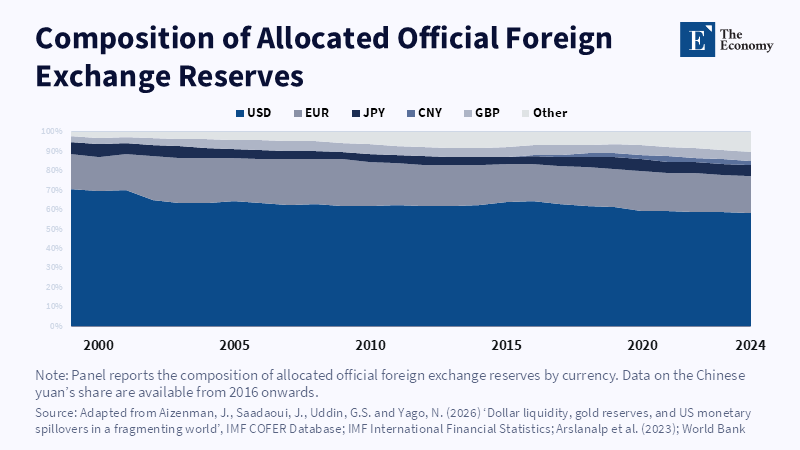
The conceptual gold standard continues to inform the logic of public debate but it is asking the wrong question. Under the traditional gold standard, fiat currencies were linked to a fixed weight of gold. Now it is just one of many holdings. Gold does not finance or settle most trade invoices or bank balances. The dollar does. As set out in detail in the latest World Economic Outlook, today it still makes up 58 percent by value of disclosed foreign-exchange reserves; it appeared on one side or the other in more than 88 percent by value of the world's foreign-exchange transactions in the BIS's last complete triennial survey. The genuine policy challenge is whether an asset that serves as a reserve matches the liability that needs it in times of stress. A country whose banks, firms or government agencies owe dollars requires assets or credit lines able to deliver them. Gold may be sold, pledged or exchanged against other assets. Each of those routes involves delay, price or legal risk. A dollar account or prearranged official dollar facility already has the necessary form.
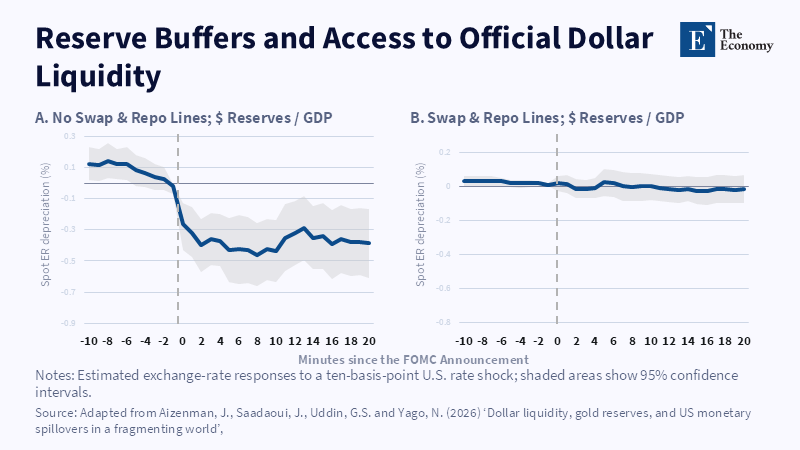
High-frequency evidence exposes this mismatch. A survey of 108 FOMC statements issued from 2009 to 2023 identified minute-by-minute exchange rates for 18 economies. A ten-basis-point U.S. rate increase produced an average 0.4 percent depreciation of foreign currencies in just 20 minutes. Countries with larger dollar reserves experienced less depreciation. Gold holdings moderated price change too but less precisely. The most robust result relates to official access. In economies with U.S. swap or repo access, reserve holdings hardly explain the short-horizon response. In economies without that access, dollar and gold cushions matter more. This does not render reserves pointless. It demonstrates that self-insurance and official backstops can partly replace one another. A credible cushion can reduce the costly reserves a country must otherwise hold.
Gold also creates an illusion of certainty when gold is rising rapidly in value. The metal was up 25.5 percent in 2024 and around 67 percent in 2025 – these gains further inflated the reported valuation of central-bank holdings where the bulk of physical stock had hardly moved. Yet a rapid ascent is not a reliable form of assured liquidity. Gold soared above $5,500/oz in early 2026 before sliding back toward $4,000 by late June, around 27 percent down from its high. While a reserve manager may be heartened by years of gains, a tool for financial distress cannot always rely on the market being in a benign state on the one day when cash is required. Gold does not produce its own intrinsic yield and imposes storage, transfer and mobilization costs. It remains valuable as a form of sanctions insurance, as a long-term set-aside of collateral and as a tool for geopolitical hedging. In terms of exactly where it belongs, the answer is primarily in the investment and hedging tranche rather than the cash layer that is supposed to suffice in a bank run.
Dollar Swap Lines Are the Modern Crisis Standard
Dollar swap lines work because they address the root of the problem. The Fed lends dollars to a foreign central bank against that central bank's currency and is then repaid at the same rate. The foreign central bank in turn lends the dollars throughout its own financial system, assuming credit risk within that system. The facility is not unconditional aid, just an interim currency swap between monetary authorities. During the global crisis, the peak of Federal Reserve dollar swaps was about $585 billion; during the shock from the pandemic, it was around $450 billion. The facilities reduced market pressures, supported credit and limited forced asset sales. They also insulated U.S. markets from potential stress emanating from a global banking and dollar funding system. They were not altruistic. They prevented the operation of global finance from running out of its principal settlement currency.
The problem is access. The permanent set of arrangements includes the Bank of Canada, Bank of England, Bank of Japan, the European Central Bank and the Swiss National Bank. That group of central banks includes the largest advanced financial centers, but covers relatively few middle-income and emerging-market economies. In 2008 and 2020, temporary swap lines included a broader array of countries, including Brazil, Mexico, South Korea and Singapore. The FIMA repo facility now offers a broader backstop. Approved foreign authorities can now obtain dollars by pledging U.S. Treasuries rather than selling those securities into a stressed market. This is helpful, but still provides a privileged alternative for those countries that have built up sufficient Treasuries in approved accounts. It also sends a distinctly weaker signal than a swap line. Many economies outside the permanent network could benefit from a more visible path to dollar funding. That does not have to mean unlimited access: it simply requires what is called a predictable ladder of facilities, providing terms that can be known well before any crisis occurs.
The principal concern is moral hazard. Easier access will reward perverse policies: weak fiscal policy, lax bank supervision, incipient foreign-currency borrowing. This is a real concern, but exclusion is an overreaction. If a country is refused a backstop, it may accumulate larger low-yield reserves, enforce highly inflexible capital-account restrictions or seek emergency finance from a rival power. A better approach would be to charge the cost of risk rather than pretend it does not exist. Countries could gain ready funds if they agree to publish reserve data, to subject banks to soundness tests, to restrict unhedged dollar liabilities or to tighten collateral arrangements, then pay a penalty premium the more they borrow repeatedly. Draws could be limited and devoted to short-term liquidity needs and access temporarily frozen when the use of funds is aimed at holding down a clearly overvalued exchange rate. Such cooperation would help discipline and stop panics. The choice is not between unconditional rescue and complete self-reliance. It is between explicit safety nets and responding to shocks with immediate crisis financing.
Argentina Shows Both the Power and the Danger
Lending to Argentina in 2025 shows how swiftly credible dollar support can alter market behavior. In September, a depreciating peso and heavy reserve depletion raised concern of a further bank run ahead of the October mid-term legislative elections. The U.S Treasury publicized its support and subsequently completed a $20 billion currency-swap scheme with the Central Bank of Argentina. It also purchased pesos directly. Argentine bonds and the peso appreciated in value following several key announcements and the initial panic eased. Ultimately, Argentina drew approximately $2.5 billion from the facility. By January 2026, that drawdown had been repaid and a report by the U.S. Treasury indicated a profit. As such, this appeared to be closer to a bridge loan than a permanent transfer. It purchased time, bolstered the evidence that dollars would be available at the time of greatest need and diminished the propensity to deplete the currency reserves at the most inopportune moment. This is what emergency liquidity should achieve. It cannot rectify fundamental issues. It merely prevents a liquidity shock from compelling choices under duress.
The case also required careful classification. Argentina was not the recipient of an ordinary Federal Reserve central bank swap line. Instead, the support was derived from the U.S. Treasury Exchange Stabilization Fund and was embedded within a broader political context. That distinction is important. A Fed line is designed with monetary or financial stability objectives in mind. The Argentina package was announced near an election, supported a politically sympathetic government and did not come with a comprehensive public explanation of its operational parameters. Market critics reasonably questioned whether it was an act of statecraft, favoritism or both. The peso remained under pressure and the country faced minimal net reserves, large foreign-borrowing obligations and an exchange-rate regime that many observers considered excessively tight. The repayment showed the operation could end without a taxpayer loss. It did not show that Argentina's monetary dilemma had been resolved. Providing liquidity may prevent a liquidity crisis, but it can neither generate fiscal credibility, nor boost exports, nor foster a sustainable exchange-rate policy.
That enhances the case for wider dollar swap lines. Ad hoc rescues foster suspicion that access depends on ideology, personal links or strategic interests. A rules-based arrangement would help dispel those doubts and prevent a crisis from becoming a test of electoral support. An ongoing framework could specify in advance the circumstances in which temporary access could be granted. The IMF could check the direction of macroeconomic policy. The Fed or the Treasury could judge dollar-market spillovers and collateral. Regional development banks could act as additional backstops for weaker borrowers. Transparency could be extended to cover the seniority, tenor, collateral, size, maturity and repayment record of each draw. Argentina showed that a relatively modest deployment can stabilize markets if it signals access to a much larger commitment. The next step is to make that signaling credible by institutionalizing it rather than reserving it for favored cases.
A Rules-Based Dollar Safety Net for a Digital Age
This strengthens the case for reform, as dollar use is extending beyond financial institutions. Now stablecoins with dollar backing are channeling payments and savings using digital wallets, often outside local banking systems. IMF estimates for 2024 put international stablecoin transactions at approximately $2 trillion. Relative to regional output, flows were largest in Latin America and the Caribbean at 7.7 percent of GDP. North America was a net source of stablecoin flows, indicating that digital tokens are filling international demand for dollar-linked asset holdings. In Argentina, Brazil, Mexico and others, stablecoins support savings and transfers, trade settlement and remittances. This can lower the costs of payments and increase household protection from domestic inflation; it can also deepen dollarization. A country can maintain its domestic unit as legal tender, while the use of its private contracts and savings still shifts towards the dollar. Private digital dollars extend the networks but do not provide central banks with emergency wholesale liquidity.
A broad-based modern framework would include three layers: retaining permanent swap lines to systemically relevant currency areas; establishing prequalified, renewable lines to sound emerging economies with large dollar commitments and good supervision; and extending collateralized repo access to a wider group, including regional pools for smaller states. The threshold for entry should be based on measurable criteria, including the composition of external liabilities, the details of reserve disclosure, bank liquidity norms and the specifics of crisis resolution and resolution planning. Use should be on a time-limited basis and priced above normal conditions. Such access should be subject to the imposition of plans to cut unhedged dollar borrowing. The same review process should examine stablecoin use, because stablecoins can accelerate a run and weaken capital controls. Central banks also need improved information from exchanges, wallet providers and stablecoin issuers.
Reserve strength must also be measured differently. A gold stock of any size can support confidence, but its headline value can also go up with the gold price. Gross dollar reserve stocks can also be misleading once borrowed, pledged or offset by short-term liabilities. The better test is usable liquidity in times of stress. The relevant measure is how much can be mobilized in a day, in what currency, on what collateral and under what legal authority. Instead of publishing one total reserve figure, central banks should publish reserve tranches. For foreign-currency liabilities across central banks, commercial banks and institutional investors, finance ministries should publish them by maturity. Instead of tracking dollar funding gaps inside banks, bank supervisors should track dollar funding gaps outside banks, including funds, entities and large companies. While gold remains useful because it has no issuer risk, it is no longer a monetary operating system; the world still generates immediate demand for dollars and reserve policy therefore must evolve from a stock of metal in tonnes to liquidity measured in minutes.
The views expressed in this article are those of the author(s) and do not necessarily reflect the official position of The Economy or its affiliates.
References
Aizenman, J., Saadaoui, J., Uddin, G.S. and Yago, N. (2026a) ‘Dollar liquidity, gold reserves, and US monetary spillovers in a fragmenting world’, VoxEU, 10 July.
Aizenman, J., Saadaoui, J., Uddin, G.S. and Yago, N. (2026b) ‘US monetary spillovers, foreign exchange, and gold reserves at times of geopolitical fragmentation’, NBER Working Paper, No. 35337.
Arslanalp, S., Eichengreen, B. and Simpson-Bell, C. (2023) ‘Gold as international reserves: A barbarous relic no more?’, Journal of International Economics, 145, 103822.
Artigas, J.C., Burnette, T. and O’Connor, F. (2026) ‘Gold mid-year outlook 2026: Point break’, World Gold Council, 1 July.
Bahaj, S. and Reis, R. (2022) ‘Central bank swap lines: Evidence on the effects of the lender of last resort’, Review of Economic Studies, 89(4), pp. 1654–1693.
Bank for International Settlements (2025) ‘Financial conditions in a changing global financial system’, in Annual Economic Report 2025. Basel: Bank for International Settlements.
Bauer, M.D. and Swanson, E.T. (2023) ‘An alternative explanation for the “Fed information effect”’, American Economic Review, 113(3), pp. 664–700.
Bertaut, C., von Beschwitz, B. and Curcuru, S. (2025) ‘The international role of the U.S. dollar – 2025 edition’, FEDS Notes, 18 July.
Bianchi, W. (2026) ‘Argentina has repaid US for currency swap deal’, Reuters, 9 January.
Board of Governors of the Federal Reserve System (2020) ‘Federal Reserve announces establishment of a temporary FIMA Repo Facility to help support the smooth functioning of financial markets’, 31 March.
Burnette, T. (2025) ‘Gold’s 2024 performance best in 14 years’, World Gold Council, 3 January.
European Central Bank (2026) The International Role of the Euro. Frankfurt am Main: European Central Bank.
Gopinath, G., Boz, E., Casas, C., Díez, F.J., Gourinchas, P.-O. and Plagborg-Møller, M. (2020) ‘Dominant currency paradigm’, American Economic Review, 110(3), pp. 677–719.
International Monetary Fund (2026a) Currency Composition of Official Foreign Exchange Reserves. Washington, DC: International Monetary Fund.
International Monetary Fund (2026b) International Financial Statistics. Washington, DC: International Monetary Fund.
Miranda-Agrippino, S. and Rey, H. (2020) ‘US monetary policy and the global financial cycle’, Review of Economic Studies, 87(6), pp. 2754–2776.
Mühleisen, M. (2025) ‘Is the US currency rescue for Argentina positive statecraft or reckless favoritism?’, New Atlanticist, 30 September.
Ravazzolo, F. and Goldberg, L.S. (2022) ‘The Fed’s international dollar liquidity facilities: Roles and effects’, VoxEU, 22 August.
Reuter, M. (2025) ‘Decrypting crypto: How to estimate international stablecoin flows’, IMF Working Paper, No. 2025/141. Washington, DC: International Monetary Fund.
Sherman, N. (2025) ‘The US bet big with Argentina bailout – is it paying off?’, BBC News, 30 October.
World Bank (2026) World Development Indicators. Washington, DC: World Bank.
World Gold Council (2025) ‘Gold outlook 2026: Push ahead or pull back’, World Gold Council, 4 December.
Working across research, policy, and data-driven analysis, the Editorial Board ensures that published pieces reflect a consistent institutional perspective grounded in quantitative reasoning and long-term structural assessment.