"Germany Joins the Capacity Race" Semiconductor Power Struggle Enters a New Phase as the Chicken Game Returns

Anne-Marie Nicholson is a fearless reporter covering international markets and global economic shifts. With a background in international relations, she provides a nuanced perspective on trade policies, foreign investments, and macroeconomic developments. Quick-witted and always on the move, she delivers hard-hitting stories that connect the dots in an ever-changing global economy.
Authored On
Modified
South Korea, Germany and Japan Race to Expand Semiconductor Manufacturing Bases
Gwangju Mega Cluster Gains Momentum Amid Delays in Yongin
National-Level Chicken Game Intensifies Alongside Growing Oversupply Risks
The global semiconductor industry is being reshaped into a state-led race to secure manufacturing capacity. While Germany and Japan are expanding their production bases with strong government backing, South Korea is also accelerating the development of its massive semiconductor clusters. The strategy aims to establish overwhelming manufacturing capacity ahead of rivals, thereby securing market leadership while discouraging large-scale investment from latecomers. However, simultaneous capacity expansions across multiple countries also carry the risk of oversupply and sharp swings in industry conditions.
Infineon Completes $5.75 Billion Smart Power Fab Ahead of Schedule
According to German newspaper Bild on July 6 (local time), German semiconductor company Infineon Technologies recently began operations ahead of schedule at its world-class Smart Power Fab in Dresden, Saxony. The project represents the largest single investment in Infineon's history and ranks among Germany's largest advanced manufacturing investments. The Smart Power Fab required a total investment of approximately $5.75 billion, while receiving approximately $1.15 billion in public funding under the European Chips Act and the Important Project of Common European Interest (IPCEI ME/CT) following final approval from the German government.
The newly opened Smart Power Fab is the world's largest facility dedicated to manufacturing power semiconductors and analog/mixed-signal semiconductors. Chips produced at the facility will be used across future growth industries, including power supply systems for artificial intelligence (AI) data centers, electric vehicles, software-defined vehicles (SDVs), wind and solar power generation systems, and smart grids.
A defining feature of Infineon's Smart Power Fab is its extensive integration of AI and digital transformation technologies throughout the production system. The company utilized digital twin technology from the design stage to optimize both building layouts and equipment placement. AI algorithms were also incorporated into production approval and quality verification processes. Most notably, Infineon established a "One Virtual Fab" system linking the Dresden facility with its plant in Villach, Austria, significantly shortening process and product certification timelines. As a result, the company can now expand production capacity up to twice as fast as before in response to changing market demand while flexibly meeting rapidly growing demand for AI semiconductors.
The Smart Power Fab also establishes new benchmarks for sustainable semiconductor manufacturing. Infineon said it minimized the facility's environmental footprint by adopting advanced production technologies and energy-optimized manufacturing processes. Notably, the plant operates without using natural gas during production, while an advanced water treatment facility and closed-loop recycling system enable approximately 90% of used water to be recycled. The design also substantially reduces water consumption while recovering up to 45% of energy usage.
The German government described the investment as a major milestone for strengthening both Germany's national competitiveness and Europe's semiconductor self-sufficiency. German Chancellor Friedrich Merz said, "Infineon's new facility sends a powerful message that Germany remains a global center for advanced manufacturing," adding that "the expansion of production capacity in Dresden will play a critical role in strengthening Europe's technological sovereignty and supply chain resilience." German Minister for Digital Transformation and Government Modernization Karsten Wildberger likewise stated, "Core components for electric vehicles, wind turbines, and AI data center power infrastructure are being manufactured here," emphasizing that "this project demonstrates Germany's ability to rapidly turn advanced technological innovation into reality."
Delays at Yongin Cluster Disrupt Supply Chain Strategy
The launch of Infineon's Smart Power Fab forms part of a semiconductor supremacy race increasingly driven at the national level. The global power semiconductor market has entered a high-growth phase, fueled by surging electricity consumption from AI data centers alongside the broader energy transition driven by renewable energy and electric vehicles. Explosive demand for high-performance power semiconductors used in servers and telecommunications base stations is intensifying competition centered on critical infrastructure. Increasingly, semiconductor investment decisions are no longer made solely by corporations. Taiwan Semiconductor Manufacturing Co. (TSMC) is building fabrication plants across the United States, Japan, Germany and China with financial support from host governments, with subsidies covering portions of land acquisition, construction, equipment and operating costs.
Major foundries and memory chip manufacturers are also placing increasing emphasis on subsidies, permitting speed, electricity costs and water supply stability when selecting investment locations. Japan has aggressively capitalized on this trend through TSMC's Kumamoto project. The Japanese government has approved subsidies of up to approximately $5.05 billion for TSMC's second Kumamoto plant, while discussions have already emerged regarding the possibility of introducing even more advanced manufacturing processes. Although some argue that overseas expansion increases costs for Taiwanese companies, Japan has prioritized domestic supply chain localization and the restoration of its semiconductor ecosystem over cost considerations.
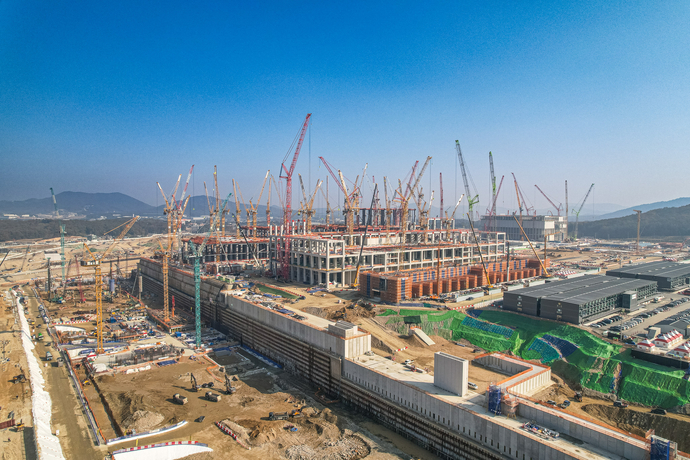
South Korea is also attempting to join this race, but inadequate infrastructure remains a major obstacle. Although the government has pledged to significantly accelerate development of the Yongin semiconductor cluster in Gyeonggi Province, political debate over relocating major projects to the Honam region has complicated plans for the semiconductor mega cluster in southern Gyeonggi. While SK hynix's fabrication plant in the general industrial complex in Wonsam-myeon, Cheoin-gu, Yongin, has visibly taken shape since construction began in February last year, land compensation for the national industrial complex in Idong-myeon and Namsa-eup, where Samsung Electronics plans to build its fabs, continues to move at a sluggish pace. According to Yongin City, negotiated compensation has been completed for only about 45% of the national industrial complex's total land area and compensation value. Meanwhile, approximately 35% of landowners have filed expedited expropriation requests with the Central Land Expropriation Committee while seeking higher compensation.
The selection of contractors for site preparation work has also been delayed. Under the original schedule, a turnkey tender covering approximately $2.17 billion in site development work should already have been announced, with contractor selection approaching completion. However, Korea Land & Housing Corporation (LH) has yet to issue the bidding notice after a delay of nearly six months. LH reportedly held a project briefing on Dec. 10 last year and originally planned to publish the tender early this year. Yet no announcement had been made by the end of June, effectively scrapping plans to launch the project during the first half of the year.
One major factor behind the delayed bidding process is LH's prolonged leadership vacuum. The corporation has operated without a permanent president for more than eight months since former President Lee Han-joon stepped down in October last year. Compounding the situation, the executive vice president who had been serving as acting president also resigned earlier this year, leaving LH under a second-tier acting leadership structure. This has inevitably slowed decision-making on projects requiring final executive approval, including large-scale national industrial complex construction tenders. As delays continue in awarding the site development contract, pressure is mounting on the overall project schedule. Even after the bidding notice is released, additional time will be required for the public announcement period, document reviews and contractor selection procedures before actual construction can begin. Officials in and around Yongin estimate that selecting a contractor alone will require at least several more months after the tender is announced.
Maintaining the Technology Gap Depends on Production Scale
With progress on the Yongin semiconductor cluster stalling, the Lee Jae-myung administration has moved rapidly to accelerate alternative projects, deciding on the location for its flagship initiative only one week after unveiling its "Three Mega Projects." According to the presidential office, the government confirmed on July 6 that the Southwestern Semiconductor Cluster will be built on the site of Gwangju's military airport. The cluster, the centerpiece of the Three Mega Projects initiative, calls for Samsung Electronics and SK hynix to invest approximately $919.5 billion to build two fabrication plants each in Gwangju, for a total of four fabs. An additional $100 billion will be invested in AI data centers, alongside approximately $9.2 billion for smart home appliances, energy infrastructure and other related industries, bringing total planned investment to roughly $1.03 trillion—surpassing South Korea's national budget for this year.
Under the Three Mega Projects initiative, aimed at fostering advanced industries outside the Seoul metropolitan area through balanced regional development, companies are expected to invest approximately $1.03 trillion in the southwestern region, $451 billion in the Chungcheong region and $359 billion in the Yeongnam region. Planned investments in Chungcheong include approximately $179 billion for semiconductors, $172 billion for AI data centers and $99 billion for displays, batteries, biotechnology and other industries. Yeongnam is slated to receive approximately $168 billion for AI data centers, $15 billion for physical AI and roughly $128 billion for automobiles, shipbuilding, aerospace, energy and related sectors. Including planned investments in the Seoul metropolitan area, such as Yongin and Pyeongtaek, total investment is expected to reach approximately $5.4 trillion. During a public-private review meeting on the mega projects held on July 6, President Lee said of global AI competition, "It appears the outcome will be determined by who moves first and who moves faster. Speed is absolutely everything."
The government's repeated emphasis on speed reflects the changing nature of competition in the semiconductor industry. Semiconductors are one of the clearest examples of an industry where manufacturing capacity directly translates into market dominance. Companies that secure fabrication capacity first can lower manufacturing costs through economies of scale while simultaneously strengthening pricing power and ensuring stable supply. Customers likewise place significant weight on production capacity and supply reliability when signing multi-year supply contracts. As a result, industry leaders no longer wait until demand peaks before expanding facilities. Instead, they invest aggressively ahead of anticipated demand growth to capture market share before competitors. By the time latecomers complete their production lines, leading companies have already achieved economies of scale and strengthened their cost competitiveness. New entrants often face oversupply and falling prices before they can recover their massive capital investments. The repeated "chicken games" that have characterized the memory semiconductor industry have unfolded according to this very dynamic.
However, aggressive capacity expansion also carries substantial uncertainty. The semiconductor industry is particularly vulnerable to severe price corrections when oversupply emerges. Should demand growth fall short of expectations due to a global economic slowdown or changes in the AI investment cycle, newly added production capacity could instead weigh heavily on corporate earnings. Furthermore, with large-scale investments being undertaken simultaneously across the industry, payback periods may lengthen while profitability deteriorates. One economic expert noted, "The semiconductor chicken game is ultimately a winner-takes-most competition, but once oversupply becomes reality, even market leaders cannot avoid sharp price declines. For countries like South Korea, where semiconductors serve as a cornerstone of exports and manufacturing investment, downturns in the industry can ripple across investment, employment, exports and government tax revenue. In the worst-case scenario, the broader national economy itself could come under significant strain."
Anne-Marie Nicholson is a fearless reporter covering international markets and global economic shifts. With a background in international relations, she provides a nuanced perspective on trade policies, foreign investments, and macroeconomic developments. Quick-witted and always on the move, she delivers hard-hitting stories that connect the dots in an ever-changing global economy.
Similar Post