AI Accountability Starts Where the Excuse Ends

Working across research, policy, and data-driven analysis, the Editorial Board ensures that published pieces reflect a consistent institutional perspective grounded in quantitative reasoning and long-term structural assessment.
Authored On
Modified
AI may sound human, but responsibility must stay human
The real danger is not AI agency, but institutions using AI as a shield
Strong AI accountability means clear owners, review rules, audits, and appeal routes

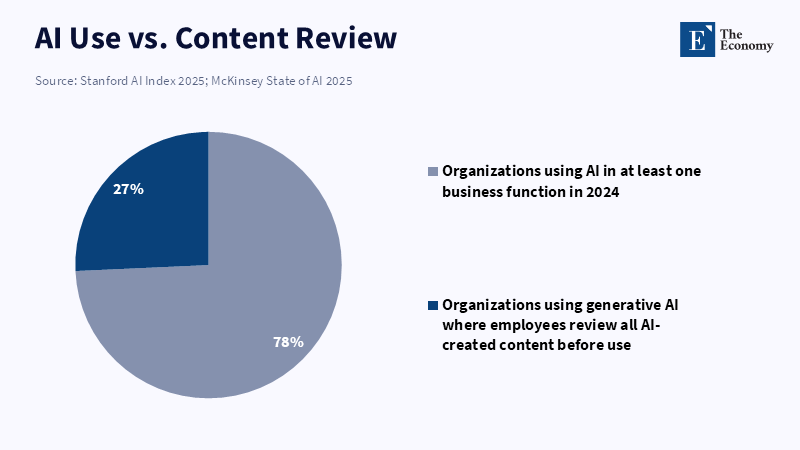
In 2024, seventy-eight percent of businesses had at least one AI application in their finance, marketing, customer support, human resources, software, security, or public administration operations. That should end the notion that AI remains an experimental side at the edge of work. Today, most business decisions and services are using AI. Yet the public language around it remains oddly childish. AI thinks. Decides. Knows. Refuses. Those phrases give the machine a social mask while hiding the fact that it has no private morals, no ethics, and no duty. Now that is the central concern of responsible AI. Many users treat AI like a domesticated tool with a human voice: not fully human, but familiar enough to excuse. But if something goes wrong, we cannot say AI did it. The person or company that bought, approved and relied on that tool still owns the result.
The accountability of AI starts with words, not machinery
The initial concern is to shift the framing of the issue. The concern is not that we use human language as we talk about AI. People call cars "him," curse laptops and thank search engines. The concern is when that tendency shifts from being a practice to following the practice at every level, from contracts and employee handbooks to public policy and legal defense. Once an institution makes it mean to be "an AI decision," then the phrase obscures the actual agents. Someone bought the system. An administrator approved the use case. A manager set the cutoff. A classifier's output constituted an accept-reject decision.
While this is why anthropomorphic language does matter, it is not for the reason that it is usually pressed. Attributing agency to a machine does not make it a person. It makes the system a useful blur. The machine looks active enough to receive praise when it saves time, ranks files, drafts text or detects patterns. Yet it remains passive enough to avoid blame when the output is false, biased, unsafe or harmful. This is the dangerous middle stage of AI: close enough to feel familiar, far enough away to keep you from upturning the balance of rights and wrongs. AI accountability needs to do away with that nonsense and ask who was in charge of the system.
That does not mean all AI errors are merely human oversight. AI may be multi-layered, probabilistic and inscrutable, but all complexity does not afford agency. Complex processes can still be owned. Hospitals are held responsible for their protocols even when making use of many hands and devices. Banks are held responsible for their credit process, even when the scoring software determines the file. Schools are held responsible for their assessments even when a platform adjudicates the drafts. AI accountability must take that principle as a starting point. There is a system that yields an output, but there is an institution that makes the decision.
AI accountability follows the chain of command
Here is a good test. If an employee commits a serious error, the manager cannot always say, "The employee was to blame, not me." The manager did not have to tender the entire job out to the user, may never have typed the email or signed the form and may never have spoken to the customer. Yet the manager is the person responsible for employee selection, training, employment conditions, workload, review rule settings and escalation. The same process works at the board level in the corporate hierarchy. The CEO does not check all the invoiced charges, yet the CEO remains responsible for the entire control process that allows fraud, safety failure, or compliance failure to develop. AI does not break that process. It simply intensifies the importance of that process.
That is why attributing AI liability has to be role-based, not metaphor-based. The developer is responsible for unsafe design, inaccurate claims, inadequate testing, known limitations; the vendor for inadequate documentation, inaccurate marketing; the deploying institution for the use case, staff training, monitoring the process, appeals procedures and ultimate reliance; the end user for careless use when rules, policy and professional duties are clear; the board and executives for scaling up AI without clear risk ownership. According to a 2025 business survey, only 27 percent of organizations that use generative AI review all output before use. This is a management problem, not a machine problem.
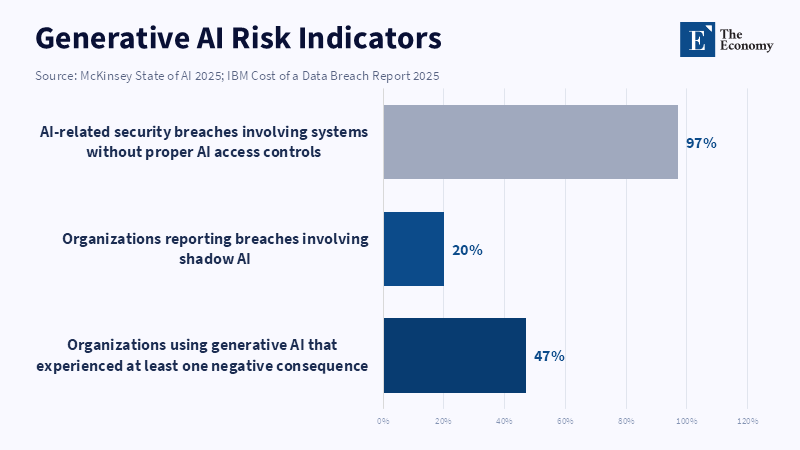
Using the same survey, though, another 47 percent of organizations that used generative AI reported experiencing at least one negative consequence from using it. That number is important because it indicates that all risk isn't a faraway abstraction. It is already embedded in business as usual. Inaccuracy, privacy, cybersecurity, intellectual property and even compliance are never novel harms. They are familiar with business risks expedited by automation. Once an AI production makes it into established workflows, it requires the same rigor as finance, legal, safety, or medical processes. The chain of command isn't just at the chatbot window; it has to go up to the people who allowed that window to shape real outcomes.
The real risk is procedure without ownership
In the end, the strongest excuse will not be "the AI is sentient." At the far end of the spectrum is colder: "the procedure was followed." This is where the accountability gap becomes more discreet. Institutions have used procedures to legitimate decisions for as long as they have existed: a form was filled out, a rule was applied, a score was computed, a file was reviewed. AI fits conveniently into this venerable tradition because it resembles procedures on a large scale: it creates a transparent outline out of cluttered judgment; it transforms a questionable choice into a technical, neutral, and hard-to-challenge one.
That's why accountability related to AI has to be less about whether someone blames the model and more about whether bigger institutions choose to use it as a cover. The AI recommended it. Can work as the data says, or Google says so. It sounds modest, trying to show humility and being risk-averse rather than the arrogant-sounding offer of certainty. But that can devalue human judgment regardless of who stands behind it and still use human authority to back up AI-generated outcomes. America's bottom is nearly blackened by a cynical public not prone to taking things at face value. When asked in a 2025 survey whether AI's spread made them more worried or excited, 50% to 10% said they were more worried. The public isn't always sure how the models work, but they can tell when responsibility is being removed from sight.
Psychological evidence bolsters the warning. In 2024, three empirical investigations demonstrated that people's perception that AI has a mind like a human increases their tendency to put the AI at fault for moral damage. That may sound like accountability, but it can be just the opposite. Putting blame on a system incapable of suffering, answering back, making amends, or a moral sense may do nothing but vent blame while shifting pressure away from the company, public agency, manager, or professional entity that was in control of the circumstances capable of causing the damage in the first place. The policy question then is not whether users' attitude that the machine is from the machine at fault persists; the question becomes whether this attitude makes it easier to hide human power.
Designing AI accountability into everyday use
The practical solution? Don't ban humanlike language from the world. That would be fragile. The practical solution is to require operational language when rights, money, security, work, education, or access to the world are at risk. Policy should not say that an AI system "comprehends" risk. It should enumerate the inputs it employs, the outputs it produces, the human moderator who monitors it, the meta-error rate that is permissible, the conditions under which a human agent must review results and the provision for an aggrieved person to appeal. A procurement should not call for an "intelligent assistant." It should require logs, test results, identifiable limits, security controls, audit access and a named internal steward.
That means the structure of AI accountability needs to be established in advance of implementation, not to be repaired after a scandal. Every serious institution needs an AI cataloging system-a ledger where each autonomous agent and deep learning model is documented with its function, its input and output, its forerunners and heir, the owner, the review schedule and the governance protocol attached to it. And for expensive, high-impact uses, there needs to be many more controls: human sign-off, appeal processes, a red team to hunt unanticipated failure, incident reporting and emergency shut-down buttons. For low-impact uses, the bar should at least be set for safeguarding privacy and accuracy. And the point here is not to slow down AI research, but to slow down dangerous uses of AIs. Any instrument that cannot be independently cross-checked and challenged cannot be safely used to determine what others should or should not do.
That is also a concern for public agencies, employers, hospitals, banks, insurers, universities, and platform companies. Many do not build AI systems themselves. They buy platforms, connect them to workflows, and let staff treat outputs as recommendations, alerts, scores, or drafts. That creates a duty at the deployment stage. If AI screens an applicant, flags risk, drafts feedback, translates a record, or recommends an intervention, the institution still owns the outcome. Staff need clear rules for when AI can assist and when it cannot decide. People affected by the system need notice, appeal routes, and a human contact point. Policy should require a record of who approved the system, who monitored it, and who had authority to stop it.
AI accountability post the pet phase
A possible criticism is that this attitude will age badly. AI technology is improving rapidly. Some are already outperforming humans in narrow exercises and costs are dropping. Why should humans carry the blame if systems become more bulletproof? Because that is not morality, it is a change in the healthcare standard. No matter how much safer it can be than surgery, responsibility still belongs to the people and institutions that approve, use and regulate it. A plane can fly on autopilot, but that does not stop airlines from operating within regulations. A model can be better at a task than a junior employee, but that does not mean the model has no stake, no duty, no conscience, or interest in the damage.
An even stronger critique is that strict AI accountability will hinder adoption. This could be true, though weak accountability would do so even more in the long term. The costs of not being in control can already be seen in shadow AI. One breach study in 2025 found that 1/5 of organizations studied had breaches involving unauthorized AI tools. Another discovery was even more startling: among organizations that experienced breaches involving AI, 97 percent did not have appropriate access controls over those AI tools. This is not an indicator that institutions need less oversight. It is an indicator that AI is accelerating faster than the control culture in the surrounding environment. Adoption without ownership is not progress. It's drift.
The road to a better future is not to pretend that AI will remain just a doll. It will go from forcing us to put a ring in its nose, to being more powerful, integrated and persuasive. Some systems will learn fast and autonomously enough that older review habits may fail as we used to. Which is precisely why the human chain must be put in place now. The more powerful the instrument, the more compelling the case for clear ownership. The greater the power of a tool, the more outrageous its deployment without a designated owner, settled limits, real-time scrutiny and an escape hatch becomes. AI accountability is not anti-technology. It is the prerequisite of wielding high-powered machinery without turning the tool into an alibi.
That 78 percent figure should be a sign to AI believers, not a boast. For all the excitement about the technology, institutions have handed it over to the world at large as if it were merely another product when it has become a kind of foundation. And in the language that the world supplies to naturalize it, public language still gives machines far too much drama and owners far too much cover. A little kid can blame her doll. An adult can't. An employee can blame his machine. A boss must check the employee's work. A company may automate the process. Its executives, not so much. So whatever the future holds, the final chapter in AI's story of accountability should be straightforward, dull and actionable: no outputs without an owner, no decisions without a review policy, no deployment without audits and no damage without responsibility to the original owners; the people and institutions that bought, installed, defined and deployed the system. AI may sound human, but responsibility should stay human.
The views expressed in this article are those of the author(s) and do not necessarily reflect the official position of The Economy or its affiliates.
References
Brailsford, J., Beretta, E., Reese, G. and Kizilcec, R.F. (2025) ‘Responsibility Attribution in Human Interactions with Artificial Intelligence’, Proceedings of the ACM CHI Conference on Human Factors in Computing Systems.
Bryson, J.J., Diamantis, M.E. and Grant, T.D. (2017) ‘Of, for, and by the people: the legal lacuna of synthetic persons’, Artificial Intelligence and Law, 25, pp. 273–291.
European Parliament and Council of the European Union (2024) Regulation (EU) 2024/1689 laying down harmonised rules on artificial intelligence. Official Journal of the European Union.
IBM and Ponemon Institute (2025) Cost of a Data Breach Report 2025. Armonk: IBM.
Joo, M. (2024) ‘It’s the AI’s fault, not mine: Mind perception increases blame attribution to AI’, PLOS ONE, 19(12), e0314559.
Kennedy, B., Yam, E., Kikuchi, E., Pula, I. and Fuentes, J. (2026) ‘Key findings about how Americans view artificial intelligence’, Pew Research Center, 12 March.
Maslej, N., Fattorini, L., Perrault, C.R., Gil, Y., Parli, V., Kariuki, N., Capstick, E., Reuel, A., Brynjolfsson, E., Etchemendy, J., Ligett, K., Lyons, T., Manyika, J., Niebles, J.C., Shoham, Y., Wald, R., Walsh, T., Hamrah, A., Santarlasci, L., Lotufo, J.B., Rome, A., Shi, A. and Oak, S. (2025) Artificial Intelligence Index Report 2025. Stanford: Stanford Institute for Human-Centered Artificial Intelligence.
Nass, C., Steuer, J. and Tauber, E.R. (1994) ‘Computers are social actors’, Proceedings of the SIGCHI Conference on Human Factors in Computing Systems, pp. 72–78.
National Institute of Standards and Technology (2023) Artificial Intelligence Risk Management Framework (AI RMF 1.0). Gaithersburg: NIST.
Organisation for Economic Co-operation and Development (2024) Recommendation of the Council on Artificial Intelligence. Paris: OECD.
Qamar, N. (2025) ‘If AI Does Something Wrong, Who Is Responsible?’, Medium, 17 November.
Singla, A., Sukharevsky, A., Yee, L., Chui, M. and Hall, B. (2025) The State of AI: Global Survey 2025. New York: McKinsey & Company.
Tanner, B. (2026) ‘Anthropomorphic AI terms create gaps in accountability’, Brookings Institution, 20 May.
Working across research, policy, and data-driven analysis, the Editorial Board ensures that published pieces reflect a consistent institutional perspective grounded in quantitative reasoning and long-term structural assessment.