Europe’s Housing Mobility Trap Is Now A Labour Market Problem

Working across research, policy, and data-driven analysis, the Editorial Board ensures that published pieces reflect a consistent institutional perspective grounded in quantitative reasoning and long-term structural assessment.
Authored On
Modified
High rents are turning Europe’s free movement into a costly privilege
Housing costs now block job matching before workers move
Affordable housing must be treated as labour-market infrastructure

After years of free movement, the glaring fact is not just how mobile Europe has become. It is how little Europe is still on the move. In 2024, only 4.4% of the EU working-age population born in one Member State was found elsewhere. This is a weak figure for a union which claims its free movement is at the heart of what it does. The familiar housing debate speculates on a problem already in motion: what happens when people move or settle where they can. Overcrowding, deprivation, crippling delays and ill health. These are valid points. But there is a deeper loss occurring much earlier. Many workers simply do not end up in a costly environment of cramped housing and high rent because they do not get there in the first place: they refuse to move. The wage appears in black and white, but the rent takes it back in practice. This is the housing mobility trap: lower mobility turns housing into a social problem; higher mobility into a labor market barrier.
The Housing Mobility Trap Starts Before the Move
A frequent finding of the housing debate today is that high housing costs produce damage to social life and household well-being. That is true but incomplete. The direct policy implication is not the only impact increased rents have on residents. The sharpest policy question is how increased rents prevent the future residents from becoming the workers there at all. The worker contemplating a move will not just compare wages; they will compare what is left over after rent, deposit, travel, commuting, childcare and risk. A young Italian might contemplate a better wage in Berlin. A Portuguese technician might seek a higher wage in Amsterdam. A Romanian nurse is in high demand. The move can still fall through if the first-year rent leaves the couple worse off than before. This is not a failure of ambition. This is household arithmetic.
The housing mobility trap hits hardest on those without wealth. Graduating, renting, caring, teaching, cooking, traveling, building and training all encounter the same hurdle. They enter the most expensive sector of the housing market at the moment of lowest savings. Existing tenants may be entitled to old contracts. Owners may reap the benefit of past price rises. New arrivals face asking rents today. This division is significant. It creates the appearance of open cities in law and closed cities in practice. The ever-expanding labor market can list thousands of vacancies. If a worker cannot get a room near a job, the vacancy is not really accessible. Europe's housing problem, therefore, limits movements before it is reflected in income, health, or social cohesion statistics.
High Rents Turn Skills Policy Into a Leaky Pipe
The numbers also make this labor-market reading difficult to contest: European Commission estimates for average house prices in the EU from 2015 to 2024 indicate a 53% increase, while rents increased between 2010 and the first quarter of 2025 by 27.8%. The proportion of income spent on housing in Greece, at 35.5%, is also the highest in the EU. These are not simply indications of economic pain; they are signals of blocked movement. They indicate how much they cost to move into employment-dense regions. When that cost increases faster than starting wages, the mobility itself becomes a luxury-when workers may be appropriately qualified, but affordably accommodated, the match itself fails.
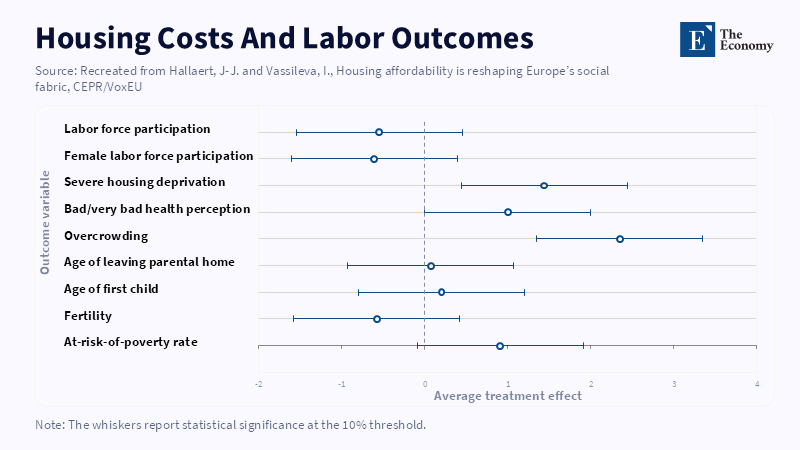
This contrast with migration from non-EU countries sharpens the point. In 2024, 12.6% of the working age population was born outside the EU before anyone even considered intra-EU movers-and the proportion is only going to get higher. Europe still clearly needs labor from many destinations and it should be easier for those already inside the single market to go where the jobs are. If it is not, much of this is because free movement does not come with a housing insurance policy: the right to take a job is somewhat less compelling when the first rent payment is one that is unaffordable.
That is why housing must be part of skills policy. Europe too often has a discourse in which skills shortages can be remedied through training alone. More nurses. More technicians. More construction workers. More digital workers. Yet training does not complete the match. The skilled worker still requires an affordable dwelling within reach of the job. If the city cannot provide this, then the training pipeline will spill over into sprawling strains of commutes, parental households, cheaper regions, or overseas markets. And that is a vital point for educators and administrators who form programs around local labor market needs. A nursing program in a high-rent region will not be enough if graduates cannot afford the city's rent. A technical college working near an industrial cluster will not solve the shortages if entry-level staff must spend half their pay on housing.
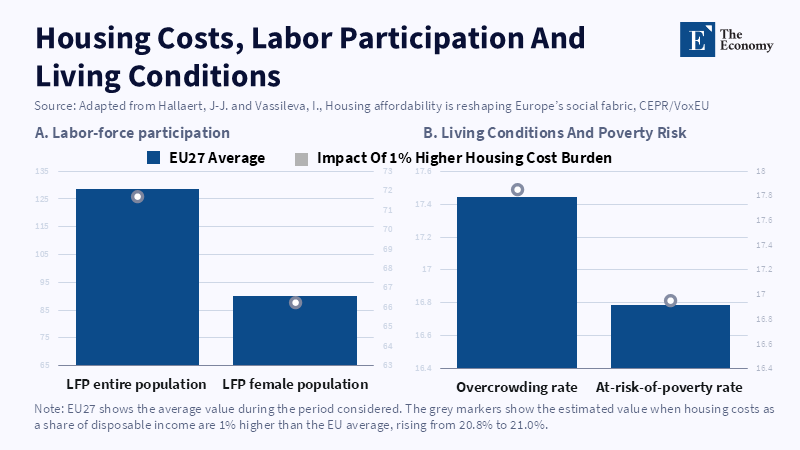
Affordable Housing Must Follow Work, Not Only Need
Evidence from Salzburg demonstrates this mechanism perfectly. It has the highest rent levels in Austria. The average private market rent in Salzburg is some 50% higher than the national average, while the same cannot be said of average incomes. From 2001 to 2021, Salzburg city recorded a net internal migration balance of around minus 6%, the exception rather than the rule for Austrian urban areas. This is not to say that there are no jobs in Salzburg. But the city's high housing costs will have a significance for the levels of in-and out-commuting: people will live further out and commute more, or simply not move there. This pressure is acutely evident in services and health care, where the wages are not high enough to compensate for private-market rent.
This lesson should overhaul affordable housing policy. Housing should still be evaluated on need, dignity, family life and fairness. However, housing must also be used as economic infrastructure. Roads, ports, grids and broadband are built where they generate growth. Affordable housing must be the same. The EU would have needed, in 2025, about 2.25 million more homes than were then under construction, some 50% higher. Social housing was only 8% of the EU stock then, 14 million dwellings in 2021, down from 11% in 2010. Demand subsidies alone cannot fix the shortfall. They can support a household today. In a constricted market, they can push up prices tomorrow. Supply must grow where jobs, transport and training converge.
The New Worker Needs an Entry Path
What isn't clear in this model is the missing policy tool in the middle. It is the entry-level path for 'needed but not rich' workers. Not in the sense of turning the housing market into a benefit for employers or handing over control of workers' homes to firms-that's a new risk even more than it is a gain. What is needed are publicly owned, not-for-profit, or cost-rental homes, which enable workers to access a city without having the entire private rental shock hit them immediately. The targeted new entrants are apprentices, young professionals, teachers, nurses, hospital care workers, transport workers, builders’ laborers and people working in other shortage sectors early in their careers. The homes they need are entry-rent, time-limited and portable across local employers, with fair turnover rules that support mobility without creating entrapment.
Short-term rentals must be considered in this context. In 2024, the four big online short-term rental platforms registered 854.1 million guest nights booked in the EU, +18.8% versus 2023. Tourism generates income; many places rely on this. But residents are affected in overheated cities and coastal resorts: whenever a flat goes from a long-term rental to visitor use, this affects the employment equation. The cleaner, waiter, nurse, airport employee, lecturer, or driver also needs a place to live. A city that loses residents but gains tourists is undermining its economic foundation. Local regulation should regard the stock of long-term rental housing as a component of the working population. Sharing data with platforms, limiting licenses in excess cities and opposing tax bills that incentivize stable tenancies do not have to close cities to visitors.
Breaking the Housing Mobility Trap Before Europe Stops Moving
It will be said that higher pay should fix the shortage. Which, of course, it should in some sectors. It can't in many: they are funded by public money or operate on tight service margins, such as hospitals, schools, care homes, convenience restaurants, haulage companies and tiny builders. None can get wages high enough to keep pace with city center rents. It will also be argued that remote working takes the edge off this argument. Which to some extent it does for white collar labor and very little for care workers, construction workers, haulers, travel agents, laboratory workers, shop workers, or public sector personnel. It will be said by others that plentiful and cheap accommodation in Europe's wealthiest cities will encourage more people and only ramp up inward migration. That possibility is real. It is not the reason for doing nothing. It is a good reason for competing in speed, redeploying spare capacity and disallowing long-term rentals where shortages are extreme.
Policy should have two speeds. The fast track should reduce the cost of accessing deposit guarantees, bridging grants, trusted housing portals and temporary rental insurance when linked to a real job offer or training spot. These are relatively cheap compared with the risk of losing trained workers. The slow track should build the stock that makes mobility viable: cost-rental homes, worker entry homes, student-worker homes, land trusts and accelerated permits controlling transit. The measure of progress should not be only units delivered, but whether shortage vacancies decrease, whether new workers settle in, whether commutes tighten. Housing ministries and labor ministries are merging into one autonomous world.
Europe's low level of cross-border working-age mobility should be read as a warning. The right to move is still there. The practical ability to move is weaker than it should be. Housing is now one of the costs that constrain that freedom. A city that cannot house its future nurses, mechanics, tutors, programmers, chefs, or builders cannot call itself open. It's only open to those able to pay the entry price. Europe does not have to choose between social housing and economic growth. They have become one and the same agenda. Breaking Europe's housing mobility trap would not make every worker move. What it would do would be to make mobility a real option again.
The views expressed in this article are those of the author(s) and do not necessarily reflect the official position of The Economy or its affiliates.
References
Cousin, G., Frayne, C., Dias Martins, V. and Vašíček, B. (2025) Housing in the European Union: Market Developments, Underlying Drivers, and Policies. SUERF Policy Note No. 387. Vienna: SUERF.
European Commission, Directorate-General for Economic and Financial Affairs (2025) Migration, Mobility and the EU Labour Market. Brussels: European Commission.
European Parliament (2026) Housing Crisis: Why Prices Are Rising and What the EU Is Doing About It. Brussels: European Parliament.
Hallaert, J-J. and Vassileva, I. (2026) ‘Housing affordability is reshaping Europe’s social fabric’, VoxEU, 7 July. London: Centre for Economic Policy Research.
Klien, M. (2024) Hohe Wohnkosten als Belastung für den Wirtschaftsstandort Salzburg. Vienna: Austrian Institute of Economic Research.
Koessl, G. (2024) ‘New study on the links between affordable housing and labour markets’, Housing Europe, 29 February. Brussels: Housing Europe.
Working across research, policy, and data-driven analysis, the Editorial Board ensures that published pieces reflect a consistent institutional perspective grounded in quantitative reasoning and long-term structural assessment.