The AI Trade Shock Will Reward Countries That Move Workers, Not Just Data

Working across research, policy, and data-driven analysis, the Editorial Board ensures that published pieces reflect a consistent institutional perspective grounded in quantitative reasoning and long-term structural assessment.
Authored On
Modified
AI will reshape trade first through prices, not only through jobs
Countries that adopt AI can gain, while non-adopters risk weaker exports
The real policy test is whether workers can move into better work fast enough

Global exports of digitally delivered services are now close to a five-trillion-dollar market. That is the right place to examine for the next wave of shakeout in world trade. The AI trade shock will not start in a factory with smokestacks and harbor cranes as a backdrop. It will start in lines of code, design, finance, legal work, marketing, technical support, translation and software services. It will reduce the cost of some activities in one country and lower the cost of many services from another. Many consumers and firms may benefit, but not evenly. However, all workers and countries whose growth has relied on exporting white-collar services may face a severe challenge. The fundamental policy question is not whether the AI trade shock boosts output; some research indicates it may. The fundamental policy challenge is whether the AI trade shock can move displaced workers into better work as fast as it shifts tasks across borders.
The AI trade shock is a price shock before it is a jobs shock
The most powerful interpretation of the global AI trade shock is that it is not a simple story of machines replacing labor. It is a story of prices, shares and exposure. If AI makes a task less costly in a given large exporting country, that effect does not remain confined within the borders of the country. The lower cost can feed into world prices, especially if competing tasks are cheaper elsewhere. A country that imports the AI-enabled service may gain from lower prices, while a country that exports the older human-made version of the same task may lose income. This is what makes the story more complex than describing a simple displacement story. This is the question that should rule the discussion rather than the narrower fear of job loss. Which countries can use lower prices to build new local activity and which will simply absorb the shock?
The world scale is large enough to matter. Recent trade modeling indicates that AI could boost global trade by about a third by 2040, with the biggest benefits in digitally deliverable services. A related macro model for OECD and G20 nations projects that AI could boost real income per head by around 0.1 to 0.95 percentage points a year in each economy over the next decade, depending on adoption pace, sector composition and trade linkages. That range is a map of policy uncertainty. A country with a sizable share of finance, software, professional services and business process exports cannot treat AI as an external tool. It is embedded in its own terms of trade.
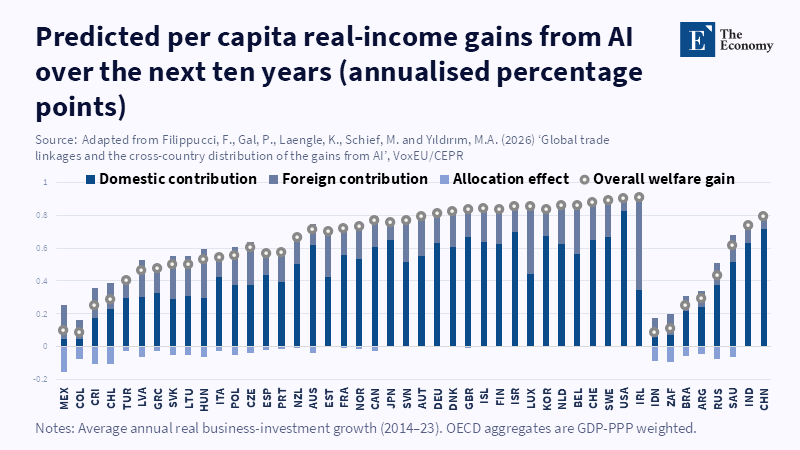
This is important because the AI trade shock will be, by design, uneven. Advanced economies hold much of the capital, patents, cloud capacity, research teams and frontier firms. They will also have proportionally more workers in the class of cognitive work whose taks AI can change quickly. That creates a paradox. While richer countries might be more subject to the immediate effects of disruption, they will, all else being equal, more easily benefit from the economic opportunities associated with such disruption, while poorer countries, all else being equal, will have less of their domestic jobs directly affected by the shock but far more threatened in their export platform, should a growth model built on outsourced services are forced to become more "import" dependent. The relatively inexpensive service that benefits a small enterprise in Africa or Europe may be one that simultaneously damages a call center, coding shop, or back-office cluster in another economy.
The winners will be countries that can absorb displaced work
The key test is absorption. In every major wave of technology disruption, there is a loss of some tasks and the gain of others, but the social effect hinges on how quickly lost tasks give way to new work and how well the gained trade is absorbed. The AI trade shock will hit countries that believe that this bridge will form itself. It will reward those able to shift workers from routinized, digitalized services into higher-value activities, shorter product life cycles, local AI support, applied data work, cyber security, compliance, health administration, logistics and industry-specific software. This is not to claim that every worker displaced by AI can become an AI engineer. That claim is false and politically reckless. The message is that many new jobs will occupy the space straddling domain knowledge and digital tools. Countries need that intermediate space because it is where the displaced service workers can flow into without having to start from scratch again.
Labor evidence supports this more careful view. The latest global work-exposure index, covering the current century, shows one in four workers is in an occupation with some generative AI exposure, although only a tiny fraction are in the highest exposure band. It shows 0.5% of workers in low-income economies compared with 4% in high-income economies being exposed at the highest level, and a clear gender gap in the most exposed jobs. And this does not imply mass unemployment is inevitable. It simply implies that task change will be broad, swift, and socially uneven. Clerical work, media, software, finance, and professional services are not marginal sectors. They are critical pathways into viable city work for millions of people. When all those pathways erode, governments will be powerless to respond with puns about innovative disruption or their unsubstantiated, vaguely confident assertions and markets will turn.
The danger is sharper for service-exporting economies. Already outflanked on cheap AI-cost imports, it can still be laid low if its export occupations utilize tasks the earliest-cheapening technologies most-AI-enabled AI advances first, for example. This is the tough lesson hiding beneath the AI trade shock. National welfare can rise on paper, but jobs themselves fall in individual groups, places and firms of concentrated hardship. The trade-policy error would be to hedge solely in consumer terms and double down in trade policy once real-world lower prices help households, while job losses transform on the ground into localized disasters. This is how a growth stimulus turns into a source of trade distrust. It is also what turns technology with substantial constructive growth potential into a source of resentment in the national economy. If success with AI does not kill the question of where workers go next, it might never be safe.
Cheaper imports are not a policy prescription
A platitude suggests these displaced workers will still capture gains through AI, lowering the cost of services. There is some truth. Software now can be cheaper and so can translation, legal templates, some logistics tools and operational support. This will help small businesses and maybe lower the investment threshold for exporters in countries that previously could not access high-cost general expertise. For many developing economies, this AI trade shock could be the one that lowers entry costs to foreign markets. A small tourism operator in a country with a big natural offering, for instance, could become a multi-lingual marketer. A small local manufacturer might be keeping the compliance papers up to date and a local foreign trade firm could be doing the customer and back-end support. These are tangible gains. They should not be excluded. But they are not a growth story and they are not sufficient.
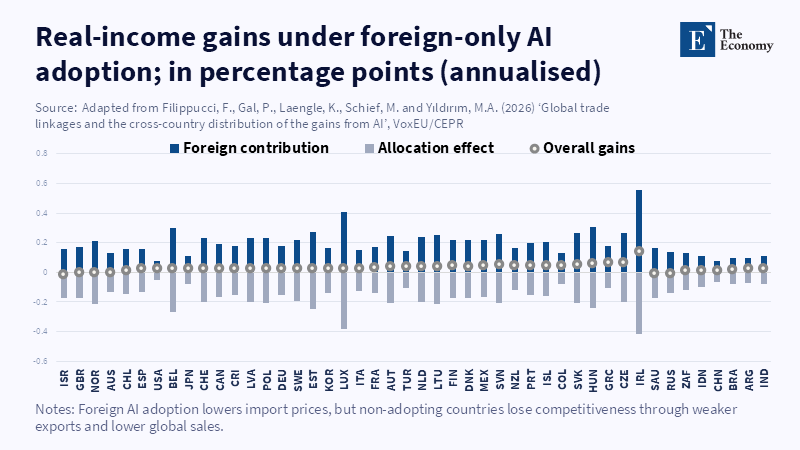
Cheaper imports are not a policy. Their lower prices do not guarantee a new job for the person who lost the old one. They do not expand broadband, repair the electricity grid, fund small businesses, or verify new skills. They do not address market power. If a handful of platforms owns the models, cloud layer, chips and customer channels, lowering costs of production may not benefit all users. The gap between productivity and wages may grow. The same technology that can lower trade costs can also rent out data, processing and distribution to the favored few. That is why competition policy must be inside of AI trade policy, not to the side. Without it, the AI trade shock may help bring down costs and increase economic rents even further.
The numerical scale of this makes the point hard to miss: worldwide, the market for AI is forecast to expand from less than US$200 billion in 2023 to almost US$5 trillion 10 years on. But the research, patents and governance of AI are very geographically concentrated, in a handful of countries and firms. In 2022, just one hundred firms - largely based in the United States and China - accounted for some 40 percent of global AI research and development; the same two countries accounted for the great bulk of AI patents. This technology shift is not a neutral technology wave flowing evenly through world trade. It is a closely concentrated production system supplying tools into a fragmented world economy: that is the dynamic structure that should inform the thoughts and actions of trade ministers, financial authorities and competition enforcers long before the effects of the shock become entrenched.
That concentration alters the policy answer. The correct answer is not digital autarky. While most nations cannot and must not consider reconstructing frontier models independently, they do require domestic capabilities to utilize, modify, monitor and negotiate across authentic markets. This pertains to shared computational resources for firms and researchers, public data availability where appropriate, capacity for model validation, stronger data protection and financial/business enablement of local-language tools. It also encompasses international trade policies that safeguard transnational data flow but are simultaneously inclusive of protective privacy and safety protocols. In the absence of this foundation, many nations may end up receiving AI tools, but few may be contributors and innovators. They may ride the technology wave, but for a prolonged period, they will have shallow benefits.
The AI trade shock requires an adjustment state
"Adjustment state" is an old-fashioned term, but the AI trade shock makes it crucial. The market can shift tasks extremely rapidly. It cannot do so, autonomously, with the same speed or care, with workers, towns, schools, firms and tax regimes. An intelligent adjustment state would begin by charting exposure by task, not only sector, to items such as clusters of exports that depend on routine coding and data entry, customer care, text editing, content generation, design work, or financial data crunching. It would then finance short-term, pragmatic retraining monitored against actual hiring. It would help workers stay attached to the labor market through wage insurance, portable benefits and job search aid. It would deliver a speedier pathway through change, not protection from it.
For businesses, aspire to diffusion, not spectacle. Too much policy on AI is written as if the only options are frontier labs or fear. Most productivity will come from ordinary firms making good use of AI: a logistics firm eliminating bottlenecks, a GP surgery trimming admin overhead, a manufacturer extending machine life, a bank catching potential fraudsters, a law practice hastening document retrieval. Public policy should support small and medium enterprises adopting tried and tested applications, retraining staff and quantifying benefits. Export promotion should include AI suitability as a trade policy. Investing in safe, useful diffusion shouldn't be hindered by procurement rules favored by showy pilots: the AI trade shock should cause policy to focus on dull mastery, because dull mastery converts tools into widespread productivity.
And for workers, the terrain is bargaining power. If AI increases output but weakens labor's rent share of the output, the politics will be menacing. Social dialogue is not a soft add-on; it is a lever for speed, for more trust and for better design. Workers are in the know about the kind of tasks that can be automated, which still require judgment and where errors imply risks. Firms that include workers can design jobs, not just cut staff. Governments can also reinforce this via sectoral agreements, training funds and transparency rules when AI is used to monitor, rank, or displace labor. The objective is not to oppose adoption. It is to make it so legitimate that it becomes sustainable. A faster economy will still require workers who believe the bargain is fair.
Turning the AI trade shock into shared growth
Policymakers must also challenge a misconception between domestic policy and global rules. The AI trade shock is transmitted via trade, so countries cannot rely solely on onshore adjustment. They require internationally agreed common standards to enable data sharing, model risk mitigation, taxation of digital services, procurement and competition policy, along with the space to develop capabilities. The low-income economies cannot progress if every effective policy is viewed as an obstacle to market access, but the world cannot sustain a subsidy war that only developed countries can win. The optimal route is predictable assistance, provided openly and within an expiry date, in exchange for skills, infrastructure and access rather than national champions. That is how free trade can stay open without leaving weaker economies on the sidelines.
The most obvious criticism is that this agenda is asking too much of governments. Some will argue that technology is advancing so rapidly that regulation is an impediment to progress. That argument gets the order wrong. Too much regulation harms some useful applications, but too little harms the very public confidence in the new technology that will be crucial. The last round of globalization proved that overall gains are insufficient when losses are concentrated and obvious. AI increases the risk because the workers at risk are not just factory workers but coders, analysts, assistants, designers, translators and clerks who believed that digital work was a safer part of globalization. If the new deal is lower costs for consumers but weaker ladders for workers, the politics will be impossible. A clever government is not an obstacle but a stabilizer.
The first fact hints at the decision to be made. A global digital services trade system measuring nearly five trillion dollars will emerge as the primary conduit by which AI transforms prices, jobs and national competitiveness. The AI trade shock can expand access to valuable tools and boost growth. It can decrease the value for countries and workers caught in substitutable tasks. The outcome will not be determined by the model alone. It will be determined by whether governments build the capacity to adapt to change. The policy demand is clear: governments should treat AI trade policy as labor policy, competition policy, skills policy and development policy simultaneously. Otherwise, the world will have more affordable services and a more fragile economy. That would be a poor return for a technology sold as a growth breakthrough.
The views expressed in this article are those of the author(s) and do not necessarily reflect the official position of The Economy or its affiliates.
References
Cerutti, E., Garcia Pascual, A., Kido, Y., Li, L., Melina, G., Tavares, M.M. and Wingender, P. (2025) The Global Impact of AI: Mind the Gap. IMF Working Paper No. 25/76. Washington, DC: International Monetary Fund.
Filippucci, F., Gal, P., Laengle, K., Schief, M. and Yıldırım, M.A. (2026) ‘Global trade linkages and the cross-country distribution of the gains from AI’, VoxEU/CEPR.
Filippucci, F., Gal, P., Laengle, K., Schief, M. and Yıldırım, M.A. (2026) AI Meets Trade: Global Linkages and the Cross-Country Distribution of the Gains from AI. OECD Artificial Intelligence Papers, No. 57. Paris: OECD Publishing.
Gmyrek, P., Berg, J., Kamiński, K., Konopczyński, F., Ładna, A., Nafradi, B., Rosłaniec, K. and Troszyński, M. (2025) Generative AI and Jobs: A Refined Global Index of Occupational Exposure. ILO Working Paper No. 140. Geneva: International Labour Office.
United Nations Conference on Trade and Development (2024) Digital Economy Report 2024: Shaping an Environmentally Sustainable and Inclusive Digital Future. Geneva: United Nations.
United Nations Conference on Trade and Development (2025) Technology and Innovation Report 2025: Inclusive Artificial Intelligence for Development. Geneva: United Nations.
World Trade Organization (2024) Trading with Intelligence: How AI Shapes and Is Shaped by International Trade. Geneva: World Trade Organization.
World Trade Organization (2025) Global Trade Outlook and Statistics, April 2025. Geneva: World Trade Organization.
World Trade Organization (2025) World Trade Report 2025: Making Trade and AI Work Together to the Benefit of All. Geneva: World Trade Organization.
Working across research, policy, and data-driven analysis, the Editorial Board ensures that published pieces reflect a consistent institutional perspective grounded in quantitative reasoning and long-term structural assessment.