AI Governance Is Now the Contest for Rule-Setting Power

Working across research, policy, and data-driven analysis, the Editorial Board ensures that published pieces reflect a consistent institutional perspective grounded in quantitative reasoning and long-term structural assessment.
Authored On
Modified
AI governance is now a rule-setting contest
The U.S. leads in capital and compute
China is gaining influence through standards

By 2025, AI companies had taken a commanding 61% share of all global venture capital, or approximately $258.7 billion from a $427.1billion market. That figure is not only a market statistic. It is a map of power. When one platform technology accrues more than half of enterprise funding, rules are no longer merely a background issue. They are a framework for determining who is permitted to develop, buy, test, export, host and govern the systems that will sit inside public services, firms, banks, hospitals, courts, transport networks and armies. The problem of AI governance has previously been characterized in terms of safety, bias and transparency. That framing is no longer comprehensive. The central question is not what regulation would look like but who is permitted to define the operating parameters of legitimate AI use and which states will be left to take regulation on someone else's platform.
AI Governance Has Become Rule-Setting Power
The best way to read the new AI governance contest is not as a dispute between more regulation and less regulation. It is a struggle over who writes the operating rules for a technology that now sits across markets, security systems and public administration. The old debate on technology was worded as talking about market rules, privacy rights, platform competition and trade flows. It was, in some way, still about how to design technology markets. AI pushes those debates on the regulation of AI technology and ecosystems into the same stack. Chips, cloud contracts, data regulations, model assessment, safety tests, sourcing policies, export controls and government use are one stack now: many bits of a new political system. When a state leads that system, it not only de-risks but also defines the cost of entry for all the others. It defines which products can scale, which state agencies can rely on AI and which, in turn, constitute a responsible AI governance paradigm.
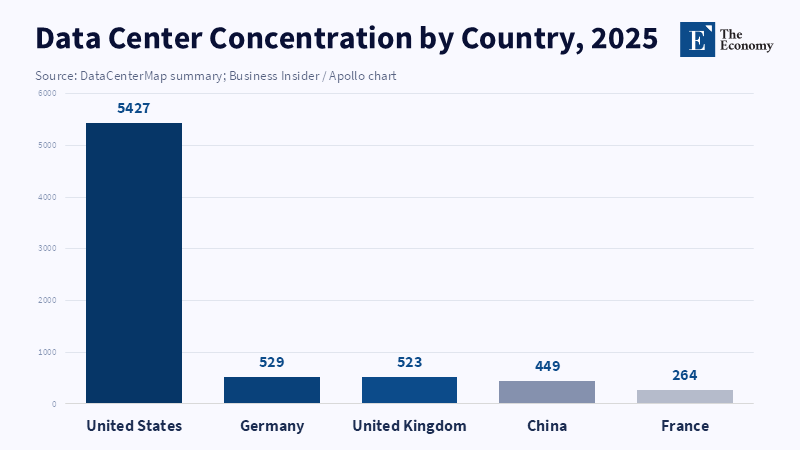
This reveals new significance, however, because the technical differences are narrowing even as the infrastructure gaps remain yawning. Since early 2025, the 2 top American and Chinese efforts have traded first place and 1 key 2026 benchmark ranked the leading US effort only 2.7 percentage points ahead of the top Chinese effort. The old assumption that one or the other economy would simply own the frontier is weaker than before. But the underlying material-structure of the AI remains substantially uneven. The United States has 5,427 data centers, the highest number by a wide margin and the advanced chips present in the global AI system remain locked into a very brittle supply chain. Thus, AI governance cannot simply be reduced to a matter of mission statements, code of ethics, or lip service at summits: the ultimate challenge is whether the rules can reduce dependence, widen access and ensure that technical potential does not translate into political weakness.
The U.S. Model Shrinks AI Governance Into Advantage
The United States continues to have the strongest hand in the AI economy. In 2025, U.S. firms drew roughly $285.9 billion in private AI investment, compared with $12.4 billion reported for China in the same category. These figures are absent from the scope of Chinese public support, guidance funds, procurement, or local state sponsorship. Nevertheless, they reflect U.S. private sector dominance. Same story for the geography of venture capital. U.S. firms received roughly 75 percent of the world's current AI venture deal value globally. The United States also remained by far the majority contributor to the outbound flow of AI venture cash. However, this is not a small lead. This is an ecosystem advantage encompassing capital, talent, cloud infrastructure, model labs, university collaborations and strong state-industry ties.
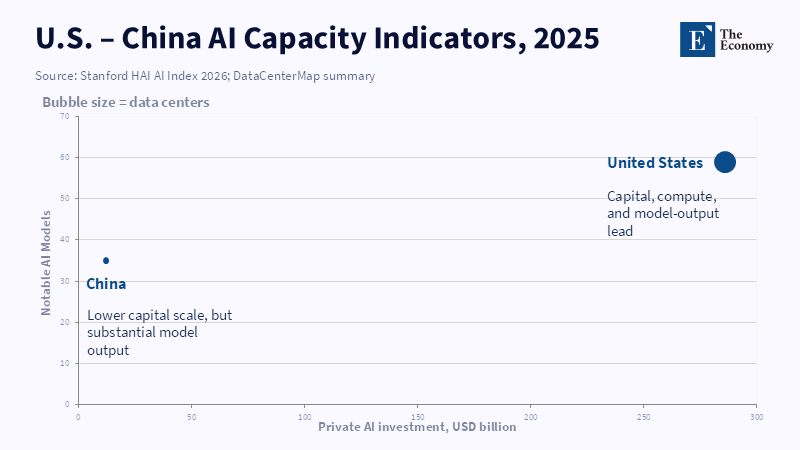
The policy problem is that this advantage has helped transform Washington toward a very narrow conception of the governance challenge. Since now the United States no longer views the global governance of AI as a concession-based institutional enterprise, the new American line emphasizes more than ever upon dominance, exports, standards and allied supply chains. This is not the same as forsaking governance. It is a decision to rule by influence. The U.S. message to allies is unambiguous: reliable infrastructure, American approaches, complementary standards and access to a powerful stack but within a strategic context and a geopolitical picture constructed for and by U.S. security and economic priorities. To many partners, that message is compelling. To other middle powers, it can be constraining. Any additional state can acquire a secure, highly capable U.S. stack and yet remain beholden to foreign cloud rules, export controls and procurement policies that it never engineered.
This is where the easy common complaint about U.S. policy falls short. It is insufficient to remark that Washington has simply become anti-governance. The more critical point is that U.S. AI governance has simply become more limited, more domestic and more commercial. The 2025 plan put forward would have emphasized faster innovation, large infrastructural projects, adoption, national standards and export promotion. These objectives are appropriate to a government seeking to keep the frontiers within its own system. They are less persuasive in an international arrangement. An effort seeking to win a race cannot alone serve as an even-handed, meaningful framework for that race. If the United States is to exercise enduring leadership, it will need to offer rules that objectively protect alliances against lock-in just as much as rivals against exclusion.
China Turns AI Governance Into Development Diplomacy
China crossed into that space with a different message. Its AI governance diplomacy is now packaging sovereignty, development, capacity-building and UN language in one bundle. That transition was made before the existing stream of summits. The Chinese campaign of 2023, rolling out its Global AI Governance Initiative (GAGI), unified the discussion on AI development with national sovereignty, social stability, equal participation and an expanded role for developing countries. The Chinese campaign of 2024 followed with an AI Capacity-Building Action Plan (ACAP) promising training, literacy work, infrastructure co-operation and 10 workshops or seminars for developing countries by the end of 2025. In 2025, China’s Global AI Governance Action Plan codified that line as a future route to global coordination. The line was straightforward: access means power and rule-drafting ought not to be reserved for those blessed with significant computing.
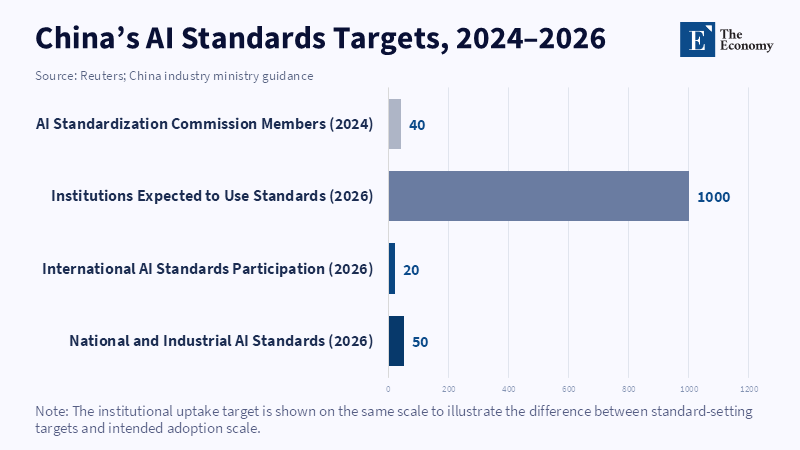
This argument is effective because it resonates with a real stake. To many states, AI governance does not sound like a theoretical debate about liberalism or state oversight. It sounds, rather, like a shortage of compute, talent, local-language models, regulatory capacity and bargaining leverage vis-à-vis foreign vendors. For such states, AI governance offerings that feature model development training packages, hardware access, pilot projects, standards work and participation in venues where they are not treated as laggards may be more persuasive than the cleanest values statement. China gets this. Its pitch is not only ideological. It is pragmatic. It turns to the Global South and says, AI governance ought not be written solely by the magnates of the richest model-builders.
However, China’s offer has a firm ceiling. The language of inclusion can be relaxed in the presence of a state-centric offer that delivers governments great scope over information, data and social arrangements. A nation willing to adopt Chinese training, platforms, standards and infrastructures may accelerate, but risk adopting particular assumptions to do so. This is not just hypothetical. AI models carry the logic of their manufacture. Content rules, censorship practices, data-access principles and security obligations can travel through models and vendor relationships. This does not imply that every nation that adopts part of China’s offer is adopting its political model. It does imply that capacity-building is rarely neutral. The workshop, the standards paper, the cloud contract and the model interface can all be the silent repositories of AI governance.
The more valid criticism of China's AI diplomacy is, therefore, not so much that it is false as that it is true. It is consequential enough to have an effect, attractive enough to persuade others to come on board and politicized enough to be cautious. Beijing has realized that, in the end, it is better to be chief tool-buyer than tool-seller. It is hard and costly to shape the parameters by which tools will be judged. Beijing is, for now, shifting from vendor-driven to institution-driven authority. This does not mean that it will dislodge the United States as the dominant source of AI power. It means that the previous rule-based international order was an artifact. In the new, post-AI Revolution hegemony, organizations, protocols and language are just as important as frontier innovations.
Middle Powers Need AI Governance Without Dependence
The probable future is not a bare U.S.-China divorce. It is a composite order. Some nations will simultaneously adopt U.S. clouds, Chinese apps, EU privacy regimes, domestic data regulations, open source architecture and U.N. shared language. That complex pattern isn't a sign of fragility. It may be the most practical version of independence remaining. The risk is that states confuse plug-and-play vendor selection with real sovereignty. Buying an AI platform from Beijing, Washington or any dominant vendor ecosystem is not the same as having authority over how it is used. Effective AI sovereignty entails the power to scrutinize models, change providers, impose local data constraints, require future compatibility, document public assets and isolate critical infrastructures from reliance on a single commercial or geopolitical provider. Autonomy now simply signifies leverage in reliance, not leadership unattached from all outside architectures.
For middle powers, the policy agenda needs to begin with procurement rather than slogans. Public agencies need to avoid long-term contracts that prevent easy switching of models. Vendors of cloud and models need to adhere to common standards on data residency, audit rights, incident reporting and exit. Governments should establish shared public-sector AI testing facilities rather than permitting governments to negotiate terms individually. Regional blocs should cumulatively develop the next-generation compute infrastructure needed for research, safety testing and public-interest use cases. Open-source models and open-weight systems should be treated as a strategic reserve for when they are safe, effective and clearly accountable-and to rejoin, when they are not. This is not a call for every state to develop a frontier laboratory. It is a call for states to avoid drifting into tenants in the AI infrastructure that governs their economy.
Equally, international institutions need a more modest but more effective role. No declaration from the United Nations will control frontier AI. However, the new scientific panel and the conversations it fosters can still be relevant if they do public work. They can catalog events; compare safety testing standards; publish procurement templates; establish evidence standards; and provide poorer nations with advice on infrastructure deals. Sounds less ambitious than a single global treaty. But an approach like that stands a much better shot at beating great power competition. The same logic is relevant for the Council of Europe treaty and other rights-based initiatives. Their true success will lie not only in, but also in, whether they influence hard edges of contracts, audits and public duties and not only in their text. AI governance needs fewer superlatives and more technical solutions.
Certainly, the toughest critique is that this agenda may move too slowly for a technology that is moving fast. That concern is fair, but the alternatives are worse. A rush into AI adoption without institutional capacity will deepen dependence. A rush into sovereignty without technical realism will waste public money. A rush into global rules without great-power buy-in will produce vague commitments. The practical path is narrower. States should build AI governance where power actually settles: procurement, infrastructure, standards, incident reporting, evaluations and public-sector use. The opening statistic returns here with force. When AI absorbs most venture capital, markets will not wait for public institutions to catch up. The call to action is therefore simple. AI governance must move from summit language to operating rules before those rules are locked into the systems themselves. The work may look dull. It will decide who governs.
This article is based on an original research article published by The Economy Research. For the original version, please refer to AI Governance as Hegemonic Statecraft: The U.S.–China Contest to Write the Rules of the AI Age.
The views expressed in this article are those of the author(s) and do not necessarily reflect the official position of The Economy or its affiliates.
References
Basu, A. (2026) ‘China’s Pivot on Global AI’, Carnegie Endowment for International Peace, 21 May.
China, Ministry of Foreign Affairs of the People’s Republic of China (2023) Global AI Governance Initiative. Beijing: Ministry of Foreign Affairs.
China, Ministry of Foreign Affairs of the People’s Republic of China (2024) AI Capacity-Building Action Plan for Good and for All. Beijing: Ministry of Foreign Affairs.
China, Permanent Mission of the People’s Republic of China to the United Nations (2025) Global AI Governance Action Plan. New York: Permanent Mission of the PRC to the UN.
Council of Europe (2024) Council of Europe Framework Convention on Artificial Intelligence and Human Rights, Democracy and the Rule of Law. Strasbourg: Council of Europe.
Kratsios, M.J., Sacks, D.O. and Rubio, M.A. (2025) America’s AI Action Plan. Washington, DC: The White House.
Leichter, R. (2026) ‘Number of Data Centers by Country: November 2025’, Cargoson, 4 January.
OECD (2026) Venture Capital Investments in Artificial Intelligence Through 2025. Paris: OECD Publishing.
Reuters Staff (2024a) ‘China Issues Draft Guidelines for Standardising AI Industry’, Reuters, 17 January.
Reuters Staff (2024b) ‘China Sets Up AI Standards Committee as Global Tech Race Intensifies’, Reuters, 13 December.
Sajadieh, S., Fattorini, L., Perrault, R., Gil, Y., Parli, V., Santarlasci, L., Pava, J., Maslej, N. et al. (2026) The AI Index 2026 Annual Report. Stanford, CA: Stanford Institute for Human-Centered Artificial Intelligence.
Slok, T. (2025) ‘5,426 Data Centers in the US’, Apollo Academy: The Daily Spark, 26 October.
The Economy Research Editorial (2026) ‘AI Governance as Hegemonic Statecraft: The U.S.–China Contest to Write the Rules of the AI Age’, The Economy, 4 June.
United Nations General Assembly (2024) Seizing the Opportunities of Safe, Secure and Trustworthy Artificial Intelligence Systems for Sustainable Development. New York: United Nations.
United Nations General Assembly (2025) Terms of Reference and Modalities for the Establishment and Functioning of the Independent International Scientific Panel on Artificial Intelligence and the Global Dialogue on Artificial Intelligence Governance. New York: United Nations.
World AI Conference (2024) Shanghai Declaration on Global AI Governance. Shanghai: World AI Conference.
Working across research, policy, and data-driven analysis, the Editorial Board ensures that published pieces reflect a consistent institutional perspective grounded in quantitative reasoning and long-term structural assessment.