The Cheap Drone Trap and the AI Warfare Sprint

Working across research, policy, and data-driven analysis, the Editorial Board ensures that published pieces reflect a consistent institutional perspective grounded in quantitative reasoning and long-term structural assessment.
Authored On
Modified
AI warfare is speeding up conflict
Cheap drones can overwhelm costly defenses
Governments need safeguards before this becomes normal
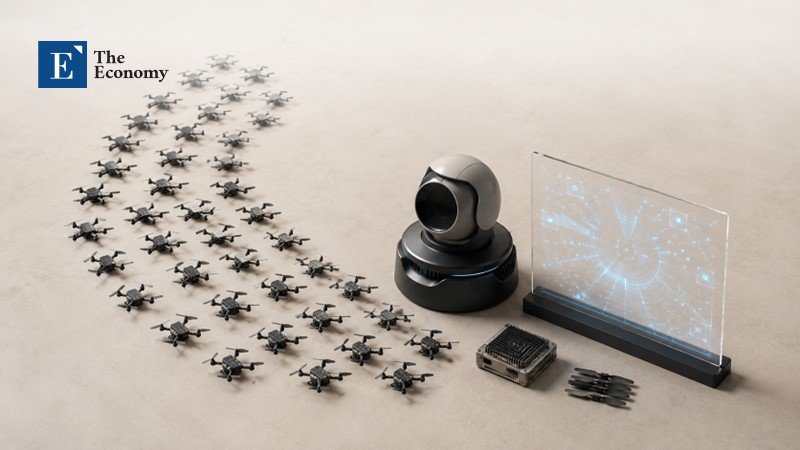
In 2024, the world had spent US$ 2.718 trillion on the military, the quickest annual rate of growth since the Cold War's end. That number is bigger than a budget report. It's a wake-up call for AI warfare. The next arms race is not about more ships, faster missiles or cheaper drones. It is about AI-enabled conflict and asymmetric warfare moving into the center of military planning. The old model of defending expensive systems with even more expensive systems is beginning to break. States can now spend millions of dollars to defend against a few tens of thousands; a single command post may be overwhelmed with more targets than it's designed to handle for human observers. This is now a matter of policy. Warfare is being rebuilt around two scales: low-cost-from-a-distance mass on the one hand and machine speed targeting on the other.
AI Warfare Now A Problem of Scale, Not Just Autonomy
The most basic way of understanding the current shifts is as a story about scale, not just smart weapons. AI warfare will matter because it will matter how many potential targets can be acquired, prioritized and engaged in a given period of time. Cheap drone warfare will matter because it will matter how many possible attacks the defender can initiate in order to overwhelm their resources of money, munitions and human capacity. The two will overlap as they combine to drive down the cost and increase the difficulty of managing force. Therefore, the story must be broadened beyond worries that a robot may kill autonomously. That concern is serious but it is no longer the whole story. Far more terrible will be a system that leaves human oversight on paper while forcing human controllers to endorse machine-driven targets because it is more efficient and rapid.
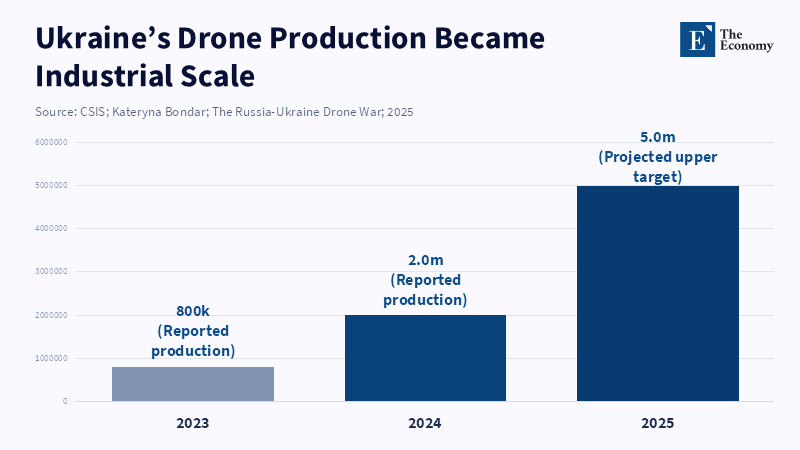
This transition is becoming effective now, not as an academic feature, but as an embedded tool. Ukraine produced roughly two million drones in 2024, including large numbers of FPV drones, a reflection of not only the industrialization of drone manufacturing but the internalization of it, as well as the acceleration of this process. In parallel, the U.S. has initiated efforts towards thousands of AI-powered autonomous systems across several warfare dimensions as a step towards comparable yet contrasting systems on the other side of the technological spectrum as part of its Replicator Initiative. The US Replicator initiative pointed in the same direction with annual funding reported at roughly $500 million for 2024 and 2025.
The Cheap Mass Will Strain the Defender State
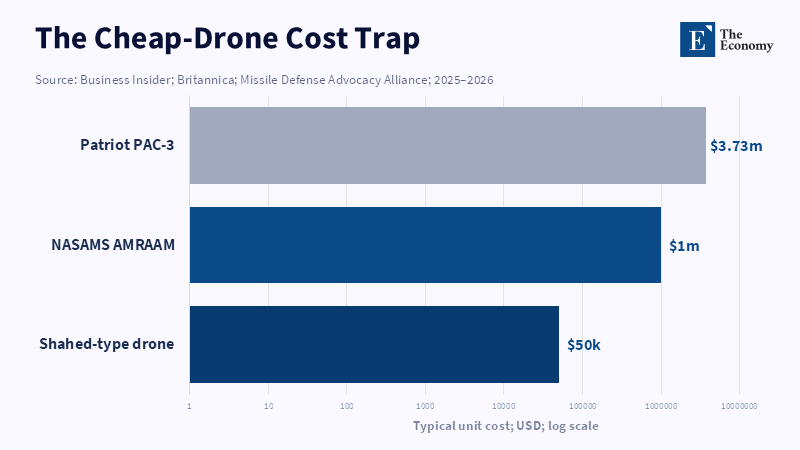
In terms of weapons development costs. Weapons need to be cheap, as a cheap drone or missile does not need to overcome its enemy's defenses directly but will be able to drain more expensive defenses by attracting more costly measures, or by attacking targeted infrastructures. A Shahed drone costs tens of thousands of dollars- compared to an interceptor firing, which will cost millions. Negotiating strategic concession, whether by tactical advantage or disadvantage, is a direct consequence of this dynamic. The cheap guided hardware is not proportionally more capable, but certainly more economically overwhelming. Even for nations with air defense, this dynamic has widened to port and airfield terminals, mainstream electrical generation and water treatment plants.
More layers are to be anticipated: cheaper counter-systems, electronic warfare, directed energy weapons, enhanced passive sensors, hardened bases and possibly their own drone swarms. All these sound reasonable measures, but all of them carry substantial additional danger; by reacting with mass to mass that response can foster an even larger and cheaper swarm, an even more rapid put in the air and even more paranoia. With global military spending reaching $2.718 trillion in 2024, the pressure to build cheaper weapons and cheaper defenses is already reshaping military planning. The market for mass-produced weapons will then emerge even before a doctrine on their control can be established.
The civilian threat is a natural effect. States will use drones and missiles for wider purposes: not only for military ends, but also for attacking the infrastructure of opponents (ports, power grids, schools, hospitals, roads), vital for its economy and politics, so damaging the civilian infrastructure will also damage the economy and political structure. International humanitarian law forbids harm to innocent civilians, but with a strategic and illegal, system of motivations in function, damaging the economy by attacking crucial wiring infrastructure could be very valuable. So, the budgets will be affected by the cheap drone trap and the gap between combatants and civilians could begin to enlarge.
Failure to Place Policy Between Humans and Machines at the Point of Attack
AI warfare is also a challenge due to decreased timeframes. While AI systems have highly advantageous battlefield awareness capabilities through increased data analysis of potential targets and data display, this advantage can be countered as targeting is pushed at such a pace that it must be expedited for human review. Even though each attack still must be confirmed by human sign-off, the AI system will be pre-screening targets, pre-suggesting weapon loadout and pre-constructing defensive or attacking argument frames in preparation for a specific attack situation and when this can be presented, what remains of the human analyst doing so is simply agreement with it that what the user has called up is what should be done, not "meaningful" analysis. It is not of purpose or intent, but an automatic system architecture driving adoption towards "higher speeds" and "automation bias."
Recent examples highlight this risk. Reports from the war in Gaza discussed AI-enabled rapid target listing and short review cycles; human rights reports argued that AI-enabled targeting supports could kill lots of civilians, provided data is inaccurate, biased, or stale enough. The problem is not, as one expert has suggested, error rates; it is the aggregate impact of even marginal error rates on high volumes of targets. A fatal error in the finance world might be a rejected loan, but in warfare, it could be the destruction of an entire home. Such policy requirements must be more stringent than accuracy alone - the real test is whether there is enough time and data for a human agent to say no.
Current US guidance requires appropriate human judgement and testing for autonomous weapon systems while responsible-AI frameworks stress reliability, traceability and governability. But they are abstractions and not operational standards, not a standard for where to minimize the time for target review,where the minimum evidentiary threshold of AI target choices, or where the minimums of reporting of civilian victims from automated targeting. Without standards on these specifics, ethics can be nothing more than the umbrella of effectiveness, not an effective tool to slow systems when civilian-concern risk rises.
Friction By Design as Necessary for AI Warfare
Banning all military AI or all cheap drones is not realistic. A stronger policy would separate defensive AI, intelligence triage and lethal target selection, then place the strictest controls on the last category. A strong policy stance would then distinguish multi-asset control systems by category – support, data-triage and the predictive or selection systems, with analogy to human anti-aircraft fire control and increase friction greatly for the last two. Friction is not disadvantageous; it is a vital security safeguard, considering whether in the lag of pause, special second check, incoming data verification, confidence lock-in, data keeping, pointing lock, or necessary refusal; for red flag targets, machine performance should rather be slowed down than fastened through the intelligence.
Procurement, then, would not just consider the cybernetic speed, accuracy and costs but would move toward additionally evaluating an AI's inspectability under duress. Targets that would not be discernible and explainable under tense circumstances need not be employed for lethal attack and data must be preserved for analytics upon civilian damage. Systems that assume the efficacy of remote and give rise to the human officer would also have to be redesigned. Civilian harm teams would still have to be involved in development onward to fielding, not as an afterthought. Training human operators would also have to include data bias, algorithmic errors and automation bias; these are not incidental facts but integral aspects of command in an age of AI warfare.
There would be new oversight required for the Ministry of Defense also; an upgrade to an AI warfare system would need to be viewed as a significant advantage and war-weapon upgrade like a physical weapon and reviewed by acquisition boards rather than a routine software patch. Legislators would have to implement rules for basic public transparency regarding targeting, although finer details can stay classified and also require civilian harm review for systems that include a log of events, an outline of training data and confidence statistics after major incidents. An allied agreement on common rules of operation would be required, so that one country was not left open to the potential political and legal repercussions of a lax approach; command simply cannot trust opaque technology.
The same logic applies to the cheap drone trap: as states will always look for a less expensive way to defend themselves, their potential use must be premised on policy measures which would prevent them from becoming part of everyday systematic attack on civilian infrastructure. An agreement to refrain from attacking hospitals, schools, water and power facilities except where stringent and transparent legal norms are satisfied would lay a foundation for regional de-escalation. These constraints, which will always be difficult to verify and will result in violations, will nonetheless establish a benchmark for allies, courts, corporations and public opinion to judge violations of; otherwise, states risk normalizing attacks on civilian assets as tools of escalation.
The adversaries will not slow down and the speed of war can be the difference between rushing to a conclusion or being overwhelmed. While a valid point, it should not be determinative. The answer is not slow-speed war, but graduated speed, in which less sensitive defense systems could operate at a high speed and targeting systems in civilian areas, even if unintentional, will be put under more safeguards. Emergency protocols may be in place, but they will need to be monitored and constrained and we should not be deploying any system at speed against the population if we cannot know that it can be verified as safe to deploy at that speed. If an AI is selecting targets by a desired, observable method, that will become a prerequisite.
The $2.718 trillion figure had hence to be experienced as much more than a budget line; that figure signals also the direction of a world that is increasingly brought awake for accelerated, cheaper and more mechanized war: its future is not laid down in words reveling in innovation, but in derivatives and cheap materials. The call to action is clear. Build friction before the next crisis, not after the next scandal. Treat civilian protection as a design requirement, not a press line. Make cheap defense a priority, but make cheap attack harder to normalize. The future of war will not wait for perfect treaties. It can still be shaped by rules that prevent the worst decisions from becoming routine.
The views expressed in this article are those of the author(s) and do not necessarily reflect the official position of The Economy or its affiliates.
References
Allen, G.C., Bondar, K. and Bendett, S. (2025) ‘The Russia-Ukraine Drone War: Innovation on the Frontlines and Beyond’, Center for Strategic and International Studies, 28 May.
Baker, S. (2026) ‘The Surging Demand for Interceptor Drones Exceeds Available Systems’, Business Insider, 1 May.
Feldstein, S. (2026) ‘The Unintended Consequences of Iran’s Asymmetric Strategy and America’s AI War’, Carnegie Endowment for International Peace, 13 May.
Liang, X., Tian, N., Lopes da Silva, D., Scarazzato, L., Karim, Z.A. and Guiberteau Ricard, J. (2025) Trends in World Military Expenditure, 2024. Stockholm: Stockholm International Peace Research Institute.
Missile Defense Advocacy Alliance (2026) ‘Missile Interceptors by Cost’, Missile Defense Advocacy Alliance.
Naber, I. (2026) ‘Iran’s Drone War Is Exposing Deep Cracks in US and Allied Air Defenses’, Business Insider, 29 March.
Persi Paoli, G. and Afina, Y. (2025) AI in the Military Domain: A Briefing Note for States. Geneva: United Nations Institute for Disarmament Research.
Stone, M. (2024) ‘US “Replicator” Drone Program to Cost $500 Million per Year, Pentagon Says’, Reuters, 11 March.
The Editors of Encyclopaedia Britannica (2026) ‘Drone Warfare in the 21st Century’, Encyclopaedia Britannica, 8 May.
Viveros Álvarez, J.S. (2024) ‘The Risks and Inefficacies of AI Systems in Military Targeting Support’, Humanitarian Law & Policy Blog, International Committee of the Red Cross, 4 September.
Working across research, policy, and data-driven analysis, the Editorial Board ensures that published pieces reflect a consistent institutional perspective grounded in quantitative reasoning and long-term structural assessment.