AI Standards Are the Only Realistic Truce in the US-China AI Race

Working across research, policy, and data-driven analysis, the Editorial Board ensures that published pieces reflect a consistent institutional perspective grounded in quantitative reasoning and long-term structural assessment.
Authored On
Modified
AI standards are the only realistic truce in the US-China AI race
Rivals may not trust each other, but they can still agree on basic safety rules
Without shared standards, AI competition will become more costly, fragmented, and dangerous

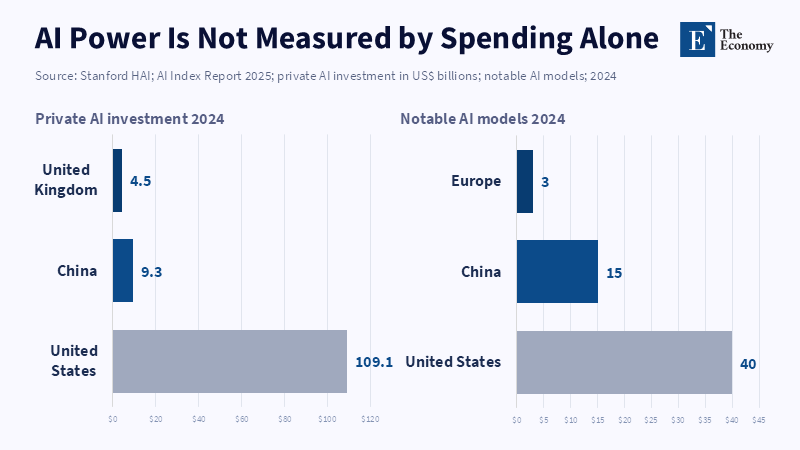
In 2024, the US drew $109.1B in private AI investment, just under twelve times the $9.3B that China did. Even then, China still produces 15 prominent AI models, led the world in AI publications and patents, and almost closed the performance gap in most tests to near-parity. That is the stark reality of the AI race: money, chips, and talent don't march in a clean, orderly fashion. It's possible for a country to be cut off from the best hardware and still pull closer with cheaper models, faster usage, and state pressure. That’s why AI standards are important. They are not a decorative add-on to the struggle for global power. They represent a sliver of order that can prevent rivalry from becoming inefficient, dangerous, and intolerably expensive for everyone caught between two competing systems. The objective shouldn't be cooperation. That is no longer e realistic starting point. The goal must be a minimalist truce over AI standards so that the race doesn't split the world into two costly rulebooks.
AI Standards: the Cold War lesson still relearning
Can rivals work together when a technology could be used as a weapon? Yes, they already have. During the Cold War, the United States and the Soviet Union were hardly friends, let alone allies. They weren't sharing their best weapons or trusting each other. Still, they worked out rules for the most dangerous parts of their competition. The Limited Test Ban Treaty didn't stop the nuclear arms race. But it prohibited nuclear tests in the atmosphere, space, and underwater, because the public dangers of radiation were so clear and the impact so pervasive to both sides. The Apollo-Soyuz mission didn't halt the space race. It was, in part, an exercise to test docking capabilities and crew compatibility because, down the line, astronauts might rely on common interfaces to save each other. That's precisely the model that should be applied to AI standards today. Not an end to competition, but guardrails.
This is important because AI is not just an end product but an input into cyber capability, biological research, weapons development, finance, logistics, and public discourse. A model trained to write code could help to locate vulnerabilities in software, while another developed to analyze science might speed drug discovery but also could be exploited to create dangerous chemical or biological agents. A model released commercially could be duplicated and tweaked at will, spreading its capabilities far beyond its originator. This makes normal frameworks for cooperation too weak. It also means that total decoupling is far too crude an approach. The better frame is one of "hostile interoperability". The two blocs can still compete furiously on technological supremacy, commercial profit, and geopolitical influence, while developing basic AI standards on risk assessments, incident reporting, and emergency contact.
This reframes the policy problem. The real choice is not between collaboration and conflict, but between whether or not conflict will have a floor. Without that floor, every company and country will have to guess at what tests matter, how data can be exchanged, how much of a model’s behavior crosses the threshold of too risky, and what export rules may suddenly change. The cost won’t just be diplomatic; it will be imposed on banks, cloud companies, hospitals, chip buyers, researchers and small states who will be forced to bet their entire investment in these tools on one system or the other. It will be passed on to firms, regulators and public agencies who will have to teach two distinct compliance systems rather than a universal safety lexicon. Public agencies will bear this cost too as hospitals, ports and tax offices will be unable to adopt new AI tools without redoing safety training, language and risk assessment.
Rival blocs will not necessarily maximize global output
The easy argument for international norms is that by sharing research and market practices with global AI standards, everyone will save money. This is true in principle but misses the point entirely. Washington and Beijing are not trying to maximize overall global AI output; they want to maximize the output of their respective blocs. AI is now a weapon, a manufacturing tool, an intelligence system and a source of competitive advantage. In this environment, redundant investment is not an oversight on either end, but a deliberate measure of control. The United States is imposing restrictions on chips and chip-making technologies because it considers them inputs for its military. China is investing in domestically produced chips, models and cloud infrastructure because it sees reliance as a critical strategic vulnerability. While the US regards its restrictions as defensive, it views Chinese efforts as part of a long-term bid for domination.
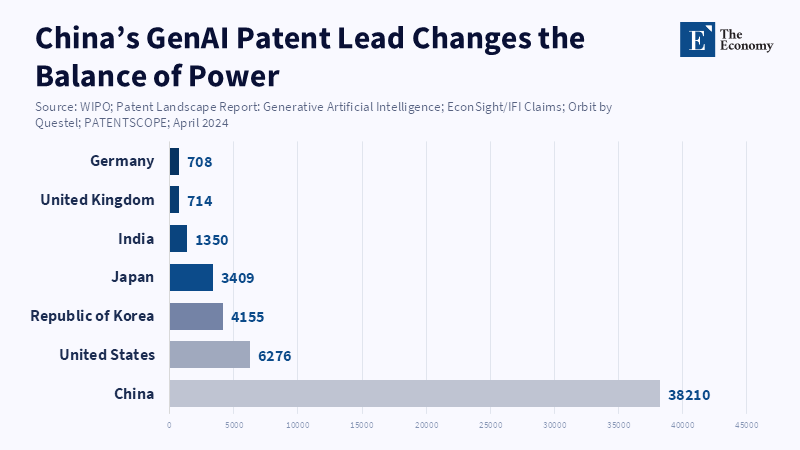
This duplication of effort becomes an informed expense. Supply chains are duplicated. Model ecosystems are separated. Cloud services, data rules and purchasing policies become distinct. These actions might not lead to global efficiency but they can be rational from the perspectives of both countries. It can be seen in their different investments; the US is still leading the race with $109.1B in private AI investment while China's investment is almost 12x smaller at $9.3B. However, China is not matching US private investment but it is closing parts of the technical and deployment gap. In generative AI inventions alone, China registered more than 38,000 patent families from 2014 to 2023, almost 6 times the number of the United States. Rivalry is unbalanced but not one-sided.
It's also why a broad bargain on AI is so unlikely. Neither side can readily agree to exchange chip access for safety commitments. The US is afraid this will give its rival an opportunity to close the technology gap; Beijing may see accepting American standards as a bid to limit its potential rise. Even a minimalist bargain on AI standards will be challenging, since standards aren't politically neutral. They affect testing costs, the shape of cloud computing, the market for audits, data access and procurement. The country setting the tests has the power to influence the market, and the nation setting the labels influences trust. As such, the argument over standards isn't merely an argument over safety; it is an argument over power, which makes the terms of any deal essential to maintain a narrow focus.
A narrow AI standards bargain could still alleviate some cost
An effective bargain on AI standards would need to be extremely specific, technical and mundane. It would not ask the US or China to slow their own progress, release their code, or reveal proprietary model parameters. Rather, it should address what each party loses when things fall apart. The first principle would be clear definitions. The US and China would need to agree on a comprehensive list of what models are capable of at a high-risk level; this list would include cyber intrusions, use of dual-use biological and chemical knowledge, weapon systems and control, large-scale fraud, and attacks on critical infrastructure. The second principle would be the standardized testing format. Each lab could continue to use their own proprietary methods; however, the standard could require their model to be documented as meeting certain defined risk thresholds before wide public use or large-scale deployment. The third principle would involve standardization of incidents; when a model is abused, agencies and firms should have a shared lexicon to use in describing exactly how and when the misuse occurred.
This framework is not naive. It mirrors the nature of how standards typically develop under competitive pressure. Instead of eliminating competition, it reduces communication costs between various parties. Existing frameworks already point in this direction. ISO/IEC 42001 offers a management-system approach to AI risk while the NIST AI Risk Management Framework provides a practical approach based on the assessment, measurement, management, and governance of risk. While the two systems do not entirely align and do not fully address frontier safety concerns, they indicate that global AI standards need not be rooted in ideology, but in process. A narrow bilateral understanding could help reconcile the existing systems. This might entail stating that a model must come with risk documentation and a plan for monitoring after its deployment, and the provider must offer immediate channels for urgent contact if significant misuse occurs.
A key counterargument would be the possibility of China or the United States circumventing standards. This is a valid concern but should not be an argument against AI standards. Standards should not require reliance or trust; they need to avoid any reliance on disclosure of sensitive data. It should be founded on publicly stated assertions and third-party validation where possible, repeated testing and domestic penalties for false safety claims. A second concern might be that standards will stifle innovation. However, the absence of such standards already slows deployment in sensitive areas. Banks, hospitals, insurance companies, and public agencies need test records, logs, liabilities and procedures for escalation, all of which would be streamlined by effective AI standards. Procurement should demand a certain floor: no high-impact system deployed without risk records, a response plan for misuse and accountability of a named owner. Agency officials should demand: what are the parameters of use, how was the model tested, who is responsible in case of a failure, and how quickly a supplier can resolve a problem.
Competition can be useful if the competition is interoperable
The real benefit of rivalry is that it is able to point out inefficiency. If American AI assets seem overvalued and Chinese AI companies underpriced, investors will flow to wherever the highest return can be achieved. This helps keep both systems disciplined; it rewards efficient models, smart deployment and firms that accomplish more with fewer resources. "The DeepSeek shock" illustrated clearly this point to investors: frontier development may not necessarily depend on expensive processes alone. Rivalry can even boost labs to improve efficiency, reduce processing costs, and make more compact models powerful. Between November 2022 and October 2024, the inference cost for a system performing at GPT-3.5 level fell by more than 280-fold, according to the 2025 AI Index.
However, this benefit can only be maintained if there is the ability to compare systems across the globe. If global AI standards are fractured along bloc lines, investment will flow not to the best system but the one that creates the least political friction. Smaller countries will be forced into a forced choice: adopt American standards and risk being ostracized from Chinese systems, or adopt Chinese standards and face political backlash from the United States. Companies will spend more on compliance costs than on actually using the technology; different safety documents will have to be created for different systems. Researchers will not be able to accurately compare claims across the divide. In such a future, competition will not produce better outputs. It will impose a tax on all those not involved in a geopolitical power struggle. This suggests that instead of a global regulatory body, a modest, step-wise global process could yield more positive results: agreeing on risk definitions, issuing notices, hotlines, simulating non-state misuse, and accepting global standards for AI management systems. Such a system would not abolish these two camps. But it would allow individuals, companies and agencies to compare safety claims before they are forced to commit to a political side.
The leading statistic should maintain honesty: the US is spending almost twelve times what China is, but China has still been closing key gaps. China has also been outpacing the US in patent filings, and though it leads the world in this metric it still requires global trust, capital, chips and customers to achieve anything significant. Each side will pay a steep price for attempting to cut itself off entirely from the other. Therefore, the challenge at hand should not be to force warm relations but to foster comprehensible rivalry. AI standards are a pragmatic way to achieve this; they do not ask rivals to end their competition but to outline the path they are racing on, define the risks involved, and maintain an emergency channel open. This is not an idealistic aspiration but the necessary minimal cost of coexistence with a technology that no nation can safely monopolize.
The views expressed in this article are those of the author(s) and do not necessarily reflect the official position of The Economy or its affiliates.
References
Bureau of Industry and Security (2024) ‘Commerce Strengthens Export Controls to Restrict China’s Capability to Produce Advanced Semiconductors for Military Applications’. Washington, DC: U.S. Department of Commerce.
Chan, K. and Hass, R. (2026) ‘Can the US and China Cooperate on AI?’, Brookings Institution, 8 May.
Fakhar, M.F. (2025) ‘Opinion – The US-China Tech Hegemony Contest: A Threat to the Neoliberal World Order’, E-International Relations, 16 October.
International Organization for Standardization and International Electrotechnical Commission (2023) ISO/IEC 42001:2023 Artificial Intelligence — Management System. Geneva: ISO.
Maslej, N., Fattorini, L., Perrault, R., Parli, V., Reuel, A., Brynjolfsson, E., Etchemendy, J., Ligett, K., Lyons, T., Manyika, J., Ngo, H., Niebles, J.C., Shoham, Y., Wald, R. and Clark, J. (2025) Artificial Intelligence Index Report 2025. Stanford, CA: Stanford Institute for Human-Centered Artificial Intelligence.
National Aeronautics and Space Administration (n.d.) ‘Apollo-Soyuz Test Project’. Washington, DC: NASA.
National Institute of Standards and Technology (2023) Artificial Intelligence Risk Management Framework (AI RMF 1.0). Gaithersburg, MD: U.S. Department of Commerce.
Office of the Historian, U.S. Department of State (n.d.) ‘The Limited Test Ban Treaty, 1963’, Milestones in the History of U.S. Foreign Relations. Washington, DC: U.S. Department of State.
Singer, S. (2026) ‘Trump and Xi Should Tackle a Previously Impossible AI Conversation’, Carnegie Endowment for International Peace, 13 May.
World Intellectual Property Organization (2024) Patent Landscape Report: Generative Artificial Intelligence. Geneva: WIPO.
Working across research, policy, and data-driven analysis, the Editorial Board ensures that published pieces reflect a consistent institutional perspective grounded in quantitative reasoning and long-term structural assessment.