Boutique Education Consulting After AI: Why Generic Advice Is Losing Its Price Power

Authored on
Modified
AI is making generic consulting easier to copy and harder to sell
That shifts value toward boutique education consulting with real sector expertise
In education, the winning firms will solve specific problems faster and better

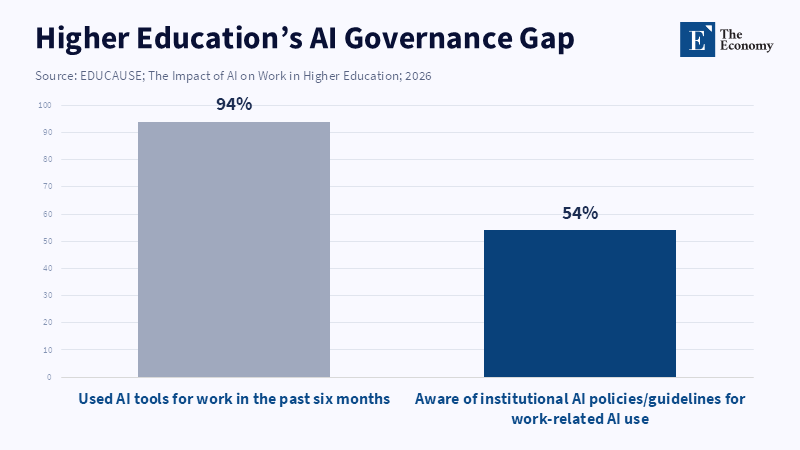
At the beginning of 2026, a survey from EDUCAUSE indicated 94% of staff and faculty in higher education had used AI tools in the course of their work during the previous six months, though only 54% indicated they were aware of policies or standards for its use. That gap says more about the future of boutique education consulting than any high gloss market forecast. The old sell was general diagnosis, benchmark decks, and A target plan for later. The new sell is tighter and tougher. It is now increasingly local. It is about workflow adjustments, vendor decisions, staff briefings, policy advice, and safe practice for real-life workspaces under real-life budget constraints. Once clients are able to receive common insight in seconds from AI, generic guidance isn't scarce and is increasingly easily imitated, and is less profitable to sell to clients. That directs value to firms that are deep in the education world and that are capable of effecting real change. In this environment, speed matters, but fit is more critical. A hastily generated wrong answer remains costly. That helps the spirit of boutique education advisory to thrive in that context, not as a consequence of small firms being usually the best solution, but because they are better able to offer relevant insight and rapid implementation.
The training of boutique education consultants is becoming a varied kind of product
The best way to think about this market isn’t “small firm vs. big firm,” since that isn’t really an apples-to-apples comparison. Boutique education consulting services are turning into a differentiated product of their own. Big generalist powerhouses still provide comfort with brand, sources, and staff, and efficient procurement. Sometimes you need that—a national system overhaul, a major digital shift across borders, a big new finance arrangement. But AI has taken one big advantage the big firms had and made it irrelevant: first, draft research, interview overviews, market checks, and slide copy costs have plummeted. In 2025, McKinsey found that 78% of companies reported using AI in at least one business function, and 71% were using generative AI regularly in at least one. That means many of the services that used to be exclusive to the next-tier advisor are now just part of the landscape. Strategy education clients can receive a barebones analysis a lot more quickly and inexpensively. They are less likely to pay high fees for generic work presented as a strategy.
That doesn't matter because no one in education is receiving advice at a relaxed moment. The OECD’s 2025 report on finance for higher education refers to 'deteriorating support, stagnating domestic demand in some systems, unpredictable international flows and increased pressure on both private and public budgets.' In the U.S. in 2005, NACUBO reports, aid paid for 58.3 percent of tuition and fees for the full population of undergraduates in participating private nonprofit colleges, and 83.4 percent of undergraduate students attending those institutions received aid. Those are not numbers that profit from a relaxed environment for broad-based consulting theater. They are numbers that profit from working to a more sophisticated degree on the question of the best return on spend. In such an environment, boutique education consultants flourish if they can do one of three things in short order: be frictionless, lift revenue, or diminish execution risk. If they cannot do one of those, can clients truly be blamed for simply asking: Why not keep it in-house?
AI is shifting the levers of power toward those firms able to deploy, train on and administer it
This is perhaps the strongest assertion—it won’t—large firms will push on small firms, leaving them behind or pushing them into awkward niches. As the 2025 Eurostat data indicated, very few small companies use AI (17%) compared with large ($55%). Small firms can lag on tools, processes, security, and capital—yet that’ll be the real story. AI saves no weak boutique, and it fragments the market. The firms that will emerge with an advantage in this brave new world are the firms that mix deep education in their fields with strong AI practices, using it to cut routine labor, reduce project rounds, and keep their most senior experts close to the action. This reduces the minimum scale needed to deliver high-value advice; a small, tightly run firm no longer needs to have a huge pool of lower-cost juniors to create a baseline level of quality—it needs just a few credible selves, well-designed processes, and a clear value proposition.
PwC’s 2025 AI Jobs Barometer can help make the case. Among other things, it found that the most,and least, AI-exposed business units experienced 3x greater revenue per employee growth, and there was a 56% premium on AI skills, and a much sharper change in the skills employers seek. Think through that by education: the signal is clear. Value is shifting away from the painstaking project labor and toward those capable of redefining work, shaping contingency, and linking commoditized tools with concrete outcomes. That portfolio is closer to boutique education consulting in many niches. It aligns with student services redesign, registrar process projects, short courses, and microcredential strategy, AI policy support, faculty research and support, vendor assessment, and institutional analytics automation. In each instance, the client is not after text pages. They are after speed, judgment, and fit. In each instance, a company that lightens manual stepwork, codifies effective practice, and sides with appropriate in situ personnel may have pricing power beyond that of a company simply showing up with a heavy platoon and established points of view.
The Cost base is changing, and that helps the specialists with narrow scopes
The way consulting costs change as more first,pass knowledge work moves to AI: Less hours spent doing the baseline analysis. More value in framing the problem, prepping clean data, selecting tools, designing new workflows, and compelling change management. That's the conveyor belt that suits boutique education consulting best because education never needs "all of strategy." Most institutions face one stubborn knot at a time. They need a weak transfer route fixed. They need an advising model rebuilt. They need better rules for staff usage of AI. They need a program mix review timed to staff demand. They need a vendor selection process for vendor A versus vendor B versus vendor C—all of which sound exactly the same. Those aren't scale problems first. They are judgment problems first. The market test of who dominates is no longer who can produce the most output. It's who can remove the most costly friction from the system in front of them. That's a better opening for specialists.
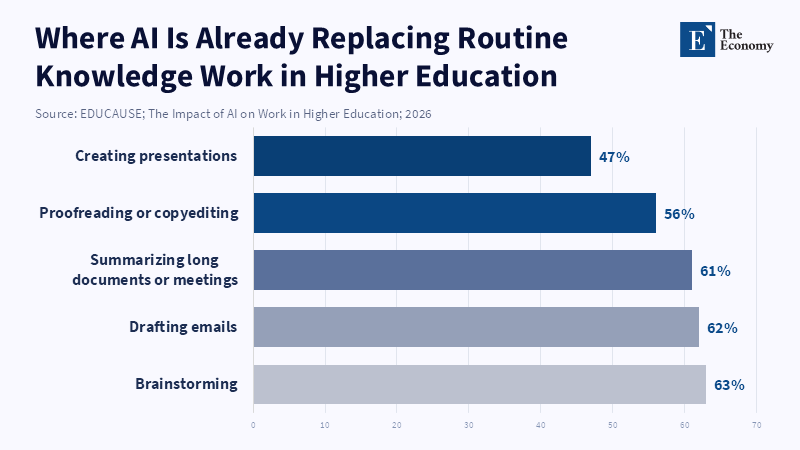
This is even more obvious when you look at the higher education data. EDUCAUSE research from 2026 showed that 56% of respondents had accessed AI tools for work that their institution did not supply, and half or fewer respondents felt their current policies inspired their confidence, with a series of prominent barriers: lack of AI expertise, lack of AG best practices, lack of time, and lack of budget. The same trend is evident in the results of Tyton Partners 2025 Time for Class study, which identified 40% of administrators, 30% of instructors, and 42% of students who accessed generative AI on a daily or weekly basis. Yet only 28% of institutions have a formal policy, and 32% are still working on one. And yet this is where boutique education consulting can be most valuable. The issue is urgent, local, and practical. The world is not in need of yet another high-level statement that AI is important. What institutions need is assistance in determining what to permit, what to block, what to purchase, what to measure, and how to train people without creating additional risk.
Likewise, the labor question counts. As drafting, searching, summarizing, and routine advising support become sit-down,for hours of work absorbed by AI, colleges have a can. They can lay off in a looted profession (and many may). Or they can redirect staff time to tasks that require trust, care, and judgment. Boutique education consulting is more justifiable when it is part of the second solution. Good work should make a registrar’s office more nimble, an advising team less swamped, a dean more sure about program economics, and faculty more ready to deploy AI without sacrificing rigor. That changes the marketing. The boutique firm isn’t marketing expertise in an outside adviser; it’s marketing in-house capacity. That’s a better value proposition in education and a stronger case to boards and CFOs hunting for what’s not paid for.
What leaders should do now
For practitioners, the takeaway is not to eliminate massive firms, but rather to buy consulting by problem type. Where work actually does require scale, financing expertise, or a big compliance presence, use a large firm. But for many of the most difficult problems emerging in education today, boutique ed consulting is the smarter purchase. Those include AI governance, workflow design, faculty upleveling, student services, vendor sourcing, and focused portfolio strategy. Leaders in each area should demand tight scopes, short timeframes, dedicated senior professionals, definitive deliverables, and actual skill transfer to the institution. Paying big fees for generic diagnosis should be a thing of the past. If a proposal does not outline what gets cheaper, faster, safer, or more effective within a year, suspect its value offering.
People should be optimistic about this, but only cautiously so. There is a pointed critique here, and not an invalid one. Some boutique outfits will package generic AI-generated content in a sector-specific idiom and claim it as a source of knowledge. Others will move quickly, discarding privacy, access, or proof for speed. Yet big companies are compromised by the same pitfalls. Large companies do not tend to be deep companies. Often, just the opposite, their very size camouflages detachment from the classroom, the support desk, the community. The solution then is not necessarily to opt for the larger organization, just to adopt the larger organization blindly. Instead, institutions need to demand quality. Demanding accountability, the promise of "who is going to do the work?" Demanding data. Demanding definitions of teachers and students in the voice of AI and the mode of consumption in the voice of analytics. Demanding measures of outcomes in the voice of the board of trustees rather than in the voice of the mechanized monitoring station.
Policymakers should also heed the obvious signpost here. This is not a vendor story. It is a state capacity story. If the public systems want the productivity gains of these tools, without a reliance on a handful of dominant providers, they need room for a broader advisory marketplace. This means procurement regulations that don't equate scale with quality. It means setting evaluation standards for AI-based applications. It means providing enough dedicated talent and sustaining it long enough for organizations to be discerning purchasers. The endgame is not to establish a stable, inescapable need for expensive consultants. The endgame is to disrupt the familiar pattern. An over-stretched institution 'rounds out' each project with tentative advice, can never enact it, and crumbles in its wake. Specialty education consulting must be most valuable when it interrupts this pattern. And this data point might be reason enough. An industry in which half of consumers already deploy AI, and others remain unsure of where to draw the line, has neither a mounting information problem nor an intensifying technology problem. It has an implementation bottleneck. That's why the coming competitive advantage for education consulting firms will come less from their capacity to assemble a large talent pool, and more from their ability to integrate local experience into education practice in time to meet the fiscal year deadline.
References
Duncan, D.S., Anderson, T. and Saviano, J. (2025) ‘AI Is Changing the Structure of Consulting Firms’, Harvard Business Review, 10 September.
Dunn, S., Krasnov, J., Moran, C. and Moreau, J. (2024) ‘Leveraging Partnerships: The Value of Consulting Firms’, EDUCAUSE Review, 3 October.
OECD (2025) The Financial Sustainability of Higher Education: Insights from Policy in OECD Countries. Paris: OECD Publishing.
OECD/BCG/INSEAD (2025) The Adoption of Artificial Intelligence in Firms: New Evidence for Policymaking. Paris: OECD Publishing.
PricewaterhouseCoopers (PwC) (2025) The Fearless Future: PwC’s 2025 Global AI Jobs Barometer. London: PwC.
Robert, J. (2026) The Impact of AI on Work in Higher Education. Louisville, CO: EDUCAUSE.
Shaw, C., Dorn, H., Martin, S., Hay, L., Janson, N. and Bryant, G. (2025) Time for Class 2025: Empowering Educators, Engaging Students. Boston, MA: Tyton Partners.
Singla, A., Sukharevsky, A., Yee, L., Chui, M. and Hall, B. (2025) The State of AI: How Organizations Are Rewiring to Capture Value. New York, NY: McKinsey & Company.
Thomson Reuters Institute (2026) 2026 AI in Professional Services Report. Toronto: Thomson Reuters.
Similar Post