Situational Advisory Is Reshaping Education Consulting

Authored on
Modified
AI is making broad, generalist consulting less valuable in education
Small specialist teams now solve specific institutional problems faster and cheaper
The winners will be institutions that buy targeted expertise and build internal capacity

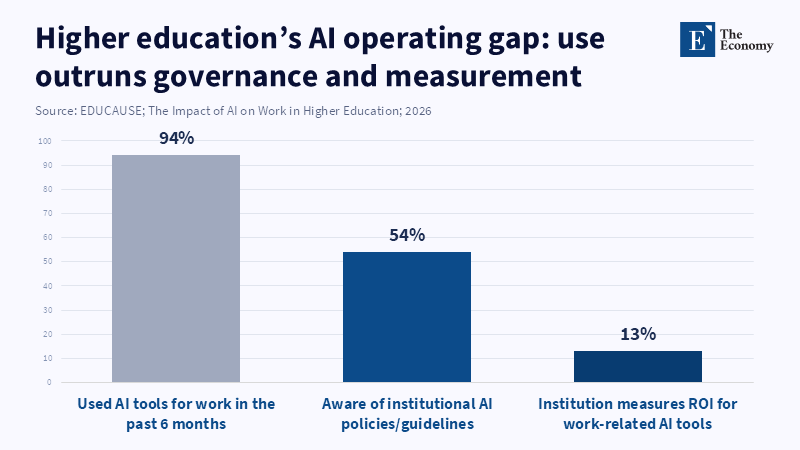
In education, the older consulting approach is waning. In a 2026 EDUCAUSE survey, 94% of all higher ed faculty and staff had used an AI tool for work in the past six months. That matters because it suggests core knowledge work is no longer unusual. Have schools and universities drafted, compared, summarized, modeled, and benchmarked with relatively cheap tools they already possess, and they are less inclined to hire work teams of generalists to do the same for them more slowly. External consulting still influences. But the market gets ready for situational consulting: coiled, defined, and specced out work led by specialist teams that resolve one knotty issue quickly, create in-house skill, and depart. In education, squeezed for money, ached for staff, and jaded by ever-present OFPP, situational consulting isn't a sideline strategy: it's the one that suits educational economics best.
3 reasons for the success of situational counseling
The clearest way to shift the debate is to shift from prestige to cost. Education and training are a sprawling market. It is a $7.6 trillion industry according to business researcher HolonIQ. But most of that finance is state or federal and under close oversight and budget pressure. Consumers want cheap, fast, proven experience. They don't just want good ideas. They want you to make progress on issues like student retention, AI policy and ethics, data governance, vendor review and due diligence, accessibility, curriculum design and labor,market signals, which are not big terms that end in "tion". They are real, specific problems, each of which is best approached with considerable domain expertise and quick, actionable diagnostics instead of broad theoretical ones. When money gets scarce, generic concepts become the first to get cut.
Agentic AI accelerates this transition by making the middle of the consulting chain cheaper. Business cases, research scans, interview coding, process mapping, draft memos, slide writing, and option lists can be produced either by in-house teams or small external teams with the right toolkit, fast and cheap. IBM found that in 2024, 89 percent of consulting buyers thought consulting services would be using AI to increase quality and productivity. Gartner has since asserted that agentic AI will move across all enterprise software but warned many projects will fail when buyers chase hype without a clear return. The point is simple. Buyers of consulting still value expert judgment but are unwilling to pay traditional prices for work that AI can now reduce.
This is why more localized advice travels well in education. It puts hard, ill, automatable human consensus in areas where machines still lag behind. Institutions still need people to clarify the real problem, judge campus politics, assess risk, negotiate with unions, read regulations, and operate the system. An experienced specialist can leverage computers (AI) to speed up faster, but still be valuable where there is no shortcut. generalist firms still have a part to play: in mergers, overhaul of system design, multi-campus revamps, and large public programs where hundreds of key stakeholders have a say. But much of the work that used to make up a pyramid of analysts looks over, supplied. The market is not beating consulting; it is breaking it apart.
The change in bargaining power in the education market
This is a power of bargaining story. Situational advisory emerges when organizations have the ability to do more for themselves and need outside help only at the margins. In higher education, that margin has been shrinking rapidly. EDUCAUSE reported in 2025 that 77 percent of respondents had some kind of AI strategy for their institutions. But only 30 percent reported that AI and analytics engagement was a top priority in data modernization. In a 2026 EDUCAUSE report, respondents reported 92 percent of their institutions were executing a work-related AI strategy, but only 13 percent reported their institutions were monitoring the ROI of those AI tools. There is a significant gap between adoption and valuation at this moment. Institutions are implementing AI, but many are not yet organized enough to value and price it.
That gap shifts who has the power on campus. CIOs, registrars, institutional research groups, digital learning directors, accessibility specialists, purchasing officers, and general counsels come into focus. Value is no longer in one slide deck of strategy. It is in being able to link policy to data to workflow to daily practice. According to EDUCAUSE QuickPoll data, operational efficiency is now the primary incentive for data modernization. The same data reveal that disconnected systems, budget constraints, staff skills deficiencies, and resistance to change are still common obstacles. So, the kind of champion who has the greatest effect is not the one with the longest list of words but the one who can resolve one exceptional bottleneck and demonstrate deliverables.
That also shifts the economics. Large, generalist firms could once sell breadth as insurance, pointing out they had seen every problem before. Once AI drives down the cost of extensive research and comparisons, breadth alone is no longer valuable. What is valuable is the reliable depth. An individual who can deploy one AI sourcing rule, fix one data governance flaw, or build one compliant student support process has a stronger case for a budget than a large team running a long diagnostic. In a world where the customer is willing to pay for value, capture is moving toward consultants whose fees are prorated by some measure of operating benefit. That is why—authorizing the term—situational consulting is winning. It is the measure of brilliance that institutions have adopted.
Another detail is important. As a report from EDUCAUSE about the impact of AI reveals, educational and learning teams have been involved in the decision to buy these tools in only 58 percent of the cases, compared with cyber security, technology, and privacy teams, which take part in many more procedures. This is why many institutions buy technology in a mistaken manner: the closest to the solution's design determine the purchase, but often this group does not participate enough. Here, advice on situational issues can be useful because an expert does not only evaluate technologies. An expert must be sure that the key players learn about the department that they are going to buy before signing the agreement.
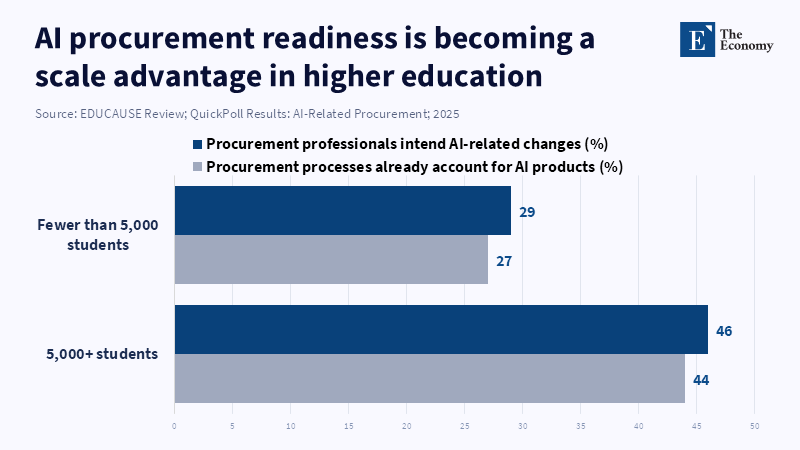
There is a snag—this approach to adoption risks expanding inequality across the sector. Big institutions are more likely to make good use of it. The EDUCAUSE report said the survey didn't give percentages as far as how big institutions approach AI and products in their purchasing processes. According to a 2024 OECD survey, institutions in some country groups that are big are now showing higher rates of current AI use in teaching and learning: for example, in Singapore, 75 percent of lower secondary teachers used AI in the last year, compared with an OECD average of 37 percent. But simply giving situational advice does not necessarily translate into broader adoption of AI or increase capacity; a digital divide can deepen if smaller colleges and public systems don't have enough staff time to scope out problems, hire specialists, and then soak up what those specialists produce. The buyers who most need effective advice can be least likely to buy it effectively.
What does this mean for work, pricing, and institutional strategy
The labor impacts are now easier to find. Generalist consulting was dependent on a pyramid of staff. Most junior bodies performed research and synthesis, and a smaller group of senior staff sold, judged, and managed the client. Agentic AI weakens that pyramid by automation of much of the junior output. The same squeeze can be seen inside the education administration as well. So-called routine drafting, meeting prep, policy review, first-level analysis, data compilation, etc., are all being squeezed into software-supported flows. The World Economic Forum's Future of Jobs Report 2025 found that employers expect a 39% change in required skills by 2030. Meanwhile, a Jobs for the Future reporting note observes that almost seven in ten 16+ learners report that AI is now part of their curriculum or training, so the changes in education are primarily a matter of role change rather than of saving or losing jobs.
That is important because the advisory situation is not just a buying pattern. It is also a signal of how institutions should organize teams. The adviser with deep knowledge that creates value is not a consultant at a lower cost. It is a handful of people with deep expertise, tools, and clearly defined tasks. Education leaders should imitate that format. Instead of flushing money into far, reaching change projects with more PowerPoint than competency, they should assemble diverse teams, with one domain leader, one data leader, one operational owner, one compliance stakeholder, and one intelligen documenting (or other meaningful) analyst, that way they will be faster and less expensive and easier to evaluate, and they will waste less, because they will have an opportunity to define the goals before the project balloons.
However, the case for situational advisory can also be overstated. Not all education issues are small and modular. Some are systemic. Universities experiencing poor governance and financial management, which lack good data and are losing students, might still require a wider external hand. In February 2026, Universities UK put a figure of around £3.7 billion a year of lost government funding for English HE providers between 2024–25 and 2029–30. In such a circumstance, leaders could conceivably start to view every challenge as a rapid, solution-oriented challenge because they are unable to afford anything else, and that would be wrong. The correct jurisdiction is not 'buy small always'. It is 'buy precise'. Use situational advisory in bounded, expert,heavy circumstances, and only when coordination load exceeds internal capacity.
A smarter policy and procurement response
For policymakers, however, this proliferation of situational advice should affect how public capacity is purchased and funded. Educational organizations still buy too much advice by report, and too little by working capability. Procurement rules too often give priority to scale, brand, and the ability to put together a good bid rather than genuine specialist skill. This encourages public buyers to opt for large suppliers, even where requirements are narrowly focused, as those listed above: AI governance, credit transfer policy, accessibility audit, faculty workload audit, student support design, or cyber security response. And it causes unnecessary waste, as institutions pay for additional layers of project management, design, and presentation costs that have little effect on outcomes. If governments want better value for money, they should ease access for specialist firms, expert consortia and multi-institutional advisory groups.
Those leading within institutions must also cease treating governance as something to get around to. EDUCAUSE reported in 2026 that , while 94% had used AI tools in the last 6 months for their work, only 54% were aware of rules or guidelines surrounding it. This kind of disjointedness is what situational advisory can address brilliantly. It doesn’t require a major strategy review. It just requires a strategic, targeted project on governance, data ownership, accessibility, procurement protocols, or human review thresholds. But these targeted projects only develop the capability if they are linked to the purpose at the organizational level. The aim is not to develop more advisors, but to reduce the reliance on them in the future by developing internal capacity from outside know-how.
The weakest refutation of the case can be made very simply: Education ought never to go to consulting logic; it ought always to build permanent internal skills. That is correct in the abstract. Not in the concrete, where the market is barrelling along too fast for schools and universities to thicken their own internal capacity to keep pace. OECD figures indicate 2020–4 is seeing an extraordinary escalation in AI adoption, at a rate of 40–50 . Already, institutions are embedding their know-how in instruction design, in administration, and in student relations. Yet governance remains hobbled in its use case. Institutions will have to improvise, rapidly and flexibly, to get those skills integrated and active at the speed of markets. They will need some assistance. How will they procure it? Situational consulting stands apart, since it offers external expertise as a temporary bridge — not a permanent replacement for institutional expertise. That is the approach education needs to reinforce now: specialist, strategic, active for a limited duration, and with a clear advanced footing. General practitioners have already established the market; procurement, leadership, and policy must accelerate to match.
References
Borgonovi, F., Bastagli Sageev, F. and Varsik, S. (2025) ‘AI adoption in the education system: International insights and policy considerations for Italy’, OECD Artificial Intelligence Papers, No. 52. Paris and Turin: OECD Publishing and Fondazione Agnelli.
HolonIQ Education Intelligence Unit (2025) The Size & Shape of the Global Education Market. HolonIQ.
IBM Institute for Business Value (2024) Consulting reimagined, powered by AI. IBM.
IFS (n.d.) What Is Agentic AI? A Guide to Autonomous AI Systems. IFS.
Jobs for the Future (2026) AI Usage in Education is Growing, But Gaps in Guidance Persist, New Survey Finds. Boston, MA: Jobs for the Future.
Kanpeki (2025) Generalist vs Specialist Consulting in the GCC: Is the Traditional Model Still Tenable? Kanpeki.
MConsultingPrep (n.d.) Consulting vs Advisory: A Comparison on Five Aspects. MConsultingPrep.
Robert, J. (2025) ‘EDUCAUSE QuickPoll Results: AI-Related Procurement’, EDUCAUSE Review, 19 May.
Robert, J. (2026) The Impact of AI on Work in Higher Education. Louisville, CO: EDUCAUSE.
Universities UK (2026) The financial impact of government policy decisions on universities. London: Universities UK.
World Economic Forum (2025) The Future of Jobs Report 2025. Geneva: World Economic Forum.
Similar Post