The New Education Consulting Market: Why Operational Consulting Is Replacing Strategy Decks

Authored on
Modified
Execution now matters more than strategy slides
AI has weakened strategy-only consulting
Boutique firms win by solving real problems

A Gallup report found that 57% of U.S. college students report using AI to complete coursework at least once a week, and roughly one in five students do so daily. That, quite simply, is the best evidence we have for what the education consulting market looks like today. There is no shortage of fresh ideas; there simply isn’t enough execution. AI is already having an impact on college campuses; there is pressure on budgets, the political landscape is unpredictable, enrollment numbers are fluctuating, and public perception remains bleak. And what schools are not yet searching for is yet another presentation about transformation. What they need, what we can help them build, is a set of systems that can be scaled: admissions processes that speed along faster, advising approaches that help flag risk before it snowballs, tutoring systems that can make it through the funding Cliff, governance structures that can keep pace with the rapidly accessible tools being used by students and staff.
That's part of the reason that this old premium in strategy consulting is falling away. Strategy advice still has a place, but it's beginning to wear a little thin. The rarer the advice, the higher the premium (and the more justifiable the extra fee). When colleges and universities can generate scenario plans, run market reviews and competitive comparisons, review operating procedures, and come up with implementation recommendations in moments, advice that stops at diagnosis is less and less sticky and less and less defensible. The premium now is for operational consulting,engineering business processes, installing controls, preparing faculty and administrators for the change, tying it all together with tools, and sustaining the benefits as a matter of operational fact. That's what counts now because the sector is being pushed from both endsin the US, the current high point for hs graduates (2025) will be followed by a 13% drop through 2041, and public confidence in higher education rose in 2025, but remains well below its peak in 2015and under these conditions, execution, not eloquence, is what will earn the premium.
The Education Consulting Market Has Shifted from Advice to Throughput
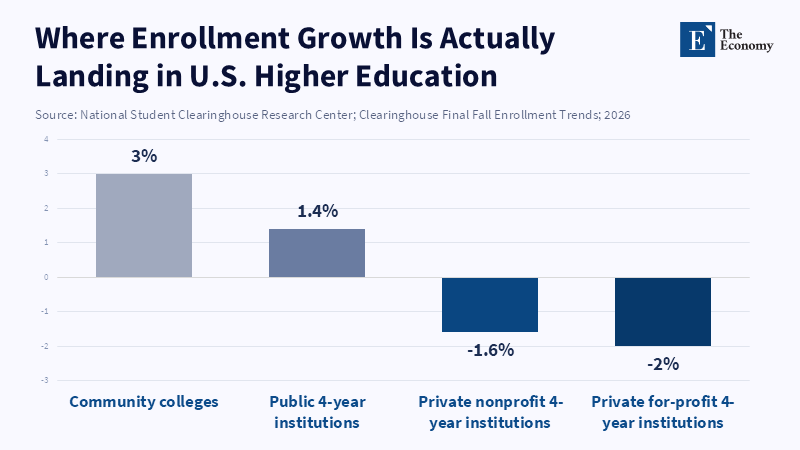
The buyer's pain is no longer hypothetical. An article from Gallup News cites that interest in postsecondary education in the U.S. among unenrolled adults remains high; former students who have previously enrolled but did not complete a degree are six times more likely to be considering returning than those who have not enrolled at all. The publication cites differences in interest by demographic groups, but does not highlight in its example what the enrollment numbers and trends will look like for 2025. Since fall 2021, undergraduate certificates at community colleges are 28.3% higher. Demand is coming back but in a different format: lower cost, shorter, more job-ready offerings. Meanwhile, pricing power is weak. Per NACUBO, private nonprofit colleges for 2024 25 ranked a median estimated 56.3% tuition discount rate for first-time, full-time undergraduates, while net tuition revenue in real dollars rose a mere 1.4%. This is not a time for an intelligent Board to throw money at expensive consulting to produce a presentation. Enrollment strategies, aid, program delivery, program redesign, and process improvements will need to translate into cash flow and success with students.
That's also happening in K–12, from the other direction. The federal government distributed about $190 billion in ESSER relief through three rounds, but the 2025 funding showed how precarious many externally supported efforts can be once the emergency money is gone, as reported by Gallup News. While high school superintendents are very supportive of summer learning efforts, many feel there are not enough kids in their communities who have access to great programs, which shifts school district priorities for planning and funding, for example, on tutoring, curriculum, and support systems. That takes the focus away from large strategic stories. It increases interest in delivery models that have been successful in budget cycles. Practically, the educational investment consulting market is drifting away from "tell us what excellence looks like" and toward "help us make it work with our staffing, our systems, our timetable, and our politics." That's an investment pattern with more sustainable demand. It favors businesses that can discern implementation, set benchmarks, and perpetuate disciplined organizations rather than perpetual parity.
Why Strategy Decks Are Losing Scarcity Value
Generative AI has not wiped out strategy, but it has rendered many of the abilities institutions used to buy from their strategists more accessible. EDUCAUSE notes that sustainable use of AI in higher education requires extensive investments and capabilities, from funding and staffing to leadership and others and robust infrastructure to support common activities such as brainstorming ideas, drafting emails, reviewing documents or meetings, editing, and making slide decks (all of which figure prominently in most consulting engagements). In a recent report, the Boston Consulting Group wrote that as companies embed more AI into their use cases, they are unveiling as much time for employees to work on their projects, meaning that activities like running a market scan or preparing a trend memo are becoming standard design services, not customized ones. And in tight budgets, with teams already up to speed on AI, strategy is just more frequently challenged in-house.
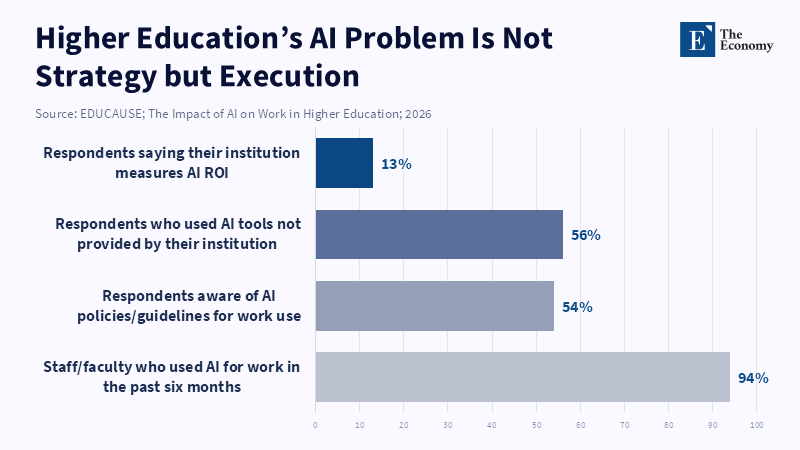
Nor does this mean an end to strategic judgment. It signals the necessity of pairing strategy with operational realities. For instance, in the EDUCAUSE 2026 work survey, the most telling number isn't that 92% of respondents say their institution has some form of an AI strategy. It is that only 13% say their institution is tracking ROI, only 54% have a policy and guide, and only 56% have operationalized tools that were not purchased. This is what failed execution looks like: adoption surpassing policies, money without accountability, and leading behaviors far behind policy. This might look like the beginning of a solution or just a different sort of consulting to some critics. In some ways, they are right. Higher ed does need less of the former. But it doesn't need less of the latter. When systems are frayed, staff lean, and changes bridge academics, techno,policing, laws, and administration, outside expertise can become an asset. It's whether that outside expertise makes an institution better, or just more acknowledged.
Another reason strategy, only work is waning, is that the third-party workforce in the sector is likely to be retaken by B2B storytelling. Gallup has indicated that " confidence in education has dropped from 57% in 2015 to 36% in 2024" and has "barely rebounded to 42% in 2025". The institutional cheerleading, to trust, is alive and growing, with only "54% of respondents noted that college has prepared graduates with the skills needed by their companies, and 69% indicated that recent graduates require considerable or significant additional training." This is not a call for crude vocational policy making. It is a comma of represented jobs delivered, brand used to explain the model fall away. The project in educational consulting will be judged by whether it can close that gap. It requires little more wise advice on reform. It requires precious few operational practitioners, often in small boutiques, who can convert a plan into throughput, a method into a model, and a burden into sustainable capacity.
The way forward is spelled out by the kickoff to this post. When only 13% of institutions have a handle on AI ROI, the problem isn't the book of ideas. It is adoption by management. The old world was to invite the consultants in to help craft the strategy. The new world will be to not blow working execution. For colleges, university systems and schools already struggling with numbers, bottom lines and budget fights, this change is crucial. The consulting market will be dominated by those firms that understand how to execute without running up fat bills, seize AI without losing accuracy of judgment and turn the institutional home runs into drapery. Surely consultants are needed. But if the advice cannot be translated into better operational decisions, the advice might as well be furniture.
References
Awad, N., Serry, M. and Vasquez, J. (2025) ‘How agentic AI is transforming enterprise platforms’. Boston Consulting Group, 13 October.
Gallup and Lumina Foundation (2026) Aligning education and work: what employers say higher education must deliver. Gallup and Lumina Foundation.
Grace, R., Kothari, T., Kim, H., Wu, B., Shenoy, R., Snegach, A. and Allan, B. (2026) ‘How AI can help higher education capture a once-in-a-generation opportunity’. Boston Consulting Group, 18 March.
Gupta, M. (2026) ‘Strategy consulting vs operations consulting: scope, roles, careers’. CaseBasix, 12 January.
Jones, J.M. (2025) ‘U.S. public trust in higher ed rises from recent low’. Gallup, 16 July.
Karamarkovich, S., Causey, J., Kim, H., Holsapple, M. and Shapiro, D. (2026) Clearinghouse Enrollment Insights: Final Fall Enrollment Trends Report. Herndon, VA: National Student Clearinghouse Research Center.
Lane, P., Falkenstern, C. and Bransberger, P. (2024) Knocking at the College Door: Projections of High School Graduates. Boulder, CO: Western Interstate Commission for Higher Education.
LexisNexis (2025) ‘What agentic AI means for consulting firms’. LexisNexis, 22 August.
NACUBO (2025) ‘NACUBO study finds private colleges and universities are offering record financial aid to students’. NACUBO, 24 June.
Robert, J. (2026) The impact of AI on work in higher education. EDUCAUSE, 12 January.
Similar Post