Taiwan Strait Security Is Japan’s New Energy Lifeline

Working across research, policy, and data-driven analysis, the Editorial Board ensures that published pieces reflect a consistent institutional perspective grounded in quantitative reasoning and long-term structural assessment.
Authored On
Modified
Taiwan Strait security is now a core economic lifeline for Japan and South Korea
A crisis there would raise shipping, energy, and supply-chain costs far beyond a local conflict
Washington must send clearer signals before silence encourages Chinese risk-takin
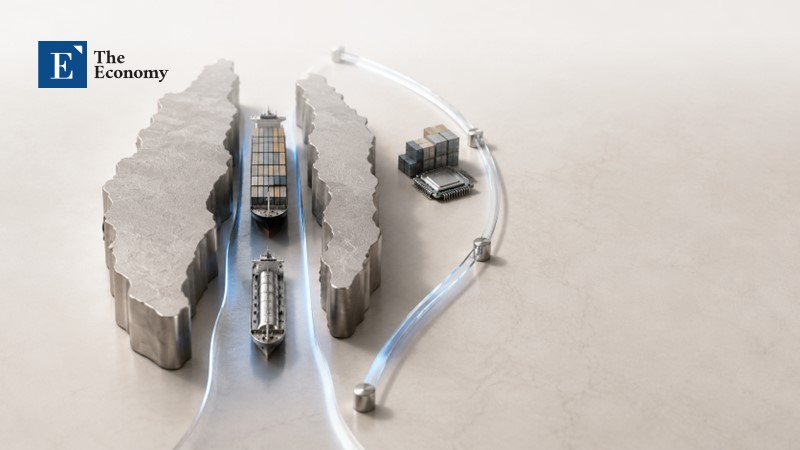
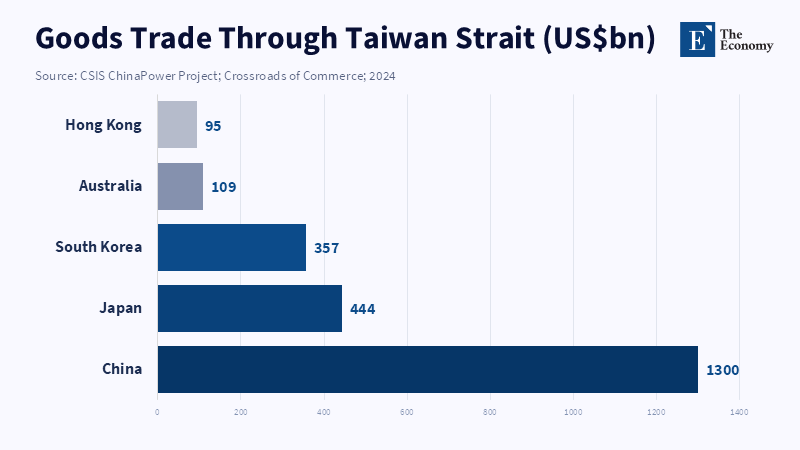
For one narrow sea lane, Japan and South Korea have a hidden balance sheet of about $801 billion. This figure represents their goods trade value through the Taiwan Strait in 2022, about $444 billion for Japan and roughly $357 billion for South Korea. This is why Taiwan Strait security is no longer a side issue in Asian diplomacy. It is at once a supply route, an energy route and a test of whether allied deterrence continues to have a usable map. Hormuz is significant because crude prices jump when tankers are imperiled. But for Tokyo and Seoul, the Taiwan Strait is significant in an even more fundamental sense. If China gained control over the strait, or compelled underwriters and shippers to regard it as a combat zone, the impact would extend well beyond the crude price: it would ripple throughout manufacturing, shipping, power production, semiconductors and the credibility of the United States.
Taiwan Strait Security Is Japan’s Economic Perimeter
A usual debate presents Taiwan as either a moral subject or a military one. Between those two oversimplified views, the baseline policy is a matter of economic geography. Japan and South Korea are not concerned about a Taiwanese invasion because it is democratic, near, or connected to US power. They are concerned because the strait is part of the transit which connects the Middle East, Europe, Southeast Asia and Northeast Asia. Any crisis can trigger a global crisis, a price shock of naval nature. Japan’s basic policy already reads that stability across the Taiwan straits remains one of the vital interests of the international community and Japan’s security and prosperity. It can read suggestively. In fact, it already declares that the Taiwan Strait could be part of Japan's economic perimeter.
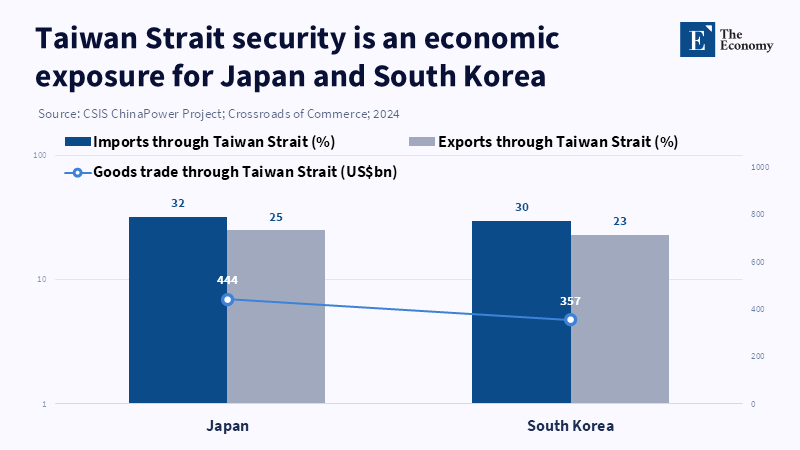
Japan depends on imports for virtually all of its fossil fuel requirements. South Korea also faces high exposure. Both countries have the single most important oil trade artery that takes the ships from the Indian Ocean via the waters off Southeast Asia and up to the main industrial belt in Japan (via Taiwan, Okinawa, Kyushu, Busan). A map explains the fear better than any speech. This is the analog of Hormuz. Hormuz is undeniably a classic energy chokepoint. In 2025, nearly 15 million bbl per day flowed through the Strait of Hormuz, accounting for one-third of the world's crude trade. Asian buyers comprised the bulk of end customers. Japan and Korea were among the most exposed advanced economies
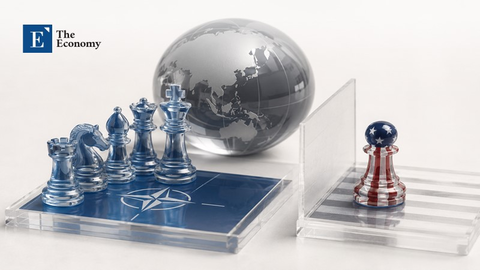
No responsible planner would underestimate the significance of Hormuz. For Japan and South Korea, the Taiwan Strait is not merely another chokepoint beside Hormuz; it is the chokepoint that connects energy security, industrial supply chains, and alliance credibility in one place. But Hormuz is more of a supply shock. The Taiwan Strait is a supply shock, a logistics shock and a security shock at once. The Strait is close to both the final approach to two of America's key allies and close to the first island chain that China's military planners regard as most crucial. This makes silence perilous. After the recent US-China summit, the official US statement communiqué did not mention Taiwan, while Trump declined a direct public response as to whether Taiwan was raised. Xi, as noted, raised Taiwan to the central challenge to the relationship. Deterrence isn't created only by ships, missiles and bases. It derives from signals other regimes can interpret. When one talks in red lines and the other in fog, it is not near neutrality. It can appear as space.
Taiwan Strait Security and the South China Sea Price Shock
The Taiwan Strait is not an absolutely isolated channel. In the framework of a larger maritime system of the South China Sea, the Taiwan Strait is the transition between the external and the internal structure. Petroleum and Petroleum products transported via the South China Sea amounted to an average of 10 billion barrels per year in 2023. LNG amounted to an average of 6.7 trillion cubic feet in the South China Sea and the Gulf of Thailand. Crude oil and condensate averaged 18 million barrels per day, which amounted to about 43 percent of the World's shipborne oil shipments in the South China Sea and the Gulf of Thailand. While China is the top destination, South Korea and Japan are not far behind. This is why the security of the Taiwan Strait is inseparable from the security of the South China Sea. They form one risk chain for the Northeast Asia.
A narrow reading says ships can always go around. That is true in the same way a country can always pay more. Rerouting is not magic. It requires more miles, fuel, crew time, port delays, insurance and risk. CSIS estimated that a Singapore-to-Busan (in Korea) container route could add 1000 miles if shippers sought to avoid routes closer to Taiwan. Over a broader South China Sea crisis, ships sailing from Europe, Africa and the Middle East could be driven toward the Lombok Channel, west of the Philippines, or, in the worst case, circumnavigate Australia into the north. That would be a new tax on every factory that relies upon just-in-time inputs, from the auto factory to refinery feeds.
Neither would the cost of this tax be evenly distributed. Japan would see increased fuel costs, increased lead times and increased squeezes on companies that are already operating in an environment of thin margins. South Korea would be squeezed in the same way through refining, chemicals, batteries, cars, steel and chips. Australia would feel the squeeze through the export routes and the alliances. For Southeast Asia, this would not be a bypass but a zone of first contact with congestion, coercion and pressure from all directions. Europe would also feel the pain because its Asian supply chains do not end at the Suez but in plants, ports and customers across north-east Asia.
Some will say this exaggerates the risk. They will contend China relies on the same maritime corridors and would do harm to itself should it close them. It's true, but this ignores the gray-zone dilemma. The Chinese need not close a route in order for it to bear higher costs. Coast guard emphases, exercising, inspection zones, cyber disruption, live fire alerts and overt port pressure all can induce risk premiums. A disruption only needs to be partial to prove disruptive. The Gulf of Aden demonstrated how swiftly shippers changed course when the backing of insurance providers and corporate executives was withdrawn to declare the corridor no longer normal. Truly, the security of the Taiwan Strait should be evaluated by these standards, not an untenable dichotomy of either peace or full invasion.
The security of the Taiwan Strait now has a northern front
The maritime problem is also going north. China's persistent attempts at making a way through the lower Tumen River, with Russia and North Korea as strategic partners, may open up the Sea of Japan (or East Sea, as Koreans call it) for China. While this is not quite a Chinese naval base on the Sea of Japan yet, the legal, technical and military steps remain very complex- strategy often evolves in the first instance through logistics. Roads, bridges, access to rivers, access to ports, the pattern of patrols and visibility created by joint exercises all make up habits of presence long before they can produce facts of control. Hence, a river project may influence the navy, the coast guard and the intelligence service's perception of the map well beyond the realm of river commerce.
This is relevant to Japan because it establishes a northern dimension to an already cluttered security map. Tokyo already monitors the East China Sea, the Senkaku/Diaoyu District, the Miyako Strait, Okinawa, Taiwan and the waters south of Kyushu. Should Beijing achieve increased, steady access to the Sea of Japan/East Sea, Japan would have to give more deliberation to Hokkaido, the Tsugaru Strait, the Soya Strait and the northern access points. South Korea would encounter an analogous challenge. The East Sea already has a presence defined by North Korean missiles, Russian operations and Japanese-Korean history and a more distinct Chinese presence would add another face in a fragile room while further complicating crisis response for Seoul and Tokyo.
This does not mean that Japan must respond to every new event with post-incident panic, but it does mean that Japan requires a broader maritime posture. The old habit of thinking of areas of operations as discrete, isolated entities no longer has a functional meaning. Taiwan, the South China Sea, the East China Sea and the Sea of Japan/East Sea constitute one risk network. State and naval force concentration in each of these areas is subject to tug and pull from the others. Crisis conditions in the Taiwan Strait will remind the north of the importance of northern patrols. Incident in the north will test alliance coordination while the South China Sea will remain hot. Middle Eastern turmoil will divert US attention and munitions up to the point where Asian allies can turn to no other institution to provide understanding and reassurance. For these reasons, safeguards for Taiwan Strait security must be integrated into much broader maritime resilience plans, not confined to a limited " Taiwan" file.
The policy response is not a war. It is actually a common sense of coverage. Japan and South Korea need more of their own shared maritime consciousness, more fuel/ LNG exchange planning, more port durability and more" joint efforts with Australia and the Philippines. They also need a subdued yet clearer message to the public. Taiwan Strait security is not a slogan for war. It is a plan to keep trade moving and make war less likely.
The logic is similar to that for naming both the Sea of Japan and the East Sea. The inclusion of both terms in regional diplomacy wouldn't resolve the objections about naming. However, it would prove that Seoul's voice is heard while being taken seriously that Japanese security is. That kind of care matters in alliance politics.
There is a need for a more defined allied script for the Taiwan Strait
The failure at the summit was not that Washington was unable to commit itself to war. Ambiguity has a long history as US policy. It was that the policy was becoming too ambiguous. There is a difference between failing to specify the details of America’s response and leaving a trusted ally wondering if the issue is up for sale. Acheson's speech is still studied more than seven decades later. The lesson is not that a solitary statement led to the Korean War. The lesson is that unclear maps invite risky guesses by rivals and allies free to take anxious shots at Washington. In 2026, the threat is not just an imminent invasion order. It is a slow-burning mission to see if Washington continues to regard other issues in the Taiwan Strait as top allied priorities.
A more intelligent allied script should say less than a treaty commitment but more than silence. Washington should say that a competitive effort to alter the current situation in the Taiwan Strait will jeopardize the security and prosperity of the United States' ally Japan and the fast-growing Asian economies of Taiwan, South Korea and the southern Trans-Pacific. We should say that no commercial vessel, not even the combatants, will be blocked or harassed or priced out of the water by coercion or intimidation. We should say that US arms transfers to Taiwan should not look like a bargaining chip in a wider deal with Beijing. We should say that South China Sea access and Sea of Japan/East Sea stability constitute the same naval problem. That proviso would not terminate strategic ambiguity. It would clean up its edges.
Some will argue that more transparent language will push China. But China is already exploring the boundaries of non-transparent language. The more relevant issue is, what kind of transparency minimizes risk? The United States cannot afford an unconditional war pledge. But a blank space presents a risk as well. The most appropriate signal is behavior-related, rather than symbolic. It should primarily address coercion, blockade, economic disruption and military pressure. That provides Beijing with a definition of expensive behavior, while preserving a window for diplomacy. It also provides allies with an array of conventions, rather than requiring allies to guess Washington's position. Credibility should not be left to tone, volume, or post-summit readback.
This is where decision makers must move from talking about the issue to action. Japan must continue to develop standoff defense, air and missile defense, cyber defense and island evacuation capabilities. South Korea must look upon the security of the Taiwan Strait as an economic security issue, even if it remains timid with regard to overt military language. Australia must link AUKUS, critical minerals and maritime patrols with a broader strategic role to act as a disincentive to coercion. Washington needs to stop taking allied skepticism as a foreign policy challenge. It presents an operational problem. If Tokyo, Seoul and Canberra cannot understand Washington, Beijing will seek to understand the dead air. This is not about pushing China into a corner. It is about making coercion less attractive than restraint.
The opening number should guidee the policy; billions of dollars worth of Japanese and South Korean imports exposed to the Taiwan Strait are not some mythical annual toll of a distant trade. It is the price of strategic ambiguity awaiting calculation. Hormuz can unsettle fuel markets. The South China Sea can stress international trade. But the Taiwan Strait can do both and still test the credibility of the US alliance system at its most vulnerable point. The task is not to shout the loudest. It is to shape the map so comprehensively that the government cannot confuse silence with acquiescence. Taiwan Strait security must anchor allied maritime strategy before the lesson becomes that much dearer if learned late. A lesson learned too late will be nothing more than an invoice.
The views expressed in this article are those of the author(s) and do not necessarily reflect the official position of The Economy or its affiliates.
References
Department of Provincial Administration (2025) Population Registration Statistics, 2024. Bangkok: Ministry of Interior.
Korea Research Institute for Construction Policy (2025) Status and Implications of Non-Residential Houses by Year and Region. Seoul: Korea Research Institute for Construction Policy.
Maeil Business Newspaper (2025) ‘Nationwide, eight out of 100 households are vacant’, Maeil Business Newspaper, 5 March.
National Statistical Office of Thailand (2025) Statistical Yearbook Thailand 2025. Bangkok: National Statistical Office.
Nippon.com (2024) ‘Number of vacant homes in Japan reaches record 9 million’, Nippon.com, 20 May.
Prasomsup, R. (2026) ‘Ageing and housing affordability collide in Thailand’, East Asia Forum, 20 May.
Reuters (2025) ‘Thailand eases loan rules to help struggling property sector’, Reuters, 20 March.
Statistics Bureau of Japan (2024) 2023 Housing and Land Survey. Tokyo: Ministry of Internal Affairs and Communications.
Statistics Korea (2024) Population and Housing Census: Housing Census 2023. Daejeon: Statistics Korea.
Thaichareon, K. and Setboonsarng, C. (2025) ‘Thai household debt stabilising, measures planned to ease credit, minister says’, Reuters, 14 March.
Tochibayashi, N. and Kutty, N. (2024) ‘What is behind Japan’s surging empty homes and how can they be turned into community assets?’, World Economic Forum, 18 March.
World Bank (2025) Population Ages 65 and Above for Thailand. Washington, DC: World Bank; distributed by Federal Reserve Bank of St Louis, FRED.
Working across research, policy, and data-driven analysis, the Editorial Board ensures that published pieces reflect a consistent institutional perspective grounded in quantitative reasoning and long-term structural assessment.