Thailand’s Demographic Housing Transition

Working across research, policy, and data-driven analysis, the Editorial Board ensures that published pieces reflect a consistent institutional perspective grounded in quantitative reasoning and long-term structural assessment.
Authored On
Modified
Thailand faces a temporary housing squeeze before long-term population decline
Ageing, low births, and city concentration could create future empty homes
Policy should shift jobs, services, and housing demand beyond Bangkok

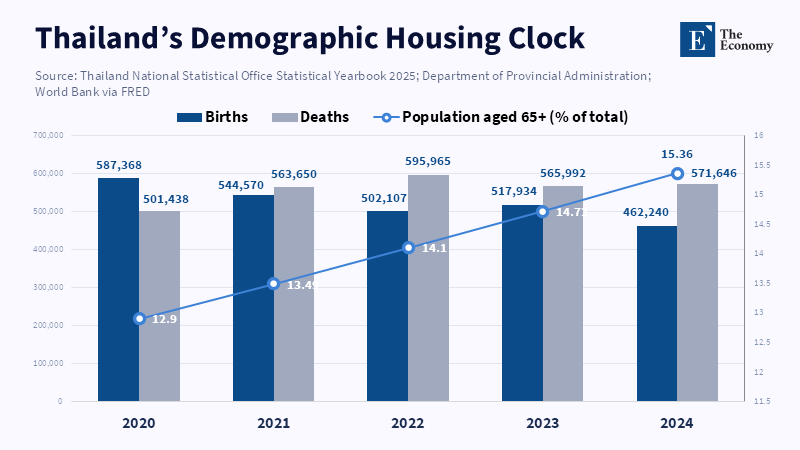
Thailand had 462,240 births and 571,646 deaths in 2024. That gap is not a foreboding statement about population growth. It is an early warning of a demographic transition in housing that will run through the country in two difficult stages. First is the squeeze: remaining long-term owners, cooped-up young workers and families with meager incomes are all competing for the handful of urban markets with job opportunities and for the prices developed for a more numerous and vigorous set of actors. Then comes the reversal: higher death rates, heirs reject old homes and the nation that once suffered from excess demand for housing could now be suffering from too many homes in the wrong places. Aging should not be viewed as an ancillary topic to the housing debate. It is the market itself. The policy question is not just how to reduce the cost of housing today. It is how to prevent building, subsidizing and financing a glut of empty houses in the future. Wrong answers will be costly twice: first in inflated costs of land, debt and infrastructure, second in piles of languishing properties and empty cities.
The Demographic Housing Transition is Already Here
Thailand's housing stress is often cast as a basic affordability failure. That is true, but is not enough. An ordinary housing deficit is relieved by increased supply, improved credit accessibility and quicker planning approvals. A demographic housing shift is much more difficult. It entails demand shifting by age, residence, household size and time. The elderly tend to live longer and retain homes longer. Young people tend to set up fewer households. Cities continue to draw in workers because jobs are still clustered. This creates a short-term squeeze even as the country moves toward long-term population decline. The pressure is real but it is transitional. Bridge problems need bridge policies, not permanent building spaces.
Numbers reveal why the bridge is narrow. Thailand's population feel below 66 million in 2024. By then, more than 15 percent of the population was aged 65 or above. The over-60 population had doubled in two decades. Meanwhile, household debt has hovered near 90 percent of GDP, so many families cannot safely borrow even for a home. This combination disrupts the traditional housing model. It weakens demand from young buyers but keeps supply over 60 locked up and promotes developers to the better incomes, safer margins market. This produces a situation where there are vacant top-end units in some places, packed apartments in others and old owners are sitting on assets that may not shift cleanly into useful future housing stock.
The big error in this scenario would be to interpret low births as an immediate easing of pressure. Housing does not react as quickly as the demographic profile. A child not born in 2024 does not reduce apartment demand in Bangkok in 2026, or previously owned housing in the interim, if there is a drop in the national birth rate. A young graduate still needs to work close to home. A woman still needs to get to a hospital. A parent still needs access to a school before affordability. That approximate timing is the biggest factor in Thailand appearing to be both a congested and a declining society at the same time and the most important reason planning needs to extend well beyond the current cycle. This time lag is why planning must extend beyond the current price cycle.
Why Subsidies Could Deepen Tomorrow’s Vacancy Risk
A government that experiences high rents and blocked mortgage access will want to create some housing subsidies. It is correct that some assistance is deserved. No family should be stretched out of all proportion for the best years of income in volatile accommodation miles from decent transport, education and health provision. Nevertheless, widely available housing subsidies in a country on the brink of a demographic transition can be dangerous. They can tempt young households into debt for developments that might not appreciate as the age range narrows through the population again. They can tempt developers into unnecessary building in areas completely dependent on fragile levels of demand. Cheap credit can disguise stagnation for a few years, but it cannot create births, heirs or jobs.
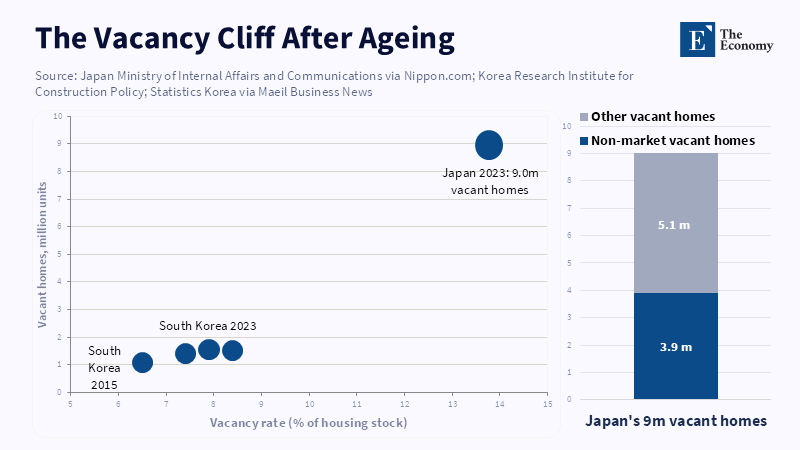
Japan warns of the perils of managing present demand under the illusion that it will be sustained indefinitely. In 2023, there were some nine million vacant homes in Japan, that is 13.8 percent of its total stock, of which nearly 3.9 million were not for rent, sale, or holiday lets. This includes numerous inherited homes, caught in the spider's web of sentimental attachment, tax law, renovation costs and feeble local markets. South Korea's housing vacancies are heading down the same track. In 2023, they stood at 1.53m, increasing 43.6 percent between 2015 and 2023. This is not just a count of empty countryside dwellings; it is a signal of timescales. Where birth rates remain low and older owners die, properties can transform very rapidly from family wealth into local liabilities.
This is a lesson for Thailand to learn before the problem becomes visible from the street. If public funds support units that fail those tests. It is a prerequisite that it occurs in a location where people can work and reach services, is suitable for residents and can be maintained. If the public funds should be invested in units that fail such tests, then the state is not solving affordability; it is purchasing empty units for the future. This is not a call for no public provision, but a call for narrowly targeted rental subsidies, kick-starting repair programs and mixed-tenure developments in well-located areas of need before investing in big ownership schemes in weaker demand locations. The state should enable people to get on with living well now, without locking them into assets whose future worth is uncertain.
However, support can still be designed well. A rent voucher close to a job cluster will keep a worker mobile. A repair grant can keep an aging owner safe while maintaining stock for future use. A shared-equity scheme can limit the risk if prices fall. But a broad call for homeownership imposes the state as a partner to household loss. This is particularly the case when aggregate household debt is high and banks are cautious. In those circumstances, "helping people buy" may merely shift risk from developers to families. A more straightforward test is simple: will this policy still look prudent if the local population were to shrink by 10 percent in 2040?
Suburban Jobs Should Become Housing Policy
The most potent housing policy for Thailand might not be housing at all. It is an employment policy. Bangkok is still the country's prime attractor because virtually all employment, hospitals, universities, finance, logistics and government offices are located there. As long as opportunity remains concentrated in one metropolitan region, workers will keep competing for access to that landmass, even when national population growth turns negative. That's why a plummeting birthrate fails to immediately translate into housing shrinkage. Older owners don't move to better neighborhoods. Younger workers continue to chase the same labor markets. Migrants pick up the slack in the service sector. The capital can feel crowded while the country's demographic base is already weakening.
The solution is not to coerce people out of Bangkok. That would fail. The solution is to provide secondary cities and suburban corridors with enough investment to make them an attractive alternative. Thailand needs a jobs-first decentralization strategy linked to investment in homes, transport and healthcare. Industrial estates, digital services, major government back offices, universities, hospitals and green logistics clusters should be located in areas capable of supporting real daily life outside the Bangkok metropolitan area. Rail and bus corridors should serve new or repaired homes. Public sector agencies should lead by relocating functions away from the central districts. Private firms will follow only if they provide workers, schools, broadband and healthcare services that are credible.
Absolutely, the task of the training and education providers here is not just a slogan about skills. They can contribute to shaping a primary city into a true labor market or a dormitory, allowing cheaper land. Local labor market issues can be linked to regional colleges, vocational schools and universities, the plan of industry, the Elderly-care systems, the need for public health and the demand for digital services. Local training and local workers can make housing demand steadier. The younger generation does not need to emigrate for a basic job; the older generation's front line can also expand for elder-care, technical work and services remaining locally. In an aging country, education policy and housing policy can meet on the same street.
This can also safeguard older citizens. Aging in place seems reasonable, but it is treated at best when the area is devoid of the services of shops, clinics and transport. A suburban jobs strategy can preserve jobs in communities before homes are deserted and create jobs locally and provide employment near to elderly homes, avoiding the need for care to be imposed on distant family members or on strained public resources. For local managers, this entails placing the housing agenda in context with local labor statistics, with age profiles, with transport shortages and access to health care. For political decision makers, this involves not just counting units delivered but also assessing the risk of future vacancy risk. For educators and trainers, this involves matching community skills schemes to the growing industry sectors that can make the secondary city function.
Thailand Must Prepare For Empty Homes Before They Arrive
Thailand requires a national empty homes strategy before vacant homes become a national image. The first step would be a live property register monitoring vacant, under-utilized, inherited, unsafe and absentee-owner properties. Waiting until buildings are abandoned is too late. Once ceilings fall in and roads empty, the costs of refurbishment skyrocket and the stigma kicks in. Municipalities require legal tools to contact heirs, promote sale or transfer, impose minimal upkeep and take action on unsafe buildings. They also require funds for minor alterations rather than major ones. A small subsidy that makes a property livable can be more economical than subsequent demolition, policing and civic decline.
Tax and inheritance rules matter as much as construction budgets. Experience in Japan reveals that homes can remain in limbo when heirs are faced with costs, titles are uncertain, or resale is unfavorable. Thailand should liberalize transfer procedures, broaden mediation (to resolve family property conflicts) and provide transparent solutions (such as donation, land pooling, direct sale, or managed rental). "Home banks" can enable this transition, but they must go well beyond a website providing information alone, through home inspections, repair forecasts, title facilitation and linking with neighbors who are seeking renters or buyers with nearby, steady employment. Vacant homes can then become clinics, student housing, elderly provision, community kitchens and workers' accommodation. But this works only if the state lowers transaction costs early.
Critics will say Thailand still has too much housing demand to worry about empty homes. They are right as a matter of policy over one year but wrong twenty years down the line. As long as the renters remain overpacked and vacant homes remain in areas owned by future generations, they can coexist. Some will maintain this is a supply problem for prices to fix and this is in a sign of ultimate optimism (see Moore, 2010). A cheap home regardless of work, care access, title clarity, repair finance and transport, is still a burden. Clearing housing markets requires legal and social clearing as well.
The better road is not anti-market and not entirely social housing. It is demographic realism. Thailand must now protect tenants, shield impoverished first-time buyers from safe debt, shift jobs closer to cheap land, refurbish functional homes, and prepare a legal pathway for homes soon to pass through the market. The message is not about halting aging or forcing growth where it no longer belongs. It's about steering the demographic housing transition before it morphs into a cycle of overcrowded cities and empty towns. The 2024 birth-death gap should be recognized as a public planning indicator. Early on, a country can still influence where populations live, work, age, and leave homes behind.
The views expressed in this article are those of the author(s) and do not necessarily reflect the official position of The Economy or its affiliates.
References
Federal Reserve Bank of St Louis (2025) ‘Population ages 65 and above for Thailand (SPPOP65UPTOZSTHA)’. FRED Economic Data.
Khaosod English (2025) ‘Thailand’s population drops below 66 million as births hit 75-year low’. Khaosod English, 17 January.
Nippon.com (2024) ‘Number of vacant homes in Japan reaches record 9 million’. Nippon.com, 20 May.
Olsson, J. (2025) ‘Seeing the glass half full amid Japan’s vacant housing crisis’. East Asia Forum, 28 August.
Prasomsup, R. (2026) ‘Ageing and housing affordability collide in Thailand’. East Asia Forum, 20 May.
Reuters (2025) ‘Thai household debt-to-GDP ratio drops to 88.4 at end-Q4’. Reuters, 31 March. Reporting by Orathai Sriring; editing by Sharon Singleton.
Sriring, O., Staporncharnchai, T. and Thaichareon, K. (2025) ‘Thailand eases loan rules to help struggling property sector’. Reuters, 20 March.
Statistics Bureau of Japan (2024) Housing and Land Survey: 2023 Survey Results. Tokyo: Ministry of Internal Affairs and Communications.
Thailand National Statistical Office (2025) Statistical Yearbook Thailand 2025. Bangkok: National Statistical Office.
Tochibayashi, N. and Kutty, N. (2024) ‘What is behind Japan’s surging empty homes and how can they be turned into community assets?’ World Economic Forum, 18 March.
World Bank (2025) ‘Population ages 65 and above (% of total population) – Thailand’. World Development Indicators.
Yonhap (2025) ‘Number of abandoned homes reaches 1.53 million in 2023 amid aging population’. The Korea Times, 5 March.
Working across research, policy, and data-driven analysis, the Editorial Board ensures that published pieces reflect a consistent institutional perspective grounded in quantitative reasoning and long-term structural assessment.