Europe’s AI Compute Gap Is Now an Industrial Policy Test

Working across research, policy, and data-driven analysis, the Editorial Board ensures that published pieces reflect a consistent institutional perspective grounded in quantitative reasoning and long-term structural assessment.
Authored On
Modified
Europe’s AI future depends on compute power
The gap is also about energy, chips and access
Europe needs its own AI infrastructure, not full dependence on others

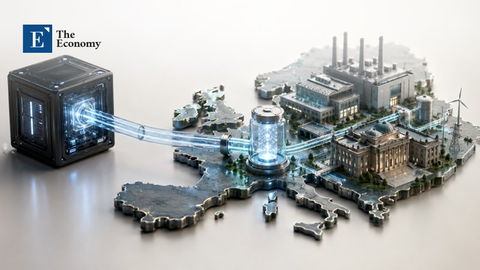
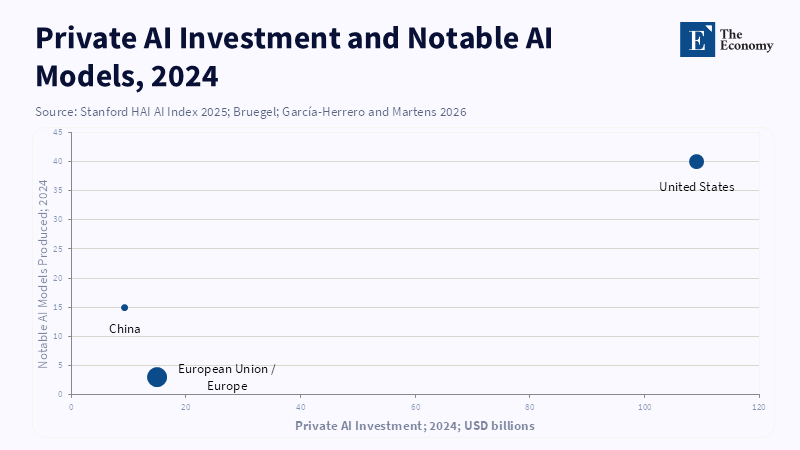
Europe's AI problem is no longer a software problem. It's a machine problem, an energy problem and a capital problem all at once. In 2024, US private AI investment was $109.1 billion, against China $9.3 billion and the UK $4.5 billion. Europe only brought a tiny slice of the world's top AI models. That disparity is no longer just a matter of talent or aspiration. It reflects a more fundamental shortage of large-scale AI compute: the costly infrastructure needed to train, test and run frontier AI systems. The AI compute shortfall is now at the heart of Europe's tech prospects. If the continent cannot secure sufficient cutting-edge chips, data centers, green electricity, cloud capacity and shared access for companies, then it will not lead the next AI economy. It will rent the foundations of it.
The AI Compute Gap Is a Sovereignty Problem
The main policy conclusion is clear. Europe will not be able to govern its own AI future if it does not have the physical infrastructure on which the most powerful AI research and applications are built. Rules matter. Safety matters. Trust matters. But none of that will be enough if Europe lacks access to the compute that makes advanced AI possible. A region that relies on outside cloud providers, outside chips, or outside infrastructure for its models can still use AI. It just cannot control its development in its economy.
The AI compute gap alters the meaning of digital sovereignty. In the prior digital era, sovereignty meant safeguarding of data assets, regulation of platforms and competitive enforcement. These remain foundational. But frontier AI has changed the bottleneck. The critical asset is now the capacity to train, fine-tune, test and deploy large models at scale This in turn deployed the specialized infrastructure of graphics chips, Ethernet networks, cooling equipment, robots and the like. It created the finance that could afford the assets, the constellation of ethics and regulation that drew them into useful ways for companies, imagined to extend beyond a few dominant technology centres.
Europe has its strengths and should not be written off. It has world-class research universities, advanced industrial firms, a high regard for rights-based governance and a single market in theory. It has HPC assets and new AI factories targeted at broadening participation. But the market is fractured across national borders. Power prices are highly disparate. The capital markets are still thinner than the US markets. Many firms treat AI as a purchasing tool, not a core part of a building system. The outcome is a perilous middle ground. Europe is too big to afford reliance, but too slow to compete at the scale of others.
Why More Money Alone Will Not Close the AI Compute Gap
The new European push to mobilize AI investment is an extremely serious initiative. The European Commission unveiled InvestAI, setting out to mobilize 200 billion for AI, including a 20 billion fund for AI gigafactories. EuroHPC followed suit with its own AI factories offering firms, start-ups and researchers access to compute and support. Such policy initiatives indicate that the debate has matured. Europe appears to be clear that computing is not a second-order issue. It is the fundamental layer of AI power.
Money alone won't bridge the AI compute gap. Simply producing the headline number can mask poor execution: compute policy does not succeed in funding machines without users, data centers without power or public infrastructure without business models. Europe must steer clear of creating prestige assets that impress but are disconnected from the needs of firms. A real factory for AI adoption in manufacturing, health, climate, finance, language tools and public services is more useful than a symbolic supercomputer few companies can harness.
The hard bit is not whether Europe should spend at all, but how it should spend. It should use public money to reduce risk when private investors will not come in, but not to crowd out private operators or keep Europe locked into slow grant cycles. The optimal system is a hybrid one, with public institutions stabilizing demand, providing open entry, setting security parameters and bridging initial capacity; and private firms being able to build, scale and operate services faster. Universities and start-ups need clear, fast and practical access routes, not slow ceremonial entry points. Bigger incumbent industrial firms require set-in, predictable, secured contracts that transfer AI from pilot to production.
The Airbus lesson still applies, provided the lesson is refreshed. Airbus succeeded because Europe brought demand, finance, technology and market ambition together in a strategic industry. AI compute is a different matter. It is dynamic. It shifts more quickly. It will rely on international chip flows. It must be open to renewal continually. A European AI compute plan cannot be a once-in-a-generation industrial endeavor. It must be a living system that acquires capacity, continually updates hardware, distributes access, monitors expenses and eliminates excess.
The Energy Constraint Is Part of the AI Compute Gap
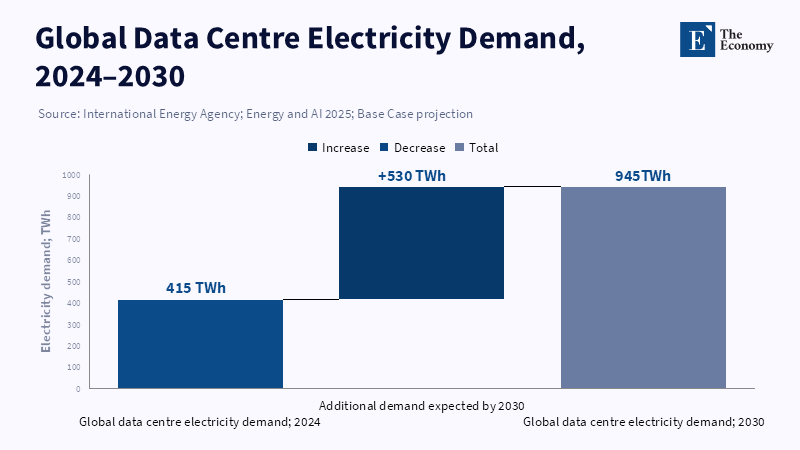
Compute is electricity turned into intelligence at scale. That brings energy policy to the front of AI policy. The International Energy Agency estimates global data center electricity consumption could more than double to some 945 TWh by 2030. This is now a core infrastructure constraint. It means AI infrastructure will vie with factories, homes, electric vehicles, heat pumps and infrastructure upgrades for electricity. So any credible plan for bridging the AI compute gap must also include grid connection, power pricing, clean power generation and faster permit processes.
Europe has a potential edge here, but it's not guaranteed. Its climate strategy and renewable energy target can anchor a greener AI compute infrastructure. However, high power prices and grid connection delays could push compute spending outside of Europe. AI data centers require reliable electricity supplies, high-capacity transmission and cooling. They also require sites with industrial proximity. Nor should the association alone of power availability with low demand be another form of waste; nor the siting of the absence of grid capacity with high demand another delay.
But the policy answer is not to set up a debate of one or the other, AI or climate. That would be a straw man. The best policy recommendation is to tie the two together. Europe should recognize AI data centers as strategic power users, subject to aggressive efficiency standards, transparent energy consumption reporting and incentives for the use of low-carbon power. In return, projects that pass these tests should benefit from prioritization in grid planning and those that do not should be delayed and subject to tighter permitting. This would bring the AI compute gap into a known infrastructure problem, rather than a political conflict over electricity.
There will be critics who argue that Europe should not dedicate people's taxes to energy-hungry AI systems while the pressures on public services increase. This is a fair point. But the solution is not to shy away from investing in AI compute. It is to ensure that computing serves societal and industry needs. AI can assist in drug discovery, grid balancing, civic administration, climate modeling, mobility infrastructure planning and sophisticated manufacturing. These improvements will not happen out of thin air. They depend on domestic capacity, domain-specific information, assured deployment and businesses willing to take risks.
Access Must Matter More Than Ownership
The greatest risk in Europe's AI policy is confusing ownership with access. While owning machines, of course, has its uses, what is really important is whether the correct users can obtain sufficient computing power when they need it, for the right price. Even a young start-up that has to wait for months to get the approval to use a machine will fall behind. Even a mid-market manufacturer who cannot access technical help will not be able to adapt their production line. And even a university researcher who can train a model but not deploy it securely on the cloud will be stuck in academia. The AI compute gap is, therefore, an access gap too.
Europe needs to develop computing as a common industrial resource, not simply as a free resource for all. That means tiered access. Researchers, new start-ups, public agencies and the most strategically important industrial users all need to be able to get into the system. Small firms need at the entry end simple steps in, with technical assistance and extensive test environments. Scale-ups need a significant step-change in availability without undue pressure to accelerate to an exit or go offshore. Public agencies need resilient infrastructure and hardware for sensitive application types. Large ones will need to pay more, but their ongoing support will be essential in generating the demand that will underpin the whole.
This model of access would also address a common critique. A few people have suggested that Europe is too far behind the world leaders in the US and China in frontier AI to be a serious competitor. To date this is a short-sighted conclusion. It isn't necessary for Europe to succeed in every model race in order to benefit from AI, it is enough for Europe to have sufficient capacity to defend consumer choice, to support and encourage its domestic firms (including multinational ones) and to learn how to govern AI for some sectors where it is a true asset, like manufacturing, energy, health, mobility, climate services, finance, public services, industrial design.
A strong access policy would prevent this type of reliance. A significant number of European companies now prefer to buy off-the-shelf/off-the-shelf artificial intelligence because it is convenient and fast. That is not going to change. Total independence in technological terms is neither possible nor appropriate. That type of dependency can only be a problem when there are no options in the event of price variations, access issues, security policy, or increasing geopolitical power. Europe needs an alternative. The aim is not autarky. The aim is bargaining position.
Closing the AI Compute Gap Requires a New Policy Discipline
The next stage should be less about political speeches and more about discipline. Europe needs a computing strategy that has a set of quantifiable targets. How many companies run on open AI hardware? How quickly can a startup gain access? How much capacity goes into frontier research compared to commercial adoption? What percentage of computing runs on green power? How many projects progress from pilot to commercial deployment? How frequently does the hardware refresh? These are not precisely the sexy implications of investment commitments, but they are the questions that will determine whether the AI compute chasm contracts or expands.
Policy should also delineate between three tasks that are too often conflated. Europe needs frontier capacity that is set aside from the rest, enabling the training of large models and the conducting of security tests. It needs widespread access to computing for companies attempting to put AI to work within their businesses. Finally, it needs public-benefit computing for research, health, climate, languages and public services. These three tasks all have different costs. They all require different rules. One fund cannot optimally address all three.
It's a governance model that is nimble and fast but resilient, that protects public value. Access rules provide incentives for projects that contribute to building European capacity rather than subsidize services that merely consume subsidized infrastructure. Public subsidy should require public reporting on usage, energy, security and results. Procurement should prefer open standards where feasible to save firms from being locked into a vendor and cross-border access should actually be cross-border, not overtaken by national policy habits. A company in Greece, Portugal, Poland, or Slovenia should not have a worse route to AI compute than a company in Paris, Munich, or Amsterdam.
The final point is political. Europe traditionally hedges when dealing with technology gaps by adopting cautious, measured and slow steps. This strategy is no longer viable. The AI compute gap is growing larger in a global race where scale begets scale. More computing facilitates better researchers. Better researchers develop better models. Better models draw in more users. More users lead to more capital. And once this positive feedback loop is established somewhere else, it's going to be that much more difficult to catch up each year.
Europe has a window of opportunity but not a window of complacency. The goal is not to emulate the United States or China; it's to create a European compute platform scaled to Europe's economy, values and industrial base. That entails common access to affordable infrastructure, democratic access to clean power, acceleration of capital, premium technical support and hard links to real economies. That opening number should be read as a caution, not a fait accompli. If Europe regards AI compute as infrastructure, the divide can be narrowed. If Europe regards it as a policy slogan, the next AI economy will be built on machines that Europe's citizens will have no way to steer.
The views expressed in this article are those of the author(s) and do not necessarily reflect the official position of The Economy or its affiliates.
References
AdvisoryRanking (2026) ‘Top 20 Cloud & Infrastructure Advisory 2026’, AdvisoryRanking, 28 April.
Draghi, M. (2024) The Future of European Competitiveness: A Competitiveness Strategy for Europe. Brussels: European Commission.
European Commission (2025) ‘EU launches InvestAI initiative to mobilise €200 billion of investment in artificial intelligence’, European Commission Press Release, 10 February.
European Commission (2026) AI Factories: Shaping Europe’s Digital Future. Brussels: European Commission.
EuroHPC Joint Undertaking (2026) AI Factories. Luxembourg: EuroHPC Joint Undertaking.
García-Herrero, A. and Martens, B. (2026) ‘Europe needs a strategy to close the artificial intelligence compute gap’, Bruegel Analysis.
International Energy Agency (2025) Energy and AI. Paris: International Energy Agency.
Martens, B. (2024) ‘Catch-up with the US or prosper below the tech frontier? An EU artificial intelligence strategy’, Bruegel Policy Brief, 25/2024.
Maslej, N., Fattorini, L., Perrault, R., Gil, Y., Parli, V., Kariuki, N., Capstick, E., Reuel, A., Brynjolfsson, E., Etchemendy, J., Ligett, K., Lyons, T., Manyika, J., Niebles, J.C., Shoham, Y., Wald, R., Walsh, T., Hamrah, A., Santarlasci, L., Betts Lotufo, J., Shi, A. and Oak, S. (2025) The AI Index 2025 Annual Report. Stanford, CA: Stanford Institute for Human-Centered Artificial Intelligence.
Working across research, policy, and data-driven analysis, the Editorial Board ensures that published pieces reflect a consistent institutional perspective grounded in quantitative reasoning and long-term structural assessment.