Betting on Rejuvenation: Global Capital Races Into a ‘Longevity’ Industry Where Expectations Outpace Science

Authored on
Modified
The Longevity Boom Created by the Healthspan Gap
Investors and Consumers Betting on the Possibility of Rejuvenation
A Gap Exposed Between the Research Stage and the Pace of Commercialization
The longevity industry, which aims to slow aging and extend healthy lifespans, is expanding rapidly. Longevity biotech companies and age-reversal technologies are drawing massive investment, while some are even claiming that aging can be treated or reversed. Yet much of the relevant technology remains in the validation stage, and the gap between the possibilities discussed in laboratories and the expectations being consumed in the market remains substantial.
Longevity Market to Reach $8.5 Trillion Next Year
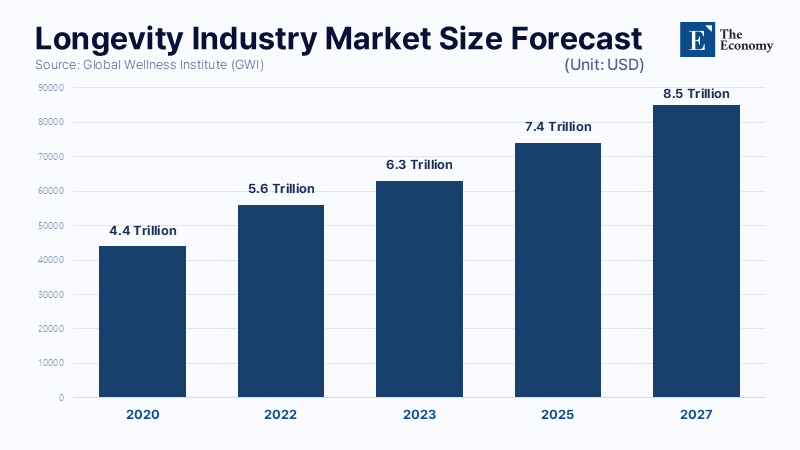
According to the Global Wellness Institute (GWI), a global market research organization, on the 1st local time, the market for longevity-related industries is projected to reach $8.5 trillion in 2027. Global investment bank Morgan Stanley also forecast that the longevity industry, including consumer-driven diagnostic testing, could expand to $4 billion.
According to Longevity Technology, a publication specializing in longevity technologies, total funding raised in the longevity biotechnology sector reached $3.74 billion in the first quarter of this year. That represents a 56% surge from the same period last year. Venture capital firm Primetime Partners has been leading this trend by expanding investments in startups focused on dementia prevention and physical function enhancement. U.S. big tech companies have also entered the longevity market. Amazon founder Jeff Bezos has invested $3 billion in Altos Labs, which is pursuing cellular reprogramming. OpenAI CEO Sam Altman has also invested $180 million in Retro Biosciences, which studies cellular age reversal.
The market’s expansion is driven by more than investment enthusiasm. The World Health Organization (WHO) has projected that the global population aged 60 and older will reach 2.1 billion by 2050. As population aging entails rising healthcare costs and a growing burden of chronic disease, governments and medical industries around the world are shifting their center of gravity from disease treatment to prevention and management. Demand for so-called preventive longevity services, including biological age measurement, genomic analysis, epigenetics-based diagnostics and wearable healthcare devices, is therefore growing rapidly.
The industry’s scope is also widening. While the early longevity market formed around anti-aging drugs and regenerative medicine, it has recently expanded into consumer-facing sectors such as health checkups, nutrition management, biomarker analysis, digital healthcare and longevity clinics. In a recent report, Longevity Technology analyzed that the industry’s current growth engine is shifting from drug development to consumer diagnostic services, biohacking and personalized healthcare. Investors, too, are concentrating capital on data platforms, precision diagnostics and preventive medical infrastructure rather than drug development, where short-term outcomes remain uncertain. Industry observers expect funding inflows to continue for the time being as population aging deepens and demand for preventive medicine expands.
In an Era of Longer Lives, Healthspan Becomes More Important
The market’s growing focus on the longevity industry is rooted in the gap between average life expectancy and healthspan. Human life expectancy continues to rise, but healthspan, the period spent living in good health without disease or injury, has not kept pace. According to the WHO, the average global healthspan is about nine years shorter than life expectancy. This means that as lifespans increase, the period spent living with chronic disease and declining physical function also lengthens.
This reality is changing the medical paradigm itself. Whereas past healthcare systems focused on treatment after disease onset, recent approaches are drawing attention by seeking to slow the aging process itself and preserve a healthy state for longer. This is also why investors view aging research as a next-generation growth industry. Expectations are forming that slowing aging itself could delay the onset of multiple diseases at once, rather than treating individual conditions such as cancer or dementia.
Indeed, global pharmaceutical and biotech industries have begun to recognize aging as a new therapeutic domain. Large-scale capital has flowed in recent years into research fields directly linked to aging, including cellular senescence, epigenetics, stem-cell regeneration and the maintenance of protein homeostasis. Global pharmaceutical companies such as Novartis, Eli Lilly and AbbVie are also expanding cooperation with aging-related biotech firms as they move to secure relevant technologies.
The consumer market is responding just as quickly. As biological age measurement services, personalized health management programs, continuous glucose monitors (CGMs) and genetic analysis services proliferate, healthcare is clearly moving from the realm of disease treatment into that of everyday consumption. Market research firm McKinsey analyzed in a recent report that consumers are increasing spending on wellness and healthspan extension, with demand growing particularly among high-income middle-aged and older consumers.

Concerns Over Age-Reversal Side Effects, Including Tumors and Brain Inflammation
A figure who starkly illustrates the reality of the longevity industry is Bryan Johnson, 45. A former tech company executive and billionaire, Johnson spends $2 million a year using his own body like a laboratory. His goal is to slow the pace of aging by measuring everything from blood markers and sleep data to organ function and epigenetic indicators. Johnson may appear to be an exceptional case, but the market structure tells a different story. Similar consumption patterns are spreading rapidly, albeit without reaching such extreme levels. Supplements, blood tests, genetic tests, longevity clinics, NAD injections and aging-clock analysis services are all supporting this trend.
Biologists have long explained that aging progresses as telomeres, the specialized particles located at the ends of chromosomes in the cell nucleus, gradually shorten as cells undergo repeated replication and division. They have also described reactive oxygen species generated by exercise deprivation, nutritional deficiencies and stress as risk factors that further shorten telomeres and accelerate aging. Yet recent trends show a growing tendency to view aging as a disease rather than a natural process. The view is that aging can be slowed, halted or reversed through treatment — in other words, that rejuvenation is possible.
A leading proponent of this view is David Sinclair, a professor of genetics at Harvard University. In his book Lifespan: Why We Age—and Why We Don’t Have To, he argued that “aging is a disease and can be treated with anti-aging drugs alongside lifestyle improvements.” His claim is that aging has no relationship with genes and can be suppressed or reversed by consuming or injecting yeast that controls longevity and drugs that stimulate it. But mainstream academia remains skeptical. Canadian media outlet The Globe and Mail has also warned readers not to forget that Johnson is an investor who has put large sums into the biotech industry, especially the anti-aging field.
Concerns over the side effects of age reversal are also significant. In academia, teratomas, or malformed tumors, have been repeatedly cited as a representative side effect of the Yamanaka factors, the key proteins in age-reversal research. When Yamanaka factors are introduced, old cells can transform into young stem cells, but some can become rapidly proliferating, massive tumors. According to the Salk Institute, a U.S. biological research institution, when Yamanaka factors were expressed throughout the bodies of mice with a premature-aging genetic disorder, many developed teratomas and cancerous tumors across their bodies and ultimately died within weeks. In a 2024 study by Stanford University, in which Yamanaka factors were introduced throughout the bodies of mice, brain inflammation was also detected.
Academia is also skeptical of the very idea of viewing aging as a disease. One pharmacology doctor rebutted the “aging equals disease” claim, saying, “Cancer does not occur simultaneously in all cells; it arises accidentally in specific cells and leads the organism to death,” adding that it is “entirely different from aging, which occurs broadly and commonly across all cells.” As such, the prevailing view in mainstream academia remains that aging and death are still part of the natural order. Improvements in lifestyle, including proper diet, exercise and meditation, can slow aging and help maintain vitality, but rejuvenation that turns back the aging clock remains effectively beyond reach, no matter how much extraordinary effort and money are poured into it.
Similar Post