Technology Transfer Consulting and the New Geography of Advisory Power

Authored on
Modified
Advisory power now comes from turning new technology into local trust
Global firms win by transferring credibility and scaling proof across markets
Rankings help buyers spot trusted leaders in crowded, opaque sectors

The advisory market is being reconstructed around one simple fact: new technology no longer enters new markets as a complete product. It arrives as a proposition that needs translating, framing, localizing, de-risking, governing, pricing, and selling. That is why technology transfer advice has shifted from support work into a source of profit. According to Eurostat, 20.0% of EU firms with 10 or more employees said they were using artificial intelligence technologies in 2025, up from 13.5% in 2024. But there is still variation by firm size, industry, and geography. The opportunity is obvious; so is the confusion. Buyers do not need just the software; they also need evidence that a frontier, market innovation can operate within their rules, workflows, talent profile, and customer architecture. In that terrain between invention and deployment, technology transfer advice is emerging as one of the defining markets of this cycle.
Technology Transfer Advice Is Not About Transferring Knowledge
The conventional way of thinking about technology transfer viewed it as a flow of intellectual property. Technologies originated in a certain place, crossed a border, and were replicated elsewhere. That perspective obscures where the money is now. In practice, technology transfer advice is about transforming frontier innovation into local consensus. It is less about product existence than about whether a buyer can believe in its ability to operate effectively in its real-world organization. The firms that succeed are not those with the earliest knowledge, but those who can reduce the distance between the knowledge frontier and local decision-making. They translate technological language into board parlance, convert pilot projects into sales prospects,agreements, and translate broad promise into reliable operations. In that sector, knowledge is secondary; credibility is what is paid for.
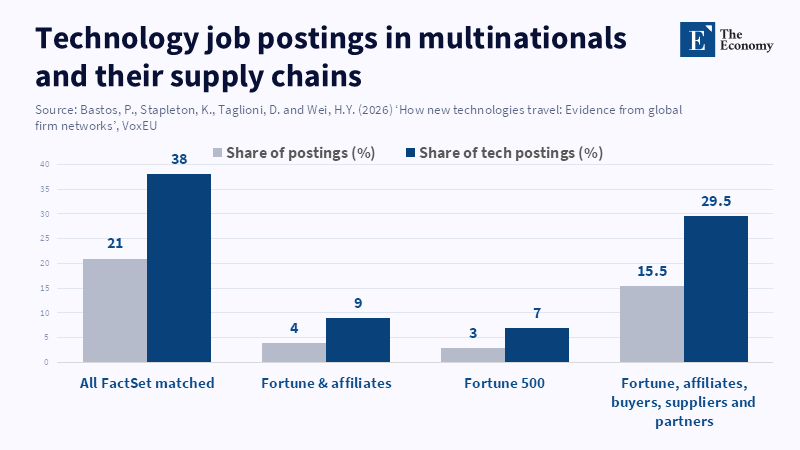
This shift in emphasis matters today because diffusion is accelerating even while certainty is lacking. CEPR, a think tank, published in 2026 that by analyzing over 500 million online job vacancies in conjunction with firm-to-firm data, 29 new technologies migrated cross-border by geographic and income levels, in addition to buyer links and collaborative innovations. Digitization has expanded accessibility, but not the need for trusted partners. If anything, it has increased it. When almost nine out of ten organizations claim to have deployed AI across one or more organizational functions, but just over a third say they are now trying to scale it, the bottleneck lies neither in awareness nor in affordability but in execution. That is precisely the realm of technology transfer advice. It is where overspill turns into institutional strength, institutional strength turns into monetized credibility, and monetized credibility turns into further overspill. Recent management research echoes this: digital instruments have reduced the expense of doing knowledge transfer but not eliminated the internal work needed to make that transfer effective. That work is orchestration: selecting providers and use cases, instructing employees, satisfying regulators, and giving advocates within the organization reason and room to persist.
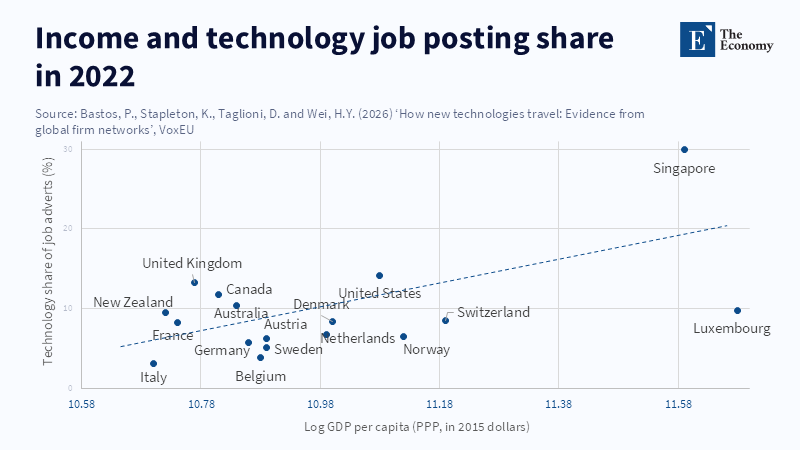
The Advantages Large Global Consulting Networks Have in Technology Transfer Advice
Large multinational agents enjoy distinct advantages when competing in technology transfer advice that local specialists may not be able to balance. The first is cross-border credibility transfer. Disruptions originating in the US, UK, Germany, Japan, or other high-trust geographies often come with untapped credibility, but that credibility does not necessarily cross a foreign border intact. Large pan, national agents have the ability to translate some of that credibility into the new environment, as in, "This is not a risky delivery, it is already operationalized, validated, and incorporated into our global network." For consumers, that messaging can be enough to advance the provider into a seller shortlist. According to 6sense, in 2025, B2B buyers typically shortlist a median of three or four vendors prior to engaging with sellers and make purchases from that shortlist 85% of the time. In the same year, PwC's Global Risk Survey indicated that 62% of companies were optimistically concentrating on gaining opportunities rather than mitigating risks. That reflects a strategic move toward actively seeking the "positive," a turning away from deferential vendors who have merely remained within their comfort zones.
Second, established networks produce superior cross-transparency. They can develop case studies more efficiently by combining cross-national, cross-industry, and cross-category observations. They do not require waiting for their local industry to develop before offering subsequent engagements elsewhere. Thus, a success in technology implementation in one location becomes a priming aid for another. Equally, multinational teams can bring not just implementation timetables but also tooling, talent, referral, and reference networks from the country of origin to the new entry point. Even the advice issued by the International Federation of Accountants for firms outside the Global Power,squads, underlines the potential customer benefit of partnerships and networks. By establishing links and alliances, often the most rapid way of entering a new practice line when the internal skills base is bare, the enterprise can accelerate from experimental prototypes to all-encompassing commercial packages. It can avoid the costs of incremental market penetration and secure bottom-tier market income faster. That is where global network proportions and expenditure levels become relevant. For FY2025, Deloitte had $70.5 billion in global revenues, PwC $56.9 billion, EY $53.2 billion, and Accenture $69.7 billion. In addition, Accenture indicated it served 195 of its 200 biggest clients for a decade. PwC announced that its services covered 82% of the Forbes Global 500. Brand giants are very large, very trusted, and very capable. Their repeat relationships and global experimentation loop make them an excellent license for commoditizing frontier innovation.
Technology Transfer Advice Is Becoming a Signal Market
Beyond the early proof, in the principal stage, technical differentiation diminishes. Many competing firms will rely on roughly comparable solution structures, alliance count, and cloud architecture. Quality will increasingly be signaled rather than attributable to one's ability to govern better, develop better alliances, develop deeper sector depth, and deliver better client outcomes. For example, PwC's 2026 AI Performance Study concluded that just 20% of organizations were meaningfully sharing 74% of the economic potential of the technology. That optimal three,in,ten distribution means not only immediate attention on the few top performers, but also a compelling commercial imperative to be acknowledged as emerging as a trusted global brand. Consequently, rankings, market share analysis, and reputation metrics will increasingly form part of navigation systems for researchers. As technologies progress, their segments mature, and small market players will become conspicuous without the benefit of rigorous due diligence. This is especially the case as boundaries between segments blur: a tax partner one year is a data AI rationalist in the next; a legal firm focused on AI compliance one year is a digital transformation interlocutor the next; a consulting organization evolves into a comprehensive managed service platform. A ranking mitigates this ambiguity by defining proprietary benchmarks. It does not replace judgment, but it facilitates comparison, it reduces search costs, and it helps consumers understand which brands hold comparative authority within adjacent files. Not only do incumbent giants benefit from that reputation. Entrant specialists, too, can leverage rankings to define the space and accelerate the visibility of their unique expertise.
Rankings Are Now Infrastructure
Some critics argue that rankings are overly reductive and thus unqualifying. An 11.1magnet ranking flawed by noise, mistgasatisca, and U.K. style self-selection is overly simplistic. Bad rankings exacerbate their problems by praising peripheral specialists and disregarding careers that have made a true name for themselves. But these points of criticism tend only to hit home when there is still a messaging gap in the absence of transparent prices and verifiable information. In today's market, that void is not prevalent. Instead, the familiar competing conditions are fragmentation, unequal branding, and uneven disclosure, leading to an ever-increasing emphasis on brand reputation analysis. The audience for seeking accurate competitive names with little specialist due diligence is swelling: according to PwC's 2025 CEO survey, around 40% of CEOs have begun competing in sectors that they did not operate in five years earlier. As sector boundaries dissolve, so do neat classifications. Accountants become data practitioners; lawyers graduate into AI regulators; consulting graybeards find a new niche as infrastructure architects. Rankings provide a streamlined indication, even when analytical judgment is otherwise unavailable. They support challengers to ascend and incumbents to defend their presence. They shape expectations before established identity or commercial benefits arrive. And they prepare markets for looming realities. Some market participants will attack them as crude, but their role is actually more refined: rankings shape market expectations while guides develop products. In an age of hypercomplexity and abundant competitors, rankings will be more than editorial noise; they will be late-arriving visitors' guides. And partners may follow the analogy further: the new game of technology may have little to do with correct answers, and more to do with whose identity is well-established.
References
Board of Governors of the Federal Reserve System, Office of Inspector General (2023) Material Loss Review of Silicon Valley Bank. Washington, DC: Board of Governors of the Federal Reserve System.
Correia, S., Luck, S. and Verner, E. (2026) ‘Bank failures: The roles of solvency and liquidity’, VoxEU, 18 April.
Deloitte (2024) Digital Banking Maturity 2024. London: Deloitte.
Department of Financial Protection and Innovation (2023) Review of DFPI’s Oversight and Regulation of Silicon Valley Bank. Sacramento, CA: California Department of Financial Protection and Innovation.
Federal Deposit Insurance Corporation, Office of Inspector General (2023) Material Loss Review of First Republic Bank. Washington, DC: Federal Deposit Insurance Corporation.
Financial Stability Board (2024) Depositor Behaviour and Interest Rate and Liquidity Risks in the Financial System: Lessons from the March 2023 Banking Turmoil. Basel: Financial Stability Board.
Gerdeman, D. (2023) ‘What does the failure of Silicon Valley Bank say about the state of finance?’, Working Knowledge, 14 March.
Similar Post