IMF Warns on China’s Growth Model, Urges Subsidies Cut From 4% to 2% of GDP as Trade Tensions Rise Amid WTO’s Waning Authority

Stefan Schneider brings a dynamic energy to The Economy’s tech desk. With a background in data science, he covers AI, blockchain, and emerging technologies with a skeptical yet open mind. His investigative pieces expose the reality behind tech hype, making him a must-read for business leaders navigating the digital landscape.
Authored On
Modified
“Chinese Subsidies Drive Overcapacity and Price Distortions”
Vacuum in Rules on Unfair Trade as WTO’s Role Weakens
Dual Track in Subsidy Disputes, With Complaints Filed Against India and the U.S.
The International Monetary Fund (IMF) has officially recommended that China reduce its industrial subsidies—estimated at roughly 4% of gross domestic product (GDP)—by half. The assessment reflects concern that Beijing’s export-driven industrial strategy has generated significant strain within the global trading system. Markets have focused on the expanding regulatory vacuum surrounding subsidies at a time when the World Trade Organization’s (WTO) mediation function has weakened. China has responded to external criticism with rebuttals, while simultaneously filing WTO complaints against other countries’ subsidy policies, underscoring a dual-track approach.
Debate Over the Scale of Subsidies
The IMF stated in its report released on the 18th, titled “Concluding Statement of the 2024 Article IV Consultation on the People’s Republic of China,” that China is estimated to provide subsidies equivalent to about 4% of GDP to firms in key industrial sectors. The Fund recommended reducing the level to around 2% of GDP over the medium to long term, citing the international spillover effects and tensions such support creates. The IMF concluded that excessive industrial subsidies, debt-fueled investment, and weak domestic demand are distorting China’s economy and generating negative external effects abroad.
While acknowledging limited official transparency on the scale of China’s industrial policy support, the IMF noted that priority sectors—primarily in advanced manufacturing—receive a range of assistance, including direct subsidies, tax incentives, preferential loans, and discounted land allocations. The critique extended beyond fiscal outlays to encompass a policy framework that combines financial, tax, and land tools. The report stressed that scaling back unnecessary industrial support would reduce fiscal costs and help narrow external imbalances. In an economic structure where weak domestic demand deepens reliance on manufacturing exports, further expansion of net exports inevitably produces adverse spillovers for trading partners.
Targeting China’s state-led, debt-backed investment model coupled with expansive industrial support, the report identified a shift toward consumption-led growth as the foremost priority. It urged a policy response combining fiscal support with structural reform, including curbing off-budget investment by local government financing vehicles (LGFVs) and restraining debt accumulation. The IMF warned that if reform is delayed, China risks simultaneously confronting slower growth, persistent deflation, and deepening financial vulnerabilities, casting doubt on the sustainability of its export-dependent model.
The IMF’s assessment triggered sharp debate. Michael Pettis, a senior fellow at the Carnegie Endowment for International Peace, wrote on social media platform X on the 19th that the Fund’s recommendation to trim industrial subsidies was merely a starting point. He argued that beyond direct central government support, local government subsidies and indirect subsidies mean China channels far more than 4% of GDP into key manufacturing sectors. An undervalued renminbi, artificially low interest rates, and labor regulations, he said, function as indirect transfers of resources from households to producers.
China, however, maintains that the scale of its industrial subsidies is far smaller than external estimates suggest. China’s executive director at the IMF said the size and impact of its industrial policies are significantly overstated, adding that such policies are open and transparent and apply equally to state-owned enterprises, private firms, and foreign-invested companies. Beijing’s forceful rebuttal reflects the reality that the IMF’s recommendation collides directly with President Xi Jinping’s “new quality productive forces” strategy, centered on advanced manufacturing and technology-led growth. A reduction in subsidies would likely hit large state-owned enterprises first, potentially weighing on short-term growth and raising political costs for the ruling party.
Prolonged Vacuum in Multilateral Trade Rules
Until recently, the WTO served as the principal forum for regulating industrial subsidies and related unfair trade practices. Through its Agreement on Subsidies and Countervailing Measures and dispute settlement procedures, the WTO addressed members’ industrial support within a multilateral framework. In recent years, however, high tariff policies pursued by the U.S. administration and the weakening of the WTO’s dispute settlement body have significantly undermined its coordination and enforcement capacity. Observers widely view the regulatory vacuum surrounding industrial subsidies as deepening. In this context, the IMF’s decision to cite specific figures and call for cuts to China’s subsidies is seen as intertwined with broader fractures in the multilateral trade order.
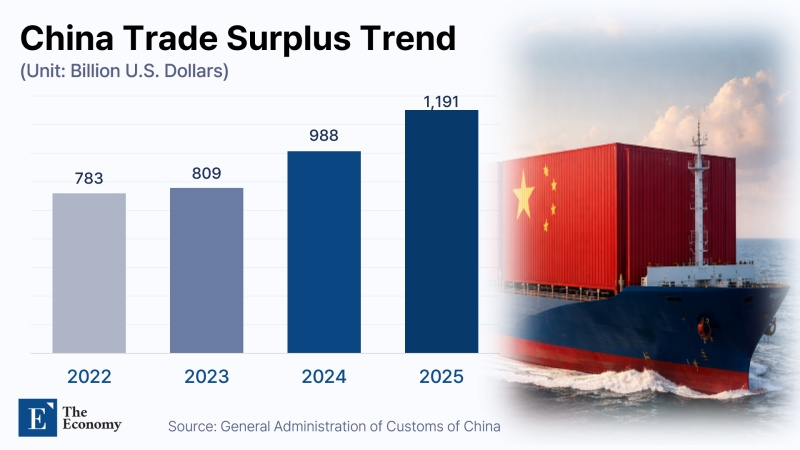
The WTO has also publicly addressed concerns about China’s growth model and trade structure. Speaking at the Munich Security Conference on the 13th, WTO Director-General Ngozi Okonjo-Iweala said that the export-led model that propelled China’s rise over the past four decades cannot guarantee growth over the next four years, urging a transition in its development strategy. She stated that the world cannot absorb China’s $1.2 trillion trade surplus and warned that absent corrective measures, additional barriers would emerge.
Preliminary data show that last year China’s exports reached $3.77 trillion and imports totaled $2.58 trillion, indicating that export expansion persisted despite U.S. tariff measures. Automobile exports climbed 19.4% year over year to 5.79 million units, while exports of pure electric vehicles surged 48.8%. On that basis, economists in China projected that the country’s trade surplus could exceed $1 trillion this year. With exports serving as a core engine for achieving a 5% growth target, international pressure on China’s industrial subsidies and export strategy now intersects directly with broader macroeconomic stability concerns.
At the same time, China has sought to shape discussions on WTO reform. Earlier this month, the Ministry of Commerce submitted a position paper on WTO reform, stating that while the multilateral trading system has been shaken by unilateral tariff actions, WTO rules and mechanisms remain a critical safeguard against trade disorder. It added that unilateralism and protectionism cannot provide a solution and called for multilateral cooperation, domestic reform, and inclusive, mutually beneficial development. The move is interpreted as an effort to project leadership in defending the international order at a time when the gravitational pull of multilateral norms has weakened.
Challenging Other Countries’ Subsidies Through Litigation
Even so, China has adopted a dual posture in subsidy disputes. In October last year, China requested consultations at the WTO, arguing that subsidies provided by India to its electric vehicle and battery industries violated WTO rules. A spokesperson for China’s Ministry of Commerce said at the time that India’s measures constituted prohibited import-substitution subsidies under WTO rules, conferring unfair competitive advantages on domestic industry and harming the interests of China and other countries. Under WTO agreements, members may challenge prohibited subsidies granted by another country. China urged India to honor its WTO commitments, though the dispute has shown no clear sign of resolution.
Earlier, in March 2024, China initiated WTO dispute settlement proceedings against the United States, alleging that the subsidy framework under the Inflation Reduction Act (IRA) was discriminatory. Although the IRA was introduced under the banner of addressing climate change and protecting the environment, China argued that it effectively conditions subsidies on the purchase or use of products manufactured in the United States or imported from specific regions, giving the policy an inherently discriminatory character. The IRA allocates $375 billion to electric vehicles and renewable energy projects and includes restrictions on the share of critical minerals and components sourced from entities of concern or non-allied countries.
The United States rejected China’s claims, describing the IRA as America’s contribution to a clean energy future pursued alongside allies and partners, and countered that China’s unfair non-market policies and practices pose the greater problem. If consultations fail, the WTO would establish a dispute settlement panel to conduct formal adjudication. The process, however, typically requires several years, including rulings and appeals, limiting its practical impact on policy adjustments. Consequently, China’s repeated WTO filings over foreign subsidy policies are viewed less as efforts to secure immediate changes and more as symbolic instruments of pressure.
Stefan Schneider brings a dynamic energy to The Economy’s tech desk. With a background in data science, he covers AI, blockchain, and emerging technologies with a skeptical yet open mind. His investigative pieces expose the reality behind tech hype, making him a must-read for business leaders navigating the digital landscape.
Similar Post