Trump Presses South Korea on $350 Billion ‘Up Front’ Investment, Seoul Draws Line Against Japan Comparison

Authored On
Modified
South Korean investment in the U.S. framed as an ‘advance payment’
Exchange rate volatility intensifies amid negotiating deadlock
Seoul’s hardline stance raises political risk for Washington
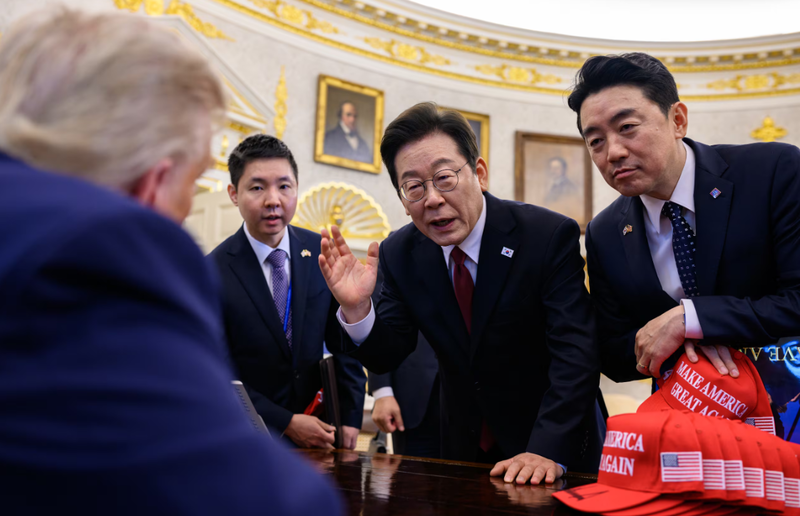
President Donald Trump has escalated pressure on South Korea, declaring that the country’s planned $350 billion investment in the United States must be paid “up front.” Seoul, however, has rejected the demand, citing foreign exchange risks and maintaining a tough posture. The uncertainty surrounding the negotiations has spilled into the currency market, with the won weakening past 1,400 per dollar and some forecasts warning it could slide to 1,600.
Washington Moves From Defense to Added Pressure
On the 25th, speaking to reporters at the White House, Trump said, “Under the trade agreement with South Korea, the amount it will invest in the United States is $350 billion,” adding, “That is up front.” With the two sides failing to narrow their differences on how the funds should be delivered, the remarks were interpreted as an overt attempt to pressure Seoul. Trump also invoked Japan’s earlier pledge of $55 million, stressing that South Korea must also pay its promised amount in advance.
U.S. Commerce Secretary Howard Lutnick likewise pressed South Korea to increase its contribution. According to the Wall Street Journal, Lutnick argued that “South Korea’s proposal is far too lenient compared with Japan’s example” and insisted on “an adjustment.” He reportedly demanded that a significant portion be provided in cash rather than loans, while also asserting U.S. authority to decide where the funds would be allocated. This clashed head-on with South Korea’s plan to minimize equity investment and focus on loans and guarantees.
Japan had earlier secured a reduction in auto tariffs from 25% to 15% in exchange for pledging $550 billion in what amounted to a blank check. Tokyo provided much of the sum in cash, handed the U.S. effective control over how the funds would be used, and even conceded 90% of the investment returns. That precedent underpins Washington’s insistence on similar terms from Seoul, while South Korea has emphasized that “we are not Japan” and adopted a more cautious stance.
As a result, the two countries are locked in a standoff over how to structure the $350 billion commitment. Seoul has made a currency swap agreement a precondition, arguing that paying in cash would expose it to unacceptable foreign exchange risk. Washington, however, remains adamant about receiving the money as an up-front cash transfer. With Trump’s public statements and Lutnick’s push for more money, the pressure on Seoul has only intensified. The stalemate suggests a protracted and painful path to any deal.
Cash Outlay Could Push Won to 1,600
The foreign exchange market is already reflecting these uncertainties. The won broke through the psychological threshold of 1,400 per dollar, adding to market jitters. In overnight trading on the 24th, the rate spiked to 1,403.8 per dollar—the first breach of 1,400 in four months—and closed at 1,400.6 the following day. The pressure on the won persisted even after the Federal Reserve cut its benchmark rate by 0.25 percentage points, underscoring the weight of political risk.
Broader currency weakness has reinforced the dollar’s strength. Britain’s widening fiscal deficit, growing fiscal risks in France, and Japan’s delay in raising interest rates all pushed the pound, euro, and yen lower, lifting the dollar index from around 96 to the high 97 range. Still, analysts caution that dollar strength alone cannot explain the won’s slide. Back in May, when the won also touched 1,400, the dollar index stood at 102; since then it has weakened by about 4%, yet the won has failed to recover, deepening currency concerns.
The critical driver, analysts say, is the uncertainty surrounding the $350 billion investment talks. While Washington demands cash commitments modeled on Japan’s example, President Lee Jae-myung and his government have rejected such terms, warning that agreeing could risk a repeat of the 1997 financial crisis. With no resolution in sight, the market is pricing in the burden of higher tariffs, capital outflows, and broader external vulnerabilities.
Brokerages echo these concerns. Korea Investment & Securities noted, “Our earlier study assumed the won-dollar rate would follow its long-term trend and stabilize at 1,431 by the end of next year. But if the U.S. investment is concentrated over a short period, it could push the rate as high as 1,579.” Even spread over four years, the brokerage estimated, the rate could still reach 1,536. The analysis underscored that rapid capital outflows could drive the won more than 100 points weaker.
Conversely, if the talks conclude smoothly, the currency could strengthen, with the won-dollar rate stabilizing in the mid-1,300s. Factors such as foreign purchases of South Korean stocks and bonds, current account surpluses, and expected inclusion in the World Government Bond Index next year provide potential tailwinds. iM Securities projected, “If negotiations are settled, the won-dollar rate could fall back to the mid-1,300s, partially offsetting tariff impacts.”
Stalemate Fuels U.S. Responsibility Narrative
Despite such optimism, the two governments remain far apart. The presidential office said Lee met Commerce Secretary Besant in New York the previous day to emphasize South Korea’s stance, urging that talks be grounded in commercial rationality. It quoted Lee as telling Besant, “Security cooperation in our alliance is going well, but trade negotiations also need to produce positive results.”
The office also accused Washington of inserting different terms into a memorandum of understanding than those agreed in July. At that time, notes indicated that most of the $350 billion fund would take the form of loans or guarantees, with only a small share as direct investment. But the draft MOU later sent by Washington reportedly contained radically different conditions. Seoul has interpreted this as a unilateral shift and linked its response to ongoing currency swap discussions.
The U.S. is not immune to the risks of prolonged deadlock. The longer the delay, the weaker its leverage in tariff negotiations, and other countries may demand more favorable terms by citing South Korea’s example. Washington also faces the danger of being blamed if a currency crisis unfolds in Seoul. Should South Korea’s economy falter under the weight of forced cash outlays, the international community could portray it as the outcome of excessive American demands, leaving Washington to absorb the political fallout. With Seoul standing firm and compromise elusive, the U.S. risks bearing the brunt of global criticism.
Similar Post