"Direct Hit from Reduced Government Support" China’s New Energy Vehicle Domestic Sales Plunge, Companies Seek Breakthroughs Through Price Cuts and Exports

Aoife Brennan is a contributing writer for The Economy, with a focus on education, youth, and societal change. Based in Limerick, she holds a degree in political communication from Queen’s University Belfast. Aoife’s work draws connections between cultural narratives and public discourse in Europe and Asia.
Authored On
Modified
China’s January New Vehicle Sales Down 3.2%, NEV Sales Plunge 20%
Domestic Demand Cools Following Reduction in Government NEV Tax Incentives
Chinese Firms Turn to Export Expansion and Low-Price Competition for Survival
China’s new vehicle sales declined last month, with new energy vehicles (NEVs), which have lost substantial domestic demand following a reduction in government support, leading the downturn. Facing increasingly austere market conditions, Chinese electric vehicle manufacturers are redoubling efforts to secure alternative growth avenues, including export expansion and effective price reductions through tactical sales strategies.
Frozen Chinese EV Market
On Feb. 12, Chinese media outlets including People’s Daily Online, Hong Kong Economic Journal, Jingji Tong, and Gongshang Times, citing the latest data from the China Association of Automobile Manufacturers (CAAM), reported that China’s new vehicle sales in January 2026 totaled 2.346 million units, marking a 3.2% year-on-year decline. Domestic sales were particularly weak, falling 14.8% from a year earlier to 1.665 million units.
The contraction in China’s domestic auto market is widely attributed to the scaling back of government support for NEVs. While Beijing had granted a purchase tax exemption for NEVs through the end of 2025, the exemption amount was halved starting this year. Ivan Li, a researcher at Shanghai-based Royal Wealth Management, assessed that “the weak January sales data serve as a stark warning that the industry faces a challenging year ahead,” adding that “nearly all EV manufacturers have been affected by the reinstatement of the vehicle purchase tax, and low-cost carmakers will also encounter significant headwinds due to adjustments in cash subsidy policies.”
According to the China Passenger Car Association (CPCA), NEV sales in January fell 20% year-on-year to 596,000 units. This marks the first year-on-year decline in NEV sales since February 2024. In response, CPCA stated that “the NEV market has entered a phase of normalized adjustment,” emphasizing that “short-term fluctuations were anticipated and do not reflect the long-term trajectory.” Market observers, however, note that given the Chinese EV sector’s substantial reliance on government incentives, a moderation in policy support inevitably weakens growth momentum.
Export Expansion Strategy of China’s EV Industry
Local manufacturers are increasingly pivoting toward export markets as domestic demand falters. Mexico has emerged as a key target. According to Mexican media outlet Reforma and data from the National Institute of Statistics and Geography (INEGI), 306,351 Chinese-made vehicles were sold in Mexico last year, accounting for 18.8% of total vehicle sales of 1.625 million units. Local estimates suggest that approximately 244,000 of these units were electric vehicles produced by Chinese brands such as BYD, Changan, and Great Wall Motor. Another Mexican outlet, El Economista, reported that Chinese EVs account for roughly 15% of Mexico’s total auto sales, noting that Chinese vehicles held less than a 1% market share just five years ago.
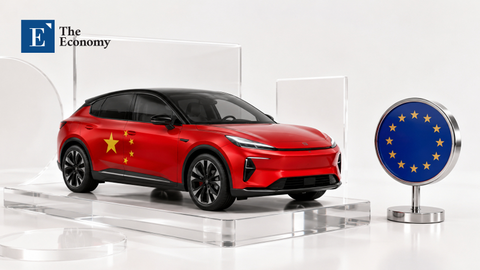
Sales channels in Western markets are also gradually expanding. Last month, the Canadian government, under a trade agreement with China, reduced tariffs on Chinese EVs from 100% to 6.1% and permitted annual imports of up to 49,000 Chinese electric vehicles. In the same month, the European Union agreed to replace high tariffs on Chinese EVs with price undertakings. Under such arrangements, exporters commit to maintaining prices above a specified threshold in exchange for avoiding countervailing or anti-dumping duties.
Individual firms are pursuing increasingly assertive export strategies. BYD, a central player in China’s EV market, has secured its own fleet of vessels to ship finished vehicles overseas. Its largest carrier, the “BYD Shenzhen,” can transport up to 9,200 vehicles per voyage, while six additional export vessels each have a capacity of approximately 7,000 units. Leveraging this fleet, BYD has focused on South American markets such as Brazil and Argentina. Of the approximately 79,400 electric vehicles sold in Brazil last year, 72% were BYD models.
Proliferation of Tactical Price-Cutting Measures
A range of survival strategies is also emerging within the domestic market. Tesla China last month introduced the industry’s first seven-year installment loan product, extending beyond the previous five-year maximum common in China’s auto sector. The annual interest rate was set at 1.36%, roughly half the typical consumer loan rate of 3%. Under this program, consumers can purchase Shanghai-produced Model 3 or Model Y vehicles for less than 2,000 per month with a down payment of 11,000. As Tesla moves to capture demand with aggressive financing terms, Chinese premium EV makers have swiftly adopted comparable strategies. Xiaomi’s SU7 sedan is currently available with a seven-year installment plan at an annual interest rate of 1%.
Automakers have also engaged in de facto price reductions by lowering factory prices below production cost or bundling high-end options as standard features—practices widely referred to in the market as “option manipulation.” In response, Chinese authorities on Feb. 11 issued pricing compliance guidelines for the automotive industry, effective immediately the following day, aiming to rein in intensifying price competition. The guidelines comprehensively regulate pricing practices from production through sales and promotional activities, applying to automakers, parts suppliers, authorized dealers, and platform operators.
The government explicitly warned that such option-related practices entail significant legal risks. It further stipulated that if options initially provided free of charge at the time of vehicle purchase are converted to paid features after a certain period, the applicable duration and pricing standards must be publicly disclosed and clearly communicated to consumers. At the sales stage, prohibited practices include charging additional fees beyond the listed price based on color, origin, specifications, brand, or other attributes; false discount or subsidy representations; and bait-and-switch advertising featuring artificially low prices. Authorities also cautioned that vehicles marketed under promotions such as “inventory clearance” or “limited-time price reductions” must not be sold at prices exceeding the lowest transaction price recorded within seven days prior to the launch of the promotion.
Aoife Brennan is a contributing writer for The Economy, with a focus on education, youth, and societal change. Based in Limerick, she holds a degree in political communication from Queen’s University Belfast. Aoife’s work draws connections between cultural narratives and public discourse in Europe and Asia.
Similar Post