China Accelerates ‘Polar Silk Road’ With Nuclear Icebreaker, Stakes Claim to Logistics, Resources and Strategic Footholds as Arctic Cold War Intensifies

Authored On
Modified
Nuclear Icebreaker Capable of Cutting Through 2.5-Meter Ice
Arctic Pipeline as Hedge Against Western Maritime Blockade
Latecomer United States Enters Arctic Route Rivalry
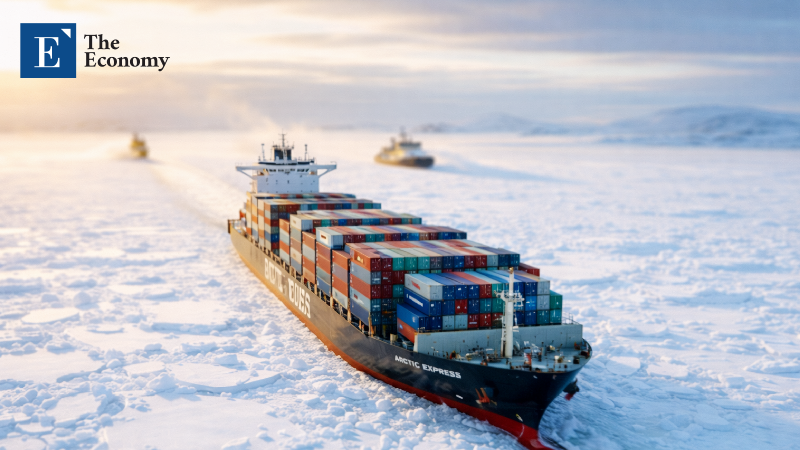
China is accelerating its “Polar Silk Road” strategy, spearheaded by a nuclear-powered icebreaker. While Beijing publicly frames the initiative as a logistics breakthrough, mounting analysis suggests it constitutes a long-term strategic gambit intertwined with military and energy security objectives. The move coincides with escalating tensions in the Arctic following President Donald Trump’s assertion of control over Greenland, positioning the region as a new flashpoint in global geopolitics.
Launch of ‘Arctic Express’ With Russia
According to the Financial Times on the 12th (local time), China has unveiled the design of a next-generation nuclear-powered icebreaker capable of cutting through 2.5 meters of ice, underscoring its ambitions in the Arctic. The vessel, designed by the 708 Research Institute under the state-owned China Shipbuilding Industry Corporation, is intended as the prototype for China’s future Arctic fleet. Although the institute describes it as a “multi-purpose” ship for cargo transport and tourism, experts widely regard it as a strategic asset.
The shipyard responsible for constructing the icebreaker operates under China State Shipbuilding Corporation, which also built China’s third aircraft carrier, the Fujian, commissioned last month. Icebreakers are indispensable assets for opening frozen sea lanes, facilitating the movement of nuclear submarines and naval vessels. Helena Legarda, lead analyst at the Berlin-based Mercator Institute for China Studies, stated, “China views the Arctic as a critical new frontier in its strategic competition with the United States and the West,” adding that Beijing’s intent to expand its influence and footprint is unmistakable.
China initiated development of a nuclear-powered icebreaker in 2018. Its Arctic ambitions date back to the 1990s, when it entered polar exploration. In late 1993, Beijing acquired the Ukrainian-built icebreaker Xue Long and began operating it the following year. Originally a cargo vessel, Xue Long was retrofitted and has served as a scientific research and supply ship since 2007. It is powered by conventional diesel engines.
Particularly noteworthy is China’s deepening cooperation with Russia, which has strengthened ties with Beijing in response to mounting pressure from Washington. In 2017, President Xi Jinping and President Vladimir Putin announced joint construction of an “Ice Silk Road.” The initiative envisions establishing a maritime logistics corridor linking China and Europe via Arctic routes, thereby extending Beijing’s Belt and Road Initiative into the polar region. In January 2018, China formally codified the concept in its Arctic policy white paper.
Russia began developing nuclear-powered icebreakers during the Soviet era to advance Arctic development. It currently operates eight such vessels in the Arctic Ocean and along the Northern Sea Route. Moscow plans to expand its fleet to at least 11 nuclear-powered ships by 2030, including the Rossiya, projected to be the world’s largest. Military expert Zhou Chenming noted that the nuclear icebreaker project is bolstered by joint Sino-Russian development of the Northern Sea Route, adding that the key question remains the extent to which Russia will transfer reactor technology to China and whether that will satisfy Beijing’s expectations.
Twenty Days to Europe, Nuclear Icebreaking Silk Road
Logistics innovation stands as the primary driver of China’s Arctic focus. At present, the main shipping lanes from China to Europe traverse waters controlled by NATO member states or pass through the Suez Canal, a corridor exposed to geopolitical instability. By contrast, the Northern Sea Route through Russian territorial waters significantly shortens transit distances.
In September last year, the container ship Istanbul Bridge departed Ningbo Port in Zhejiang Province and arrived at the UK’s Port of Felixstowe in 20 days via the Arctic route. The Suez Canal route typically requires 40 days, while the Cape of Good Hope route takes around 50 days, underscoring a reduction of more than half. Shorter routes dramatically cut fuel consumption and carbon emissions, while reducing shipping times and logistics costs, thereby enhancing the price competitiveness of Chinese exports.
The Arctic route also holds strategic military value. Naval vessels or aircraft carriers traversing the Northern Sea Route could shift between the Atlantic and Pacific in significantly reduced time. China’s Arctic push aligns with a broader strategy to preempt Western maritime blockades and safeguard energy security. More than 70 percent of China’s crude oil imports transit the Strait of Malacca, a chokepoint vulnerable to disruption by the United States. In response, Beijing is prioritizing the Northern Sea Route and overland pipelines linking Russia and Central Asia.
According to the latest report from the International Energy Agency, China has completed the Power of Siberia project, enabling annual gas imports of 38 billion cubic meters from Russia, while simultaneously securing supply chains for critical minerals such as lithium and cobalt in South America and Africa. Analysts assess that China’s strategy has evolved beyond quantitative expansion toward an “energy sovereignty” contest aimed at influencing the pace of the West’s energy transition. An IEA official stated, “China’s strategy centers on ensuring supply chain continuity under any circumstances,” adding that the Polar Silk Road represents the final piece in consolidating a vast resource stronghold.
Trump Enters the Arctic Contest
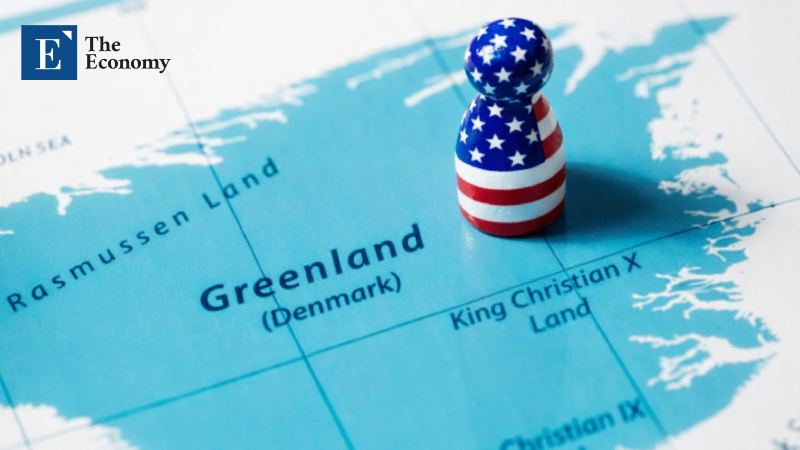
President Trump’s overt interest in Greenland is closely linked to these developments. On the 7th of last month, Trump formally declared the acquisition of Greenland, an autonomous territory of Denmark, a key U.S. foreign policy objective. What had once been dismissed during his first term as a negotiating tactic or real estate-style brinkmanship has evolved into a proposal intertwined with concrete security, military, and resource considerations, emerging as a destabilizing factor within the Atlantic alliance.
Washington’s determination to secure Greenland, despite allied resistance, reflects intensifying great-power competition and a strategic realignment in the Arctic. On the 4th, Trump stated that “Greenland is essential to national security,” warning that Russian and Chinese vessels are increasingly active in surrounding waters. The so-called GIUK gap—linking Greenland, Iceland, and the United Kingdom—constitutes a critical maritime chokepoint for Russia’s Northern Fleet nuclear submarines seeking access to the Atlantic. Control over this corridor would enable the United States to constrain Russian naval deployment. The U.S. military already operates missile early-warning radar systems at the Pituffik Space Base in northwestern Greenland.
The United States is also pursuing construction of nuclear-powered icebreakers. At present, it possesses only two icebreakers. The medium-class Healy is inoperable following a fire, while the more than 50-year-old Polar Star is frequently sidelined for repairs in dry dock. Operational capability is effectively negligible. Washington aims to secure eight to nine icebreakers. In July last year, Canada and Finland signed the ICE Pact to support U.S. construction efforts. In December, the U.S. Coast Guard and Navy commenced building a 23,000-ton Polar Security Cutter.
Similar Post