Myron of the Fed: “Resurgent U.S.-China Uncertainty Makes Rate Cuts More Urgent,” Powell Signals Possible End to Quantitative Tightening

Siobhán Delaney is a Dublin-based writer for The Economy, focusing on culture, education, and international affairs. With a background in media and communication from University College Dublin, she contributes to cross-regional coverage and translation-based commentary. Her work emphasizes clarity and balance, especially in contexts shaped by cultural difference and policy translation.
Authored On
Modified
Growing Rate-Cut Pressure Amid U.S.-China Trade Tensions
IMF Identifies ‘Trade Uncertainty’ as a Key Downside Risk
Powell Hints at Policy Shift Toward Ending Quantitative Tightening
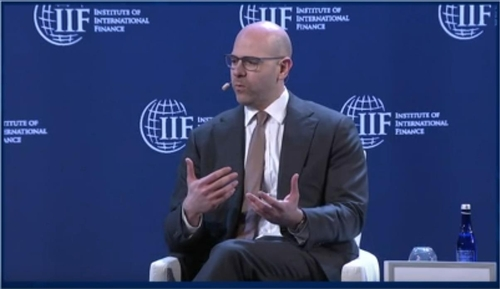
Stephen Myron, a member of the U.S. Federal Reserve Board and a close ally of President Donald Trump, has called for a rapid interest rate cut, citing the escalating U.S.-China trade conflict. With signs of tightening fatigue emerging within the Fed, Chairman Jerome Powell also suggested the possibility of ending quantitative tightening (QT), signaling a shift in the central bank’s liquidity management stance. As the trade dispute deepens, curbing trade volume and intensifying cost pressures through supply chain realignments, the U.S. economy faces increasing downside risks—prompting a more reactive monetary policy response.
Myron Warns: “Shocks Hit Harder Under Tight Conditions”
According to Bloomberg on the 16th (local time), Myron said in a speech at CNBC’s Invest in America Forum in Washington, D.C., that “the recent stalemate in U.S.-China trade negotiations has introduced a new threat to the economic outlook, making the need for rate cuts even more urgent.”
“I had been relatively optimistic about certain aspects of growth because I believed uncertainty had subsided,” he said, “but that uncertainty has returned now that China has reneged on an agreement already signed.” He added, “From a policymaker’s standpoint, we must recognize the emergence of a new tail risk.” A “tail risk” refers to an event with a very low probability but potentially severe consequences.
“The current stance of monetary policy is quite restrictive, and when a shock hits under these conditions, the economy reacts much more sharply than it would in a looser environment,” Myron emphasized. “We should move back to a neutral position as quickly as possible.”
Myron had previously argued for a rate cut of 1.25 percentage points this year—down to the 2.75–3.0% range—following the September Federal Open Market Committee (FOMC) meeting, according to the dot plot. His latest comments suggest an even more aggressive reduction is warranted. Market expectations align with this view: according to the CME FedWatch tool, the probability of a 0.25 percentage point cut at this month’s FOMC stands at 97.8%, with an 83.2% chance of another cut in December.
Powell Hints at Ending Quantitative Tightening “Within Months”
Chairman Powell has also hinted that the Fed’s ongoing balance-sheet reduction program—quantitative tightening—could conclude within the next few months. QT involves selling off or letting maturing securities roll off the Fed’s balance sheet, thereby withdrawing liquidity from the financial system. It is the opposite of quantitative easing (QE), in which the Fed buys securities to inject liquidity.
In a speech at the National Association for Business Economics (NABE) conference in Philadelphia on the 14th, Powell said, “We plan to stop balance-sheet reduction once we judge that reserves in the banking system are ample,” adding, “That point could come within the next few months.”
The Fed began QT in June 2022 to reduce its balance sheet, which had swelled during the pandemic-era money expansion. The total assets, which once peaked at $9 trillion, have since declined to about $6.6 trillion.
“Liquidity conditions have shown signs of tightening,” Powell said, “and reducing reserves further could impede growth.” However, he drew a line at returning to pre-pandemic levels of around $4 trillion. Powell refrained from commenting on the outlook for the benchmark rate. The Fed lowered its policy rate by 0.25 percentage points last month to a range of 4.0–4.25% and is expected to decide on further cuts at the upcoming FOMC meeting on October 28–29.

Trump’s Tariffs Deepen Global ‘Low-Growth Trap’
As Myron’s remarks suggest, the trajectory of U.S.-China trade tensions has become a decisive external variable shaping the course of the U.S. economy. Intensifying tariff disputes are simultaneously curbing trade, disrupting supply chains, and raising corporate costs, thereby constraining aggregate demand and exerting downward pressure on real growth.
The impact extends far beyond the U.S. economy. As the trade conflict reshapes global commerce, its ripple effects—reduced exports and weaker investment in emerging economies—could lead to a synchronized global slowdown. In particular, the Trump administration’s tariff policy is emerging as a key factor that could weigh heavily on the world economy. The re-escalation of tariff hostilities not only threatens global growth but also risks entrenching economies in prolonged stagnation.
The International Monetary Fund (IMF) recently cited “trade uncertainty” as a principal downside risk in its latest global growth forecast, warning that the world economy remains skewed toward negative risks. With signs of renewed U.S.-China friction, the IMF cautioned that mounting uncertainty in global trade could trap the world economy in a low-growth equilibrium.
Siobhán Delaney is a Dublin-based writer for The Economy, focusing on culture, education, and international affairs. With a background in media and communication from University College Dublin, she contributes to cross-regional coverage and translation-based commentary. Her work emphasizes clarity and balance, especially in contexts shaped by cultural difference and policy translation.
Similar Post