Global Alarm Grows Over China’s Property Slump as Stimulus Fades and Outlook Dims

As one of the youngest members of the team, Tyler Hansbrough is a rising star in financial journalism. His fresh perspective and analytical approach bring a modern edge to business reporting. Whether he’s covering stock market trends or dissecting corporate earnings, his sharp insights resonate with the new generation of investors.
Authored On
Modified
S&P: “China’s Homebuyer Sentiment Remains Fragile as Policy Support Loses Momentum”
Housing Prices Keep Sliding, With Even New Builds Losing Steam
Local Governments Roll Out Stimulus Measures, but Impact Remains Unclear
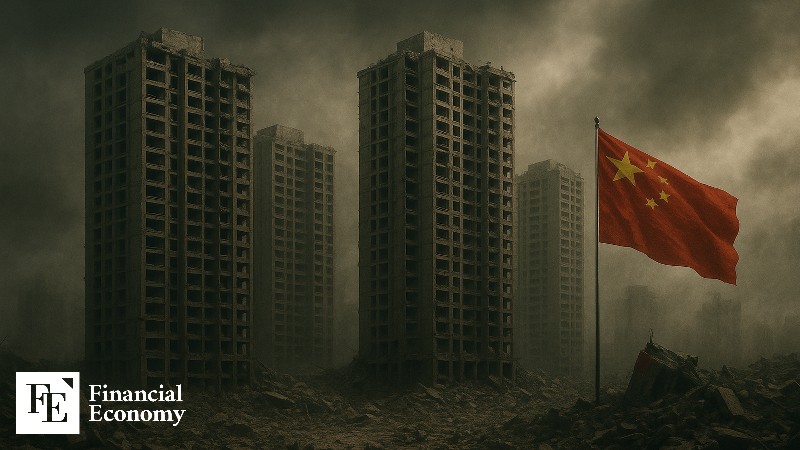
China’s property market downturn has worsened far more sharply than expected this year. As government stimulus measures lose momentum and home prices continue to slide, analysts warn that a recovery in housing stability may take even longer than previously anticipated.
China’s New Home Sales Expected to Drop Sharply
According to industry sources on October 17, S&P Global Ratings projected in its latest report that China’s new home sales will fall by 8 percent this year to around 8.8 to 9 trillion yuan (about 1.26 to 1.29 trillion dollars), more than double the 3 percent decline forecast made in May.
Edward Chan, director of corporate ratings at S&P, told CNBC that “homebuyer sentiment remains fragile,” emphasizing that “the government needs to continue supporting the market and revive demand to restore confidence.” He added that while Beijing pledged last September to stabilize the property market, the political momentum behind those efforts has weakened significantly this year.
S&P’s data shows that China’s five-year loan prime rate (LPR) has been cut by only 10 basis points (0.1 percent) so far this year — a stark slowdown compared with last year’s 60-basis-point reduction. Although authorities have eased home purchase restrictions in three major cities, including Shanghai and Shenzhen, S&P noted that the policy mainly applied to low-cost housing in suburban areas, limiting its real impact on demand. Chan added, “If demand first stabilizes in top-tier cities such as Beijing and Shanghai, the broader market recovery will be more sustainable.”
Pessimistic Outlooks Mount Across the Market
S&P is not the only institution sounding alarms over China’s property sector. According to Bloomberg, John Lam, head of China and property research at UBS, said in August that “sales momentum among Chinese developers has slowed in recent months,” warning that if this trend continues, the recovery of the housing market will take longer than expected. He added that without additional government stimulus, price stabilization may be delayed until the second half of 2026.
Such growing pessimism stems from the continued deterioration of key real estate indicators. Data from the China Index Academy, a private property research firm, showed that as of September, the average price of existing homes across China’s 100 largest cities fell to 13,381 yuan per square meter (about 1,830 dollars), down 0.74 percent from the previous month and 7.38 percent from a year earlier. The cumulative decline for the third quarter reached 2.26 percent — widening by 0.14 percentage points from the second quarter — while the total drop for the first nine months of this year hit 5.79 percent.
New home prices in the same 100 cities edged up slightly in September, rising 0.09 percent month-on-month and 2.68 percent year-on-year, supported by stronger supply from high-quality projects in major markets during the traditional “Golden Sales Season.” However, quarterly data indicated that new home prices gained only 0.47 percent in the third quarter, a slowdown of 0.17 percentage points from the previous quarter. From January to September, new home prices rose just 1.63 percent in total — underscoring the limited impact of existing policy support.
Local Governments Roll Out Stimulus Measures, but Impact Remains Unclear
As China’s property slump drags on, local governments across the country are introducing a wave of support measures in hopes of reviving the market. Earlier this month, Beijing lifted purchase restrictions for homes in suburban areas, eased requirements for housing provident funds — a long-term savings program jointly funded by employers and employees for home purchases — and reduced down payment ratios to lower buyers’ costs. In late September, the city of Changchun announced that individuals who make lump-sum purchases of newly built homes in designated areas during the month would receive consumption vouchers worth 15,000 yuan (about 2,100 dollars) per home. Meanwhile, provinces such as Liaoning and Hunan, as well as Chongqing municipality, are promoting large-scale housing expos and other local events to encourage private homebuying.
However, it remains uncertain whether these regional measures can reverse the deepening slump in property transactions. One market analyst noted that “China’s real estate sector is facing the consequences of years of instability — with developer defaults, sluggish sales, and rising vacancy rates pushing the market to the brink.” The analyst added that “stronger, more coordinated action will be needed to achieve a real recovery,” pointing out that “the central government has shifted its focus from property financing to industrial production. Given the persistent deflationary pressures and previous asset bubbles, the downward trend in China’s housing market is likely to continue for some time.”
As one of the youngest members of the team, Tyler Hansbrough is a rising star in financial journalism. His fresh perspective and analytical approach bring a modern edge to business reporting. Whether he’s covering stock market trends or dissecting corporate earnings, his sharp insights resonate with the new generation of investors.
Similar Post