NVIDIA’s Market Share in China Falls to 0% amid U.S. Semiconductor Sanctions, Losing the World’s Largest Market

Authored On
Modified
U.S. export restrictions on semiconductors to China since 2022
China accelerates AI and semiconductor self-sufficiency, narrowing the gap with the U.S.
NVIDIA partners with Intel to develop integrated CPU–GPU models

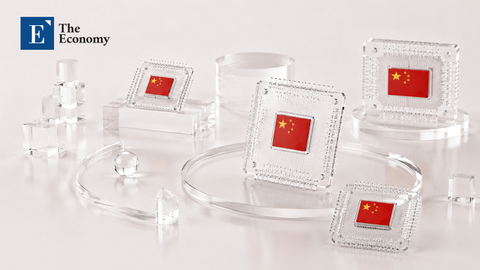
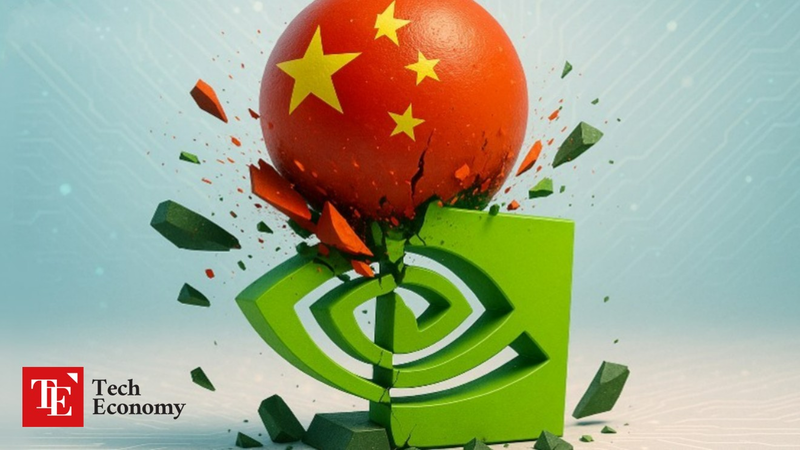
NVIDIA’s foothold in China’s artificial intelligence (AI) semiconductor market is rapidly eroding. As U.S. export restrictions on semiconductors to China—imposed since 2022—accelerate Beijing’s push for technological self-sufficiency, NVIDIA’s market share in China has plunged from 95% to 0%. Effectively withdrawing from the world’s largest market, NVIDIA is now signaling a new phase in the global tech power race, seeking to navigate the crisis through equity investments and collaboration with Intel.
Jensen Huang: “We have effectively withdrawn completely from China.”
According to IT outlet Tom’s Hardware on the 19th (local time), NVIDIA CEO Jensen Huang stated during Citadel Securities’ Future of Global Market 2025 event in New York on the 6th that “we are now 100% withdrawn from the Chinese market,” adding, “our share in China’s advanced semiconductor sector has dropped from 95% to 0%.” In fiscal year 2024, NVIDIA’s revenue from China totaled $10.3 billion, accounting for 17% of its total sales. However, the company is estimated to have lost $10.5 billion in revenue from China in just the first half of this year.
The U.S. government has restricted exports of NVIDIA’s high-performance AI chips—such as the A100 and H100—to China since 2022. Although exports of lower-performance models like the H20, specifically designed for the Chinese market, were allowed in July, Chinese regulators have countered by advising domestic firms not to use NVIDIA chips, citing security concerns. Huang has consistently criticized Washington’s sanctions, arguing that “U.S. restrictions only accelerate China’s technological independence.” He reiterated that stance, saying, “We have completely lost access to the world’s largest market,” and added, “No policymaker would view this outcome as a good thing.”
China’s Generative AI Users Double in One Year
China’s rapid advance toward technological self-sufficiency is evident across the board. According to the AI Index 2025 released in April by Stanford University’s Human-Centered Artificial Intelligence (HAI) Institute, China has made significant strides in every domain—from AI model performance to research and development (R&D), investment, and national strategy.
On LMSYS Chatbot Arena, a platform evaluating large language model (LLM) performance in dialogue scenarios, the performance gap between U.S. and Chinese AI models narrowed dramatically—from 9.3 percentage points (ppts) in January 2024 to 1.7 ppts in February. In specific domains such as language understanding (MMLU), multimodal comprehension (MMMU), mathematical reasoning (MATH), and coding (HumanEval), the U.S.–China performance gap also shrank sharply—from 17.5–31.6 ppts in 2023 to just 0.3–3.7 ppts in 2024.
In patent filings, China has already surpassed the U.S., propelled by massive state-backed funding and speed-driven initiatives. Global AI patents surged from 3,833 in 2010 to 122,511 in 2023, with China accounting for 69.7% of them. The country also overtook the U.S. in AI research talent. According to U.S.-based digital economy think tank MacroPolo, as of 2022, 28% of the world’s top 2% of elite AI researchers were American, while 26% were Chinese. However, among the top 20% of “high-tier” researchers, Chinese nationals made up 38%, surpassing Americans at 37%.
China’s AI education pipeline has also expanded dramatically—from 1,232 graduates across 35 universities in 2018 to 43,333 graduates from 535 universities in 2024.
Amid this surge, the number of generative AI users in China has exploded. According to the Generative AI Application Development Report by the China Internet Network Information Center (CNNIC), as of the end of June this year, the number of generative AI users reached 515 million—up 106.6% from the end of last year. The adoption rate stood at 36.5%, with users under 40 accounting for 74.6% and college graduates or higher representing 37.5%. As of late August, there were 538 registered generative AI services and 263 related applications in China, covering areas such as search, content creation, and office productivity, with growing use in agriculture, industrial manufacturing, and scientific research.
China’s rise to near parity with the U.S. has taken less than a decade. Since President Xi Jinping proclaimed the “Digital China Initiative” at the Second World Internet Conference in 2015, Beijing has continuously expanded policies covering the internet, big data, information technology, and AI. In 2023, the National Data Administration (NDA)—a new central body overseeing the nation’s digital policy—was established. The NDA now leads initiatives such as the “East Data, West Computing” project to expand AI computing infrastructure, policies for digital talent development, and the cultivation of a domestic data market. In August this year, the government unveiled a Digital Strategy Master Plan incorporating the “AI Plus” initiative, which focuses on advancing AI applications and building high-quality datasets.
U.S.–China Tech Rivalry Enters a New Phase
As China’s AI ambitions accelerate and NVIDIA’s position weakens, the company has turned to collaboration with U.S. peer Intel. According to investment media Motley Fool, NVIDIA recently decided to invest $5 billion in Intel. The report noted that “the partnership is a strategic alliance encompassing both AI and central processing unit (CPU) technologies, going beyond a simple capital tie-up,” and added, “NVIDIA’s investment in Intel could significantly strengthen its leadership in the AI and data center markets.”
Under the partnership, NVIDIA—renowned for its strength in graphics processing units (GPUs) for AI computing—plans to integrate Intel’s CPU technology into its platform. Conversely, Intel will equip its PC systems with NVIDIA’s GPU chips. This reciprocal integration is expected to launch a new “CPU–GPU convergence model” spanning the full AI ecosystem—from data centers to personal computing. Industry analysts predict that the alliance will exert considerable pressure on competitors such as AMD and Broadcom.
The partnership also signals potential shifts in the semiconductor supply chain. Until now, NVIDIA has relied primarily on Taiwan’s TSMC for its foundry (contract manufacturing) operations. However, an expanded collaboration with Intel will likely necessitate diversification of production channels. This could intensify competition not only for TSMC but also for Samsung Electronics’ foundry business.
With China’s technological self-reliance accelerating and governments worldwide classifying AI semiconductors as strategic national assets, the NVIDIA–Intel alliance may mark the beginning of a new phase in the global race for technological supremacy.
Similar Post