Trump Approves South Korea’s Nuclear Submarine Program, Signaling Expanded Role in Countering China

Authored On
Modified
China-Sanctioned Philly Shipyard Specifically Named
Sharing “Top Secret” Technology Never Granted to the U.K.
Reflects Washington’s Determination to Confront Beijing Head-On

U.S. President Donald Trump has approved South Korea’s acquisition of nuclear-powered submarines, just one day after President Lee Jae-myung formally requested Washington’s authorization during the bilateral summit. The decision marks a historic policy shift: the United States has agreed to transfer submarine nuclear propulsion technology that it has never before shared—not even with its closest ally, the United Kingdom. Analysts view this as a manifestation of Washington’s intent to confront Beijing’s maritime dominance head-on, leveraging the U.S.–Korea alliance as a strategic linchpin in the Indo-Pacific.
Trump: “Korean Nuclear Submarines to Be Built at Philly Shipyard”
On October 30, Trump wrote on Truth Social, “The Korea-U.S. military alliance has never been stronger. I have approved South Korea to build nuclear-powered submarines to replace its outdated diesel fleet.” Building such submarines requires U.S. technical assistance, nuclear fuel supply, and amendments to the bilateral nuclear cooperation agreement—making Trump’s statement a clear policy commitment that Washington will back these steps institutionally.
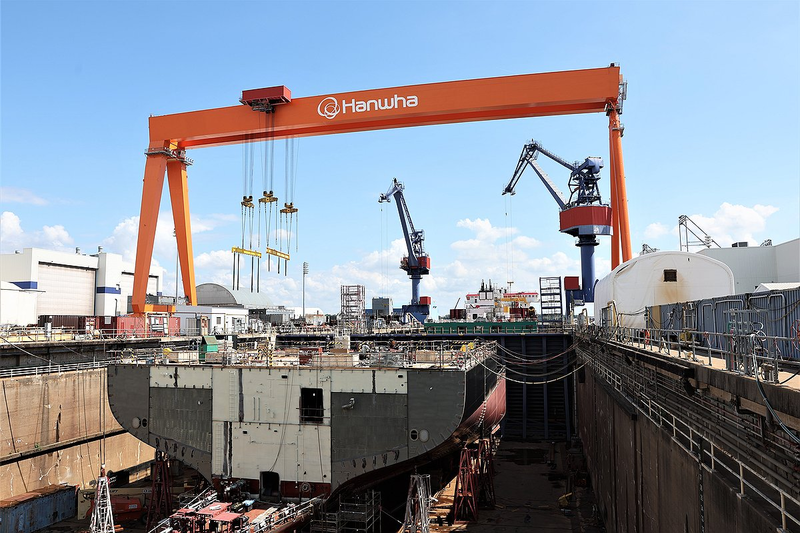
He added, “America’s Philadelphia Shipyard will play an important role in South Korea’s nuclear submarine construction. The U.S. shipbuilding industry is headed for a big comeback.” Though Trump did not explicitly confirm that the submarines would be built at the site, his deliberate mention of the facility—symbolic of U.S.–Korea shipbuilding cooperation—was seen as a strong signal of intent. The Philadelphia Shipyard, acquired last year by South Korea’s Hanwha Group, is a central pillar of the “Make American Shipbuilding Great Again (MASGA)” initiative. Hanwha announced an additional $5 billion investment there in August.
Trump’s remarks came just one day after President Lee appealed for Washington’s decision to supply reactor fuel for the submarines. Lee had argued that “diesel-electric submarines have limited underwater endurance, making them insufficient for tracking North Korean and Chinese submarines,” adding that “with fuel supply approval, South Korea could build conventionally armed, nuclear-propelled submarines using domestic technology, bolstering defense of the peninsula.”
A Long-Deferred National Aspiration
Developing nuclear-powered submarines has been a 30-year ambition for both the South Korean government and its shipbuilding industry. Such vessels can remain submerged for extended periods, minimizing detection risk while delivering sustained power from nuclear propulsion. Yet the program has long been stymied by the U.S., as acquiring mini-reactors and enriched uranium fuel requires Washington’s consent. Although the 2015 revision of the U.S.–Korea Atomic Energy Agreement permits enrichment below 20%, each case still needs individual approval—none of which have ever been granted.
For decades, Washington viewed nuclear propulsion as unnecessary given Korea’s operational environment. Bryan Clark, a former U.S. Navy submariner and senior fellow at the Center for Strategic and Budgetary Assessments (CSBA), noted that the narrow and shallow waters surrounding the Korean Peninsula favor diesel-electric submarines, which are quieter, cost-effective, and well-suited for short-range coastal defense. Modern diesel submarines, powered by batteries while submerged, produce minimal noise and are difficult to detect—ideal for Korea’s littoral strategy.
Cost has also been a formidable barrier. Nuclear submarines, equipped with advanced reactor systems and sophisticated hull designs, are among the most expensive military assets. Each unit costs more than three times that of diesel counterparts—over $3 billion compared to about $1 billion. In the U.S., construction can exceed $5 billion per vessel. By contrast, France’s Scorpène-class diesel submarine costs roughly $300–500 million. U.S. naval analyst Eric Wartime emphasized, “If South Korea has no need for long-endurance blue-water operations, nuclear submarines are an inefficient investment; diesel models offer superior stealth and endurance for regional missions.”
Strategic Countermeasure to China
Nonetheless, Seoul has concluded that the nuclear option can no longer be deferred. North Korea’s development of submarine-launched ballistic missiles (SLBMs) poses a growing threat, with launches that are virtually undetectable before impact. Nuclear propulsion would allow South Korean submarines to remain submerged for months, conducting continuous surveillance and preemptive tracking of enemy activity.
The 3,600-ton “Jang Young-sil,” launched last week, is South Korea’s most advanced diesel submarine, yet its maximum submersion duration is just three weeks. A nuclear-powered alternative would dramatically alter the nation’s maritime posture—enabling long-range, long-duration missions and serving as a true game-changer in undersea deterrence. It would strengthen reconnaissance, anti-submarine warfare, and strike capabilities across both regional and deep-sea theaters, reinforcing South Korea’s strategic deterrence against Pyongyang.
Trump’s decision to release one of America’s most sensitive and tightly controlled technologies—nuclear submarine propulsion—underscores Washington’s intent to bolster allied deterrence against China and North Korea alike. Beijing already operates nuclear submarines, and Pyongyang announced in March that it had begun building one of its own. Moreover, China recently sanctioned Hanwha Ocean’s U.S. subsidiaries, including the Philadelphia Shipyard, placing them on a trade blacklist—a move widely seen as retaliation against deepening U.S.–Korea defense-industrial cooperation.
Experts say Trump’s rapid authorization could mark a milestone in modernizing the alliance. They note that the move not only elevates the strategic standing of the U.S.–Korea partnership but also signals Washington’s expectation that Seoul will assume a greater regional role—particularly in supporting the Indo-Pacific containment of China under the banner of an “alliance modernization” framework.
Similar Post