‘China Resembling Japan’s “Lost 30 Years” as Long-Term Slump Warnings Intensify’

Authored On
Modified
China–Japan Government Bond Yield Gap Nearing First-Ever Inversion
China’s Production, Consumption, and Investment in Retreat
Stimulus Measures Failing to Restore Momentum
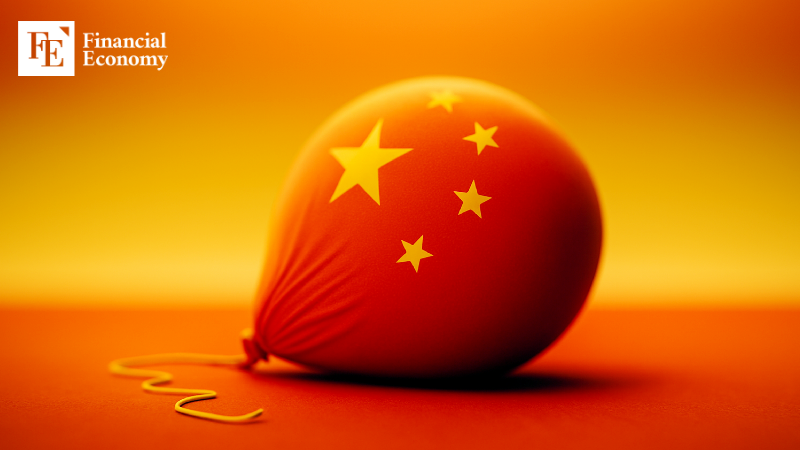
The yield spread between Chinese and Japanese government bonds has narrowed to an unprecedented level. Japan is attempting to exit the prolonged deflationary era known as its “Lost 30 Years” following the collapse of its real estate bubble, while China is entering a downturn marked by a property slump, weak domestic demand, and slowing exports—mirroring the trajectory Japan once faced. Investors are effectively betting that the world’s second-largest economy is repeating Japan’s past mistakes.
China–Japan 10-Year Yield Spread at Record Lows
According to Bloomberg on the 19th (local time), China’s 10-year government bond yield is currently trading around 1.81%. In contrast, Japan’s 10-year JGB yield stands at roughly 1.77%, leaving a gap of just 0.04 percentage points—an all-time low. China’s 10-year yield has remained near its trough for more than two months as investors shifted capital into safer government securities amid disappointing economic indicators such as slowing GDP growth. Conversely, Japanese yields have climbed to their highest levels since 2008 amid concerns that the government’s aggressive fiscal expansion will stoke inflation and increase the burden of national debt.
Japan’s bond market continued to weaken on the 19th. The Financial Times (FT) reported that the 10-year JGB yield hit 1.765%, the highest since June 2008 at the onset of the global financial crisis. The 40-year yield surged to a record 3.695%, while demand was weak in the latest 20-year bond auction. Expectations that Prime Minister Sanae Takaichi will unveil a massive stimulus package this week amplified volatility across the Japanese bond market. The government is reportedly reviewing a supplementary budget worth USD 119.0 billion to fund economic stimulus and household support.
This has fueled speculation that China–Japan yields may invert for the first time in history. Miki Den, chief rates strategist at SMBC Nikko Securities, said, “Fundamentals clearly point to rising yields in Japan and falling yields in China,” adding, “Japan’s 10-year yield is likely to surpass China’s, triggering greater capital flows from China to Japan.”
The plunge in China’s long-term bond yields symbolically reflects the country’s medium- to long-term growth deterioration. Analysts widely interpret China’s 10-year yields falling to—or below—Japan’s level, despite China being at a much earlier stage of its economic maturity, as an alarm bell for China’s future prospects. In capital markets, pessimism is mounting that China’s entrenched deflation cannot be resolved through fiscal or monetary easing alone.
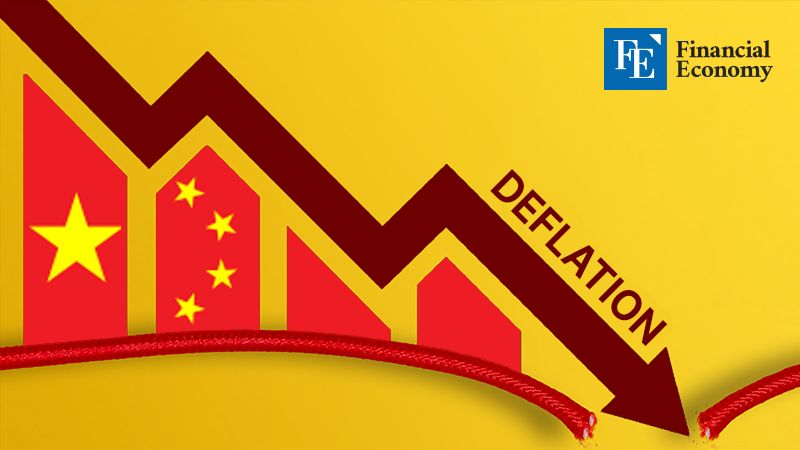
Economic Indicators Cratering, Recovery Prospects Remote
China’s economy is effectively trapped in a prolonged tunnel of stagnation. Despite pouring money into advanced technology sectors such as artificial intelligence (AI) and robotics, domestic demand shows no signs of recovery, with the Producer Price Index (PPI) remaining in negative territory for dozens of consecutive months. According to China’s National Bureau of Statistics, the October PPI fell 2.1% year-on-year and has stayed negative for 37 straight months since October 2022.
Retail sales—China’s key barometer of domestic demand—also remain weak. Retail sales grew just 2.9% last month, the lowest since August 2023 (2.1%). Growth has slowed for five consecutive months since May, marking the longest deceleration since 2021 during the pandemic. With the real estate sector—accounting for 30% of China’s economic activity—stuck in a deep slump, the outlook remains bleak. Property development investment fell 14.7% year-on-year last month. New-home prices in 70 major cities declined 0.5% month-on-month and 2.2% year-on-year in October.
Deflationary pressures are severe. Bloomberg’s survey of 70 major consumer and industrial goods across 36 cities shows sharp declines across the board—from daily necessities to automobiles and property. Since 2023, prices dropped in 51 of the 67 surveyed items: home prices fell 27%, BYD electric vehicles 27%, and Great Wall wines 29%. Food staples such as eggs, beef, and potatoes fell 14–17%, while microwaves, appliances, and apparel also declined. Although official CPI remains near zero, real-world price declines are far more pronounced.
Falling prices are eroding profitability across entire industries. Bloomberg’s analysis of 6,000 listed companies found that the proportion of “zombie firms” unable to cover interest costs surged from 19% five years ago to 34% last year. Wage growth at private firms has fallen to the lowest level since records began, and salaries in the IT industry have even declined. Meanwhile, China’s export growth—its last remaining pillar—turned negative for the first time in eight months. According to China Customs, exports fell 1.1% year-on-year last month, sharply below September’s 8.3% growth and well under the 3% increase expected by Reuters.
Local governments—tasked with driving domestic stimulus—are also out of fiscal ammunition. Combined official and “shadow” debt reached USD 1.81 trillion at the end of last year, doubling in four years. Global rating agencies warn that politically driven projects and opaque local borrowing pose systemic risks. With land-sale revenues collapsing and tax income weakening, local authorities have scaled back spending on healthcare, social welfare, and infrastructure. As a result, Beijing’s efforts to stimulate domestic demand are yielding little real improvement.
USD 6.3 Trillion Sitting Idle, Untethered From the Real Economy
Despite more than six years of stimulus efforts, China’s domestic economy shows no signs of revival. In theory, lower interest rates should stimulate aggregate demand through the monetary transmission mechanism, but China is stuck in a liquidity trap—rates are too low for further easing to spur activity. Fiscal expansion is the alternative, but China’s debt burden limits maneuvering room. In highly indebted economies like China, increasing fiscal spending through special treasury bond issuance risks crowding out the private sector, worsening rather than improving growth. Analysts warn that China faces rising odds of “fiscal stagnation,” where the economy weakens even as inflation accelerates.
In this bifurcated economy—where finance and real activity diverge—liquidity injections fail to circulate. Although bank deposit rates hover around 1%, more than USD 6.3 trillion remains parked in household and corporate deposits. Including dormant cash hoarded informally, total idle liquidity may reach USD 9.7 trillion. This vast hoard of dormant capital is not feeding into real economic activity.
To mobilize this idle money, China must quickly shift from an “extensive growth” model to an “intensive growth” model that prioritizes productivity and efficiency. China has pushed its extensive growth model to its limits: the labor force is shrinking rapidly as both total population and working-age population decline, and capital investment—outside cutting-edge sectors—has hit diminishing returns.
Yet China’s capacity for intensive growth is even weaker. Labor productivity is only about half that of the United States, and capital productivity is less than 30% of U.S. levels. Total factor productivity (TFP), weighed down by corruption and aging infrastructure, has deteriorated sharply. Years of delay in transitioning to an intensive growth model have deepened China’s economic duality and structural stagnation.
Similar Post