Asia builds USD 8 trillion FX shield against renewed currency pressures

Niamh O’Sullivan is an Irish editor at The Economy, covering global policy and institutional reform. She studied sociology and European studies at Trinity College Dublin, and brings experience in translating academic and policy content for wider audiences. Her editorial work supports multilingual accessibility and contextual reporting.
Authored On
Modified
Concern over FX instability drives demand for reserves
Anxiety grows over insufficient reserve levels
Tariff pressures and FX volatility heighten market uncertainty
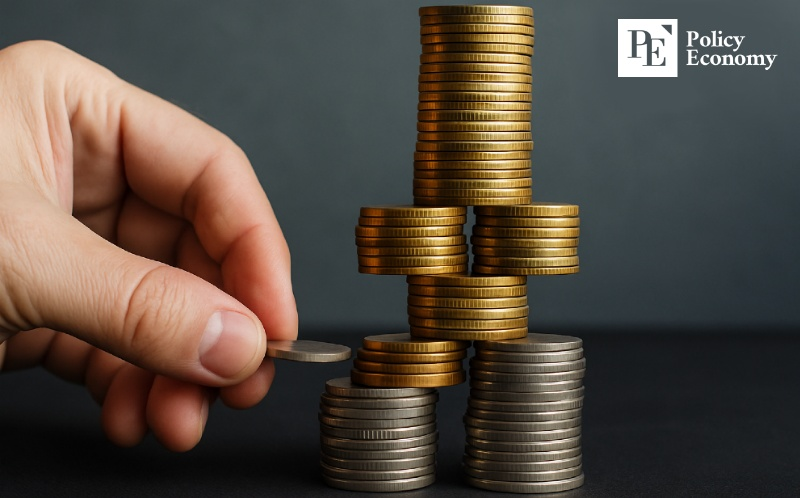
With U.S. high tariffs and mounting exchange-rate pressure destabilizing global markets, Asian economies are once again prioritizing foreign-exchange accumulation. Although expanding FX reserves can strain public finances and limit monetary-policy flexibility, central banks across the region are increasingly focused on how much additional “currency armor” they need should FX pressure escalate. FX-reserve strategy is no longer viewed as a numbers race, but as a long-term safeguard against the risk of another currency crisis.
Korea’s past FX-buffer performance revisited
According to Bloomberg on the 20th (local time), FX reserves held by 11 major Asian central banks have increased by about USD 400 billion since the beginning of the year. By country, China recorded the largest increase at USD 141 billion, followed by Japan at USD 116 billion. Korea’s reserves rose from USD 415.6 billion at the start of the year to USD 428.8 billion at the end of September, an increase of USD 13.2 billion. As a result, Asia’s combined FX holdings are now near USD 8 trillion. Bloomberg noted that the rise in non-dollar asset prices and a sharp increase in global gold prices contributed to the expansion.
Global financial conditions are also adding pressure to build buffers. Supply-chain instability and policy uncertainty at the U.S. Federal Reserve have amplified volatility in global equities, while Asian currencies face persistent depreciation pressure. In addition, the Trump administration’s decision to list exchange-rate issues as the first category of “non-tariff cheating” and to use FX disputes as a bargaining chip in trade talks has further constrained central-bank maneuvering room.
The 2022 experience is frequently cited to explain the current push for reserve accumulation. Combined FX reserves of Asian emerging economies surpassed USD 2.8 trillion in October 2021 and remained around USD 2.6 trillion in September 2022. Bloomberg at the time stated that Korea, Indonesia, and the Philippines “held up relatively well” during U.S. rate shocks and global inflation thanks to their pre-existing reserve buffers. Their currencies showed more stability than traditional safe-haven currencies such as the yen and the euro, and local bond markets stayed resilient.
The current situation differs in that several Asian currencies are weakening sharply. India’s rupee hit all-time lows in recent months, having weakened more than 3 percent this year. The Reserve Bank of India has intervened in both onshore and offshore markets to prevent the exchange rate from breaching 88.80 rupees per dollar. Korea’s won weakened about 3.2 percent in the past month, prompting authorities to raise the possibility of joint FX-hedging operations with the National Pension Service. This underscores how Asian currencies are simultaneously pressured by dollar strength, U.S. policy uncertainty, and tariff-driven risks.
Wide gaps in FX-reserves-to-GDP ratios
In Korea, the perception that the current reserve level is insufficient is now widespread domestically and internationally. With the won-dollar rate fluctuating around 1470 won and volatility rising, the won has posted the steepest decline among major global currencies this year. Given that Korea’s trade-dependence ratio is 75 percent and that the dollar accounts for 70 percent of international settlements, this FX surge is viewed as exposing structural vulnerabilities in the Korean economy. The Bank for International Settlements (BIS) estimates Korea’s adequate FX reserve level at USD 920 billion—more than twice the current stock.
International comparisons reinforce the view that Korea’s FX buffer is thin. Korea’s nominal GDP is USD 1.8697 trillion and its FX holdings USD 428.8 billion, meaning reserves equal just 22.9 percent of GDP. Taiwan, by contrast, holds USD 576.6 billion in reserves despite a GDP of only USD 782.4 billion, representing 73.7 percent. Switzerland and Hong Kong both exceed 120 percent. Such comparisons amplify the argument that Korea’s “dollar shield” remains insufficient.
The International Monetary Fund (IMF) provides another benchmark, calculating adequate reserves by summing 30 percent of short-term external debt, 15 percent of foreign securities investment, 5 percent of broad money (M2) and 5 percent of goods exports, then multiplying by 150 percent. Applying this formula to Korea’s figures at the end of last year yields USD 522 billion, or USD 815 billion if short-term debt is assumed to be twice the narrow measure. The gap between these estimates and Korea’s actual reserves below USD 430 billion underpins the ongoing debate over whether Korea needs USD 1 trillion in reserves.
This debate is also linked to fiscal and financial-stability indicators. Korea’s uncovered interest-parity (UIP) premium sensitivity stands at 2.11 percentage points, far above the emerging-market average of 1.68 percentage points. UIP premia reflect risk perceptions in areas such as FX volatility and sovereign default, meaning Korea’s foreign-funding costs rise faster than peers during global stress. The Bank of Korea has noted that this necessitates reinforcing multiple safety nets simultaneously, including fiscal soundness.
Possible “currency-devaluation race” among export-dependent economies
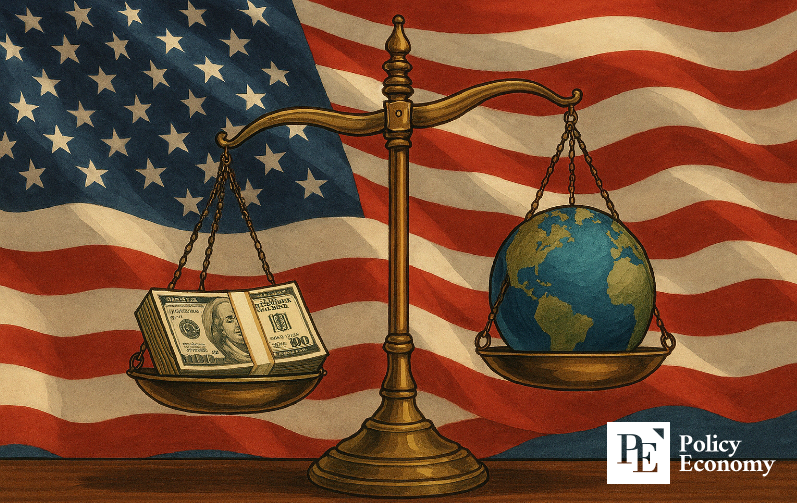
Markets are now watching whether the tariff war launched by the Trump administration could spill over into a full-scale currency war. Trump has repeatedly argued that “a weak dollar makes us much more money,” emphasizing the need for a softer dollar. His decision to nominate Stephen Myron—former chair of the White House Council of Economic Advisers during his first term—to the Federal Reserve Board is seen as an effort to infuse this view into monetary policy.
Myron’s own report adds to concerns. In a November paper titled “A User’s Guide to Reworking the Global Trading System,” he proposed imposing tariffs of up to 20 percent on all trading partners to reduce America’s trade and fiscal deficits, and adjusting major-currency values through multilateral FX agreements if tariffs lead to excessive dollar strength. His appointment to the Fed raises the odds that trade, interest-rate policy, and FX strategy will move in a coordinated direction.
Some even argue that with reciprocal tariffs already in effect, the next logical step for the U.S. is to directly target exchange rates. The Korea Capital Market Institute warned last month that “the U.S. may soon shift to a global FX-adjustment strategy using tariffs and defense-cost sharing as leverage,” and would likely pressure countries with large U.S. trade surpluses to strengthen their currencies. Such a scenario would push the won, yen, and yuan downward simultaneously, amplifying volatility across Asian financial markets.
Another scenario is a “survival-driven” devaluation race among export economies. Countries facing high U.S. tariffs have an incentive to weaken their currencies to offset price increases in the American market. For example, if a country facing a 20 percent tariff weakens its currency by 5 percent, the effective price increase in the U.S. drops to about 15 percent. But such moves would directly conflict with America’s own objective of achieving trade-balance improvement through dollar weakness, making U.S. tolerance extremely unlikely.
Niamh O’Sullivan is an Irish editor at The Economy, covering global policy and institutional reform. She studied sociology and European studies at Trinity College Dublin, and brings experience in translating academic and policy content for wider audiences. Her editorial work supports multilingual accessibility and contextual reporting.
Similar Post