‘Silent Invasion’ and China’s Grip on Europe’s Maritime Logistics Ignite Alarms Over U.S. Maritime Hegemony

Anne-Marie Nicholson is a fearless reporter covering international markets and global economic shifts. With a background in international relations, she provides a nuanced perspective on trade policies, foreign investments, and macroeconomic developments. Quick-witted and always on the move, she delivers hard-hitting stories that connect the dots in an ever-changing global economy.
Authored On
Modified
China’s Global Maritime Footholds Across Europe, Latin America, and Africa
Piraeus, the Flagship of China’s Maritime Silk Road
China’s Tightening Command of Global Maritime Logistics Spurs U.S. Pushback
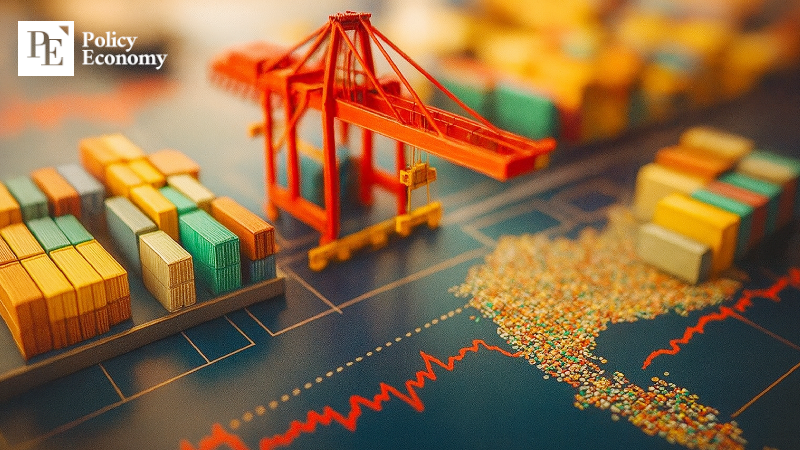
China’s consolidation of European ports is hardening into a geopolitical realignment that effectively places control nodes of Europe’s supply chains under Beijing’s reach. Using Piraeus as the initial beachhead, Chinese state-owned enterprises have fused equity stakes with operating rights to expand their footprint, binding Europe’s maritime routes ever more tightly to China’s port network. Analysts say recent U.S. moves to maintain tough regulations on Chinese shipbuilding and shipping—despite significant economic pain—reflect Washington’s growing sense of urgency to block a strategic shift of supply-chain power toward China.
Belt and Road as Europe’s Maritime Hub, Accelerating the Expansion of Influence
According to Bloomberg on the 9th (local time), Europe’s major supply chains are increasingly exposed to China’s overseas maritime expansion. China’s foreign ports now sit along key maritime corridors for Europe’s critical minerals, aligning squarely with Beijing’s Military-Civil Fusion strategy. Over the past decade, Chinese state-owned enterprises have expanded their global maritime footprint and now hold stakes in at least 78 of Africa’s 231 ports, while owning or operating 129 ports worldwide.
Of all regions, Europe stands at the center of China’s global port strategy. China’s full-scale push into European ports began nine years ago. Under Xi Jinping’s ambitious Belt and Road Initiative—China’s overland and maritime Silk Road—Beijing acquired Greece’s largest port, Piraeus, in 2016. Piraeus is a gateway to Asia, Eastern Europe, and North Africa. Backed by “China money,” Beijing has long sought to secure sea lanes and energy routes stretching from the Middle East to the South China Sea, strengthening strategic ties with littoral states along these passages. The ports of Gwadar in Pakistan, Chittagong in Bangladesh, the Bay of Bengal in Myanmar, and key locations across the South China Sea form a chain commonly described as the “String of Pearls.”
Piraeus serves as the critical bridgehead that extends this String of Pearls into Europe. The port has accelerated the entry of Chinese goods into Europe and has strengthened Beijing’s leverage through integration with Chinese shipping lines, infrastructure firms, and rail investments across Southeast Europe. After Piraeus fell under Chinese ownership, it rapidly transformed into a global logistics hub. Leveraging this success, China expanded its network to Valencia in Spain, Genoa in Italy, Zeebrugge in Belgium, Hamburg in Germany, and Rotterdam in the Netherlands. These ports occupy strategic corridors connecting Northern Europe and the Mediterranean, enabling China to process its trade flows and coordinate logistics networks across Europe.
Port Ownership in Europe, a Symbol of Economic Power
Beijing executes this entire strategy through state-owned enterprises masked as commercial players—the most prominent being COSCO. As the world’s fourth-largest shipping company and a firm tightly intertwined with the Chinese government, COSCO uses private-sector style investments to carry out national strategy. These acquisitions are not merely economic ventures; they are instruments of geopolitical influence. Seizing control of maritime logistics means controlling trade routes, increasing dependency from other nations, and securing political leverage. Ports are not just trade gateways—they are forward operating bases for national strategy.
Notably, China’s port takeovers in Europe often exploit moments of crisis. Much like Greece, where fiscal distress opened the door to Chinese capital, Beijing moves in when local operators face financial strain or seek divestment. This crisis-driven entry has been described by experts as “China’s silent port invasion.” Moreover, Europe’s highly privatized and foreign-capital-friendly port structure created ideal conditions for Chinese investments.
Europe’s ports also offer advanced infrastructure and highly sophisticated logistics systems. Whereas China uses build-and-operate models in developing nations, in Europe it simply acquires high-quality assets and boosts efficiency to expand its network. This gives China direct influence over maritime trade corridors favorable to its own cargo flows. Increasingly, Europe is viewed as the front yard of China’s port empire. European governments that once welcomed the Piraeus acquisition now widely regard it as a strategic miscalculation.
U.S. Countermeasures Against China’s Maritime Dominance, Drawing Lessons From Europe
Experts say Washington’s efforts to curb China’s maritime rise are shaped in part by lessons learned from Europe. Earlier this year, the U.S. Trade Representative (USTR) proposed regulations requiring up to USD 1 million per Chinese-operated vessel entering American ports, or up to USD 1,000 per ton of cargo capacity, and up to USD 1.5 million for Chinese-built ships depending on vessel type. In April, the U.S. finalized these entry fees for Chinese-built ships and for shipping companies using them.
These measures impose heavy economic costs on the United States. Roughly 45% of import volume at the Port of Los Angeles—the nation’s largest—is Chinese-origin cargo. The U.S. is already suffering sharp declines in throughput due to the tariff war. Even so, Washington has chosen to maintain a hard line on China’s shipbuilding and shipping industries due to escalating concerns over maritime dominance.
President Donald Trump’s “Make American Shipyards Great Again (MASGA)” campaign reflects the same urgency. According to a CSIS report titled “Mapping the Threat of China’s Dual-Use Shipyards,” China operates more than 300 shipyards and produces half of the world’s commercial vessels each year. By contrast, U.S. shipyards produced only five large commercial vessels last year, totaling just 76,000 tons. China’s state-owned CSSC alone built more than 250 ships—amounting to 14 million tons. Remarkably, the combined tonnage of all vessels built in the U.S. since World War II remains below CSSC’s single-year output. When factoring in China’s other shipyards, the scale of America’s challenge becomes overwhelming.
Washington is also alarmed by China’s ability to capture global ship orders through low labor costs and vast production capacity. U.S. officials warn that revenue from China’s commercial shipbuilding is being reinvested into naval expansion and deployed to undermine Indo-Pacific security. Allies such as Japan, France, and Germany heavily rely on Chinese-built ships. Even more striking is Taiwan: three Taiwanese shipping companies rank 7th, 10th, and 11th globally—and all depend heavily on Chinese-built vessels. CSIS notes that Taiwanese firms are “supporting China’s naval buildup by purchasing from high-risk shipyards, despite Beijing’s military threat.” Evergreen, the world’s seventh-largest carrier, builds more than 15% of its new orders at shipyards that also construct vessels for the Chinese navy. China’s navy surpassed the U.S. fleet in ship numbers in the 2010s and continues to widen the gap. For Washington—determined to preserve dominance in the South China Sea—this trajectory presents a problem that must be addressed, even belatedly.
Anne-Marie Nicholson is a fearless reporter covering international markets and global economic shifts. With a background in international relations, she provides a nuanced perspective on trade policies, foreign investments, and macroeconomic developments. Quick-witted and always on the move, she delivers hard-hitting stories that connect the dots in an ever-changing global economy.
Similar Post